Facebook
 Google
 GitHub
 Linkedin
All-in-One Rooftop Device Delivers Power, Heat, and Cooling
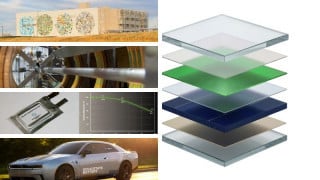
The stacked system passes sunlight through a transparent radiative cooler before concentrating it onto a small PV-thermal receiver.
Researchers at the Karlsruhe Institute of Technology (KIT) have demonstrated an energy system that produces electricity, high-temperature heat, and sub-ambient cooling simultaneously from a single surface. In outdoor tests, the prototype delivered 60.6 W/m2 of electrical power and heat at up to 110.8°C while its top layer cooled as much as 6.5°C below ambient temperature.
The system targets the physical constraints on building rooftops and facades. The photovoltaic panels, solar thermal collectors, and air conditioning crowd the space, and the air conditioning consumes the electricity the panels produce. KIT's hybrid approach delivers all three services with a single device.
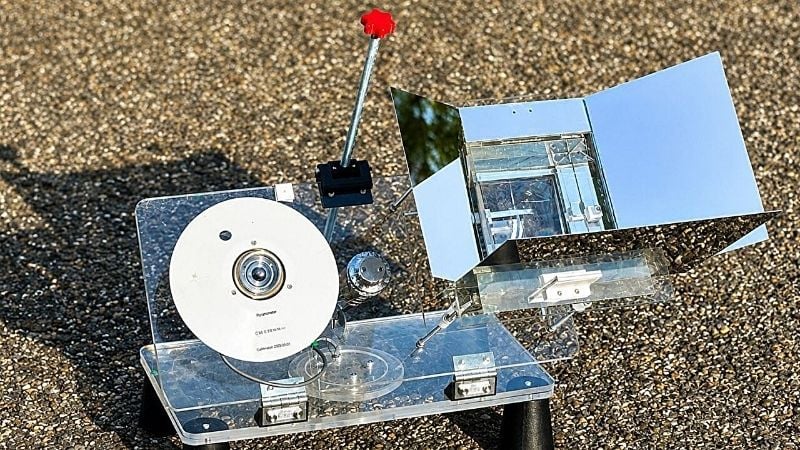
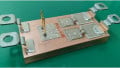
A prototype of the hybrid sun-universe energy harvester. Image used courtesy of KIT/Gan Huang
A Rooftop of Fire and Ice
The design combines concentrated photovoltaic-thermal collection with passive daytime radiative cooling (PDRC). A PDRC surface stays cold by emitting thermal radiation through the atmosphere's 8 to 13 µm transparency window directly into deep space, a heat sink at roughly -270°C, with no power input.
However, the thermodynamic catch is that a solar collector should absorb as much energy as possible and run hot, while a radiative cooler must stay as cold as possible. Placed side by side, the two functions fight against one another. Previous hybrid attempts delivered radiative cooling alongside PV but not sub-ambient cooling and high-temperature heat at the same time.
KIT's answer was a tandem stack. The top layer is a transparent radiative-cooling emitter, a silica substrate coated with polydimethylsiloxane that passes the solar spectrum almost untouched while emitting strongly in the mid-infrared atmospheric window. Beneath it, a Fresnel lens concentrates the transmitted sunlight onto a much smaller PV-thermal receiver, which generates electricity and captures the remaining energy as heat above 100°C.
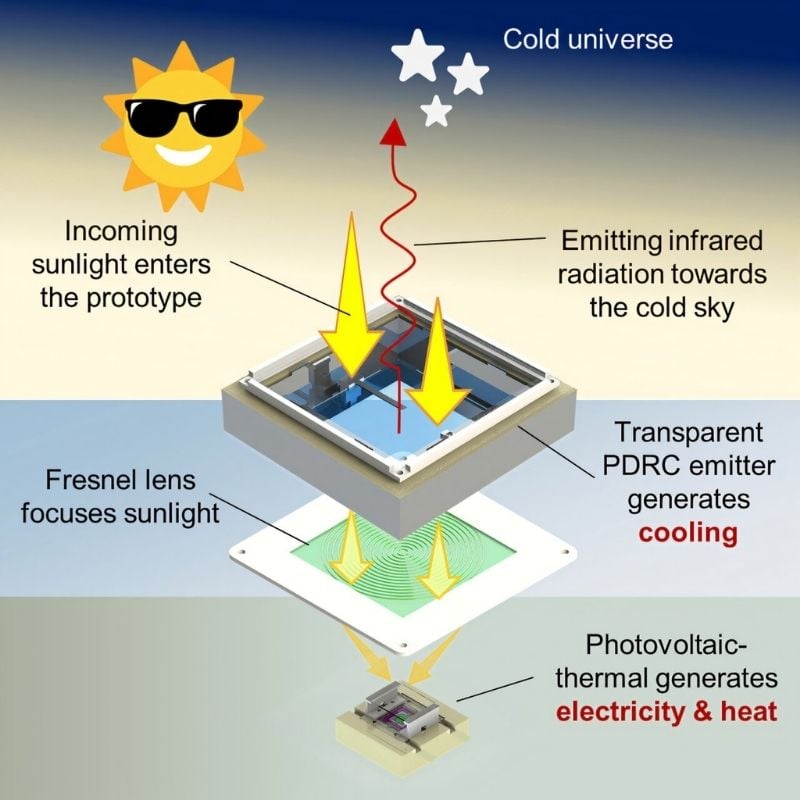
Diagram of the tandem stack system. Image used courtesy of Garcia et al.
What the Prototype Measured
In outdoor testing at KIT, the prototype produced its three outputs concurrently rather than in alternation: 60.6 W/m2 of electricity, heat up to 110.8°C suitable for domestic hot water or process heat, and a cooling surface up to 6.5°C below the surrounding air. The heat figure is notable, with conventional flat-plate solar thermal collectors typically topping out well below 100°C, and earlier PV-plus-radiative-cooling hybrids producing no usable high-grade heat at all.
The researcher builds on a 2014 Stanford University study, which demonstrated that a photonic surface could passively cool ambient temperature below under direct sunlight. This study launched the modern PDRC field. KIT’s research follows its 2024 study of a micro-pyramid silicone metamaterial that combined 95% solar transmittance with 6°C of passive cooling, supplying the foundation for the transparent emitter used here.
Roofs, Facades, and Data Centers
The KIT team explained that their vision is for roofs and facades to become active energy surfaces, capable of providing electricity, heating, and cooling. Beyond buildings, the all-in-one concept could also be ideal for energy-intensive applications requiring intensive power and cooling, such as AI data centers.
Next steps for the team include refining the optical design, improving thermal management, and upgrading the solar cells. The researchers noted that the sun isn't the only renewable resource overhead, and systems that harvest both solar energy and the cold of space can extract more useful output from the same square meter of roof.
The study was published in Cell Reports Physical Science.