
 Facebook
 Google
 GitHub
 Linkedin
Wind-Catching Sphere Generates Energy from All Directions
This wind turbine design could make renewable power more accessible in cities.
Wind turbines are usually located in rural or remote areas because these areas offer consistent, strong winds, and traditional turbines only capture wind traveling towards them on a horizontal plane. But what if apartment and office buildings could harness wind power as effectively as wide-open farms—capturing wind blown from multiple directions?
How can a small sphere provide wind energy where it is needed most? Video used courtesy of O-Innovations
As cities continue to grow upward, they are becoming increasingly windy. Air is funneled between buildings, dragged down to the street, and pushed up to the sky. This chaotic flow renders traditional turbines unusable in urban areas.
However, by harnessing a simple geometric form, the O-Wind Turbine can capture these turbulent winds and generate energy. The O-Wind—a bladeless, omnidirectional wind harvester by U.K. startup O-Innovations—is under development in O-Innovations’ laboratories. The latest version, ready for commercialization, can generate around 3 MWh of electricity annually, enough energy to power around 900 average U.S. households for a full day.
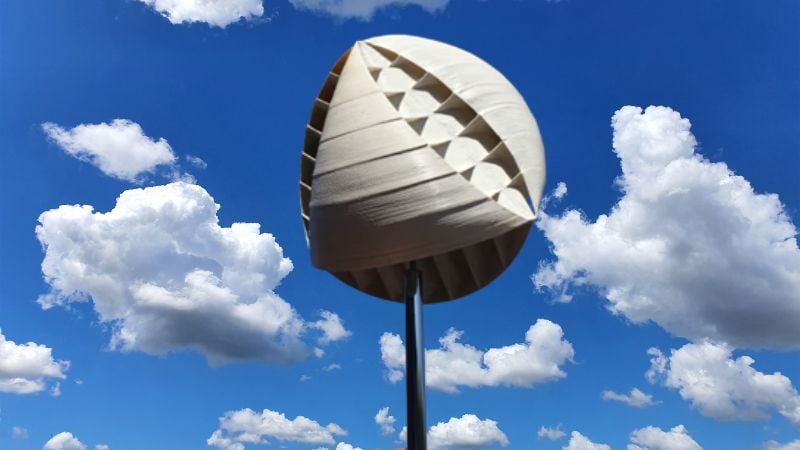
The O-Wind. Image used courtesy of O-Innovations
Inspiration for O-Wind
In the early 2000s, NASA’s Mars Tumbleweed rover was an experimental concept designed to explore the red planet in a radically different way. About six feet in diameter, the rover was essentially an inflatable ball meant to bounce and roll across the Martian surface, much like a wind-blown tumbleweed. However, this design faced major challenges because it relied solely on unidirectional wind for propulsion and struggled with obstacles, terrain changes, and unpredictable gusts.
Yet, the Tumbleweed inspired Nicolas Orellana and Yaseen Noorani, students at Lancaster University. Orellana was intrigued by the challenge of multidirectional wind and the theory behind the Mars Tumbleweed. He studied the challenges and limitations of the design to inform his own three-dimensional wind turbine technology. Orellana and Noorani’s design won the James Dyson Award in 2018 and served to launch the O-Wind.
The O-Wind Turbine is a 25 cm sphere with geometric vents mounted on a fixed axis that spins when wind hits it from any direction. This design utilizes the Venturi effect. This principle describes how a liquid or gas encountering a small space must accelerate to maintain its flow rate, creating a lower pressure and higher velocity. The O-Wind turbine’s spherical surface features angled vents that funnel air to generate spin around the fixed axis.
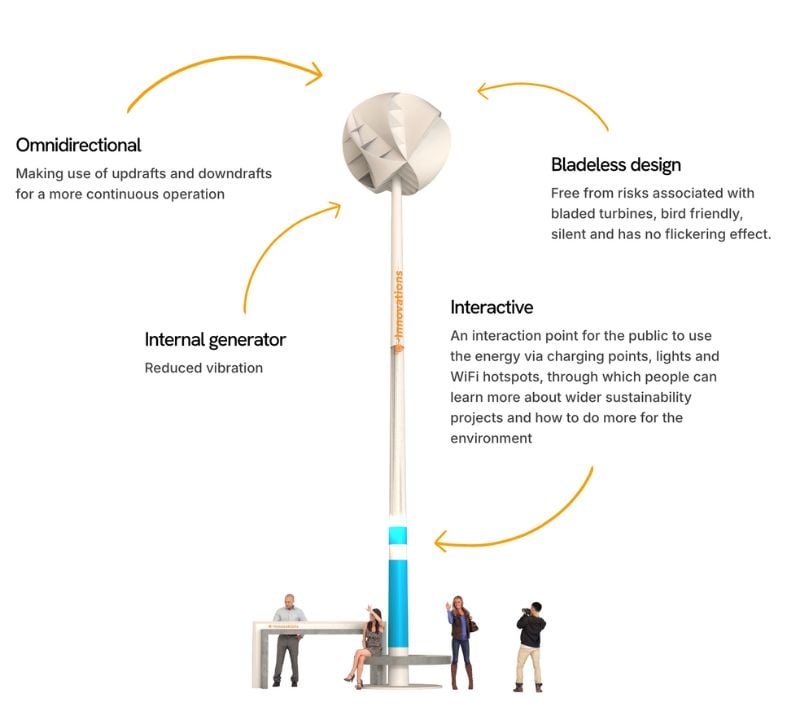
The O-Wind design. Image used courtesy of O-Innovations
Inside the turbine, a generator converts the rotation into electricity, which can then be stored in a battery. Compact yet effective, the O-Wind Turbine is efficient and safe for use in densely populated areas, making it practical for integration into urban areas.
Urban Impact and Potential
In 2015, the U.K. government banned the construction of new onshore wind turbines, creating a 94% decline in projects. This ban was overturned in 2024, with a commitment to double onshore wind production by 2030.
Currently, the majority of onshore wind output in the U.K. is in Wales, Scotland, and Northern Ireland. The closer to London and more densely populated areas, the output drops significantly. As the U.K. aims to increase onshore wind production, introducing O-Wind to British urban areas could be an innovative addition to the planning process.
Complementing Solar Power
The O-Wind fits into the existing energy landscape by offering diversity to the market.
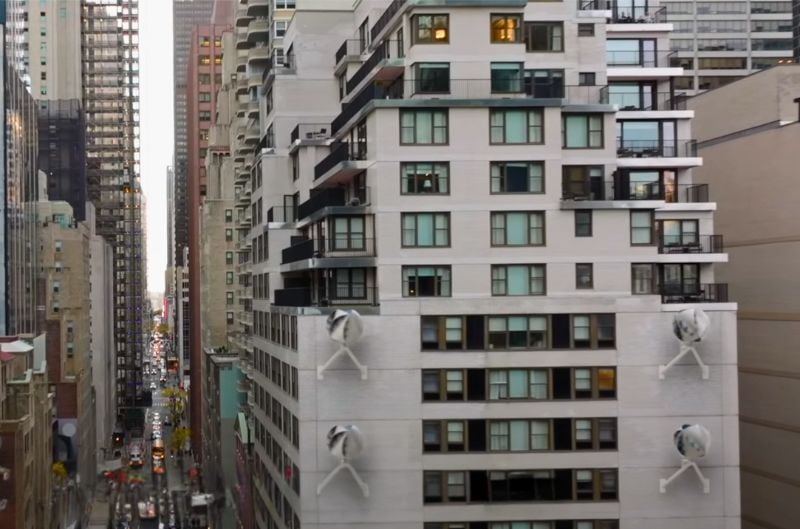
Concept of O-Wind turbines in an urban setting. Image used courtesy of O-Innovations
Rooftop solar array installations have been on the rise as a way to directly bring renewable energy to residential and urban areas. Like solar, O-Wind can be installed on existing structures, reducing the need for new land-intensive projects and limiting construction-related carbon emissions.
But O-Wind has one advantage solar does not: it can generate electricity around the clock, as long as the wind is blowing, not just during daylight hours.








It certainly would have been nice (nay, ESSENTIAL!!!!) to have some pointers or web sites to go to for more information. I would think that EEPower would be more of an information source rather than simply a ‘puff piece’ publisher. FYI I could find NOTHING on the web about this company or the product or the concept. Disappointing.