Facebook
 Google
 GitHub
 Linkedin
Low-Wind Turbines Generate Big Energy
Two projects have catalyzed advances in wind turbine technology and performance.
In 2023, the global wind industry set a record by installing 117 GW of new capacity. Despite this growth, the sector still faces several challenges hindering its widespread adoption and efficiency. A primary obstacle is that lower wind speeds limit wind turbine performance in areas otherwise available for development. Moreover, installing wind turbines can lead to land degradation by disrupting soil and vegetation, potentially harming local ecosystems.
Watch how AES built Delta Wind, Mississippi’s first utility-scale wind farm. Video used courtesy of AES
The wind industry has made multiple advancements in wind turbine design to push the technology forward. Two notable projects address the need to harvest energy from low-speed winds.

Wind turbines. Image used courtesy of Pexels
Wind Turbines for Low Wind Speeds
The Nordex Group has introduced a 5 MW wind turbine designed for the U.S. market to address the challenge of low wind speeds.
Leveraging proven technical concepts from its Delta4000 series, the N169/5.X turbine features a larger rotor diameter of 169 meters (554 feet) and a power rating of up to 5.5 MW, significantly enhancing energy yield in low to medium wind speeds. The turbine repurposes many key components from the N163/5.X model, such as the main shaft, bearing, electric power system, and generator frame. However, architecturally, the N169/5.X incorporates larger rotors and higher hub heights, which are optimized for varying wind classes and allow for an optimized capacity factor.
Nordex Delta4000 wind turbines in action. Video used courtesy of Nordex
Production of the N169/5.X and the N163 turbine will begin in 2026 at Nordex’s West Branch, Iowa, factory. Manufacturing the turbine’s components in the U.S. is economically feasible due to tax credits receivable under the Inflation Reduction Act.
To date, Nordex Group has installed 51 GW of wind power capacity globally.
Capturing Low Wind Speed Energy
Mississippi recently launched its first utility-scale wind farm, Delta Wind.
Meant to address the challenge of lower wind speeds in the Southeastern U.S., Delta Wind features the nation's tallest onshore turbines. These 692-foot blades, developed by AES Corporation, help the turbines boast a capacity of 184.5 megawatts (or 535,750 MWh), equivalent to the energy to power about 80,000 homes annually. Additionally, it is expected to generate $100 million in local tax revenue and create nearly 300 jobs during peak construction for Tunica County.
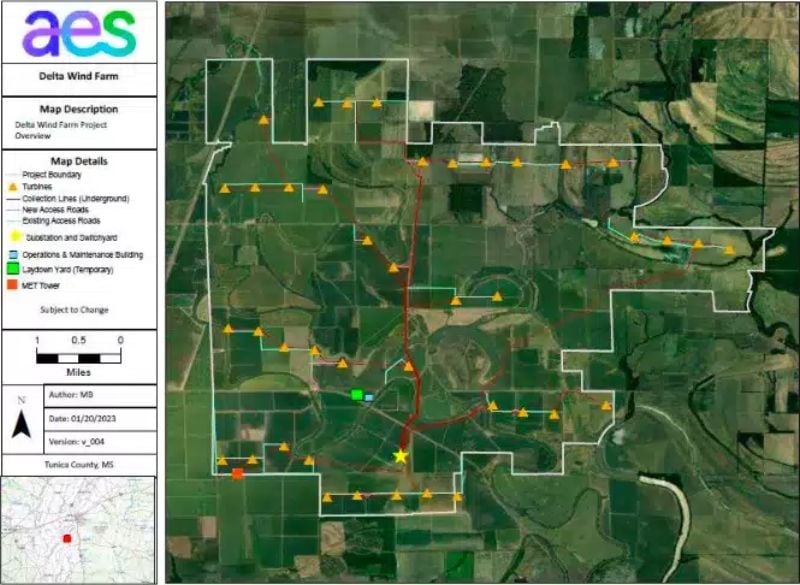
Delta Wind project details. Image used courtesy of AES
Central to this project are notable advanced technological features, such as larger rotors to increase energy capture and specially designed foundations that protect agricultural activities on the 14,000-acre site. Despite initial concerns about land feasibility and potential degradation, the unique foundation design has minimized agricultural disruption, effectively making this effort a dual-use land project.
Breaking Barriers
Thanks to projects from both Nordex and AES, the wind energy sector is addressing both technical and ecological concerns. Between advances in energy production in low-wind scenarios and novel foundation techniques to mitigate agricultural disruption, these technological strides may pave the way for broader adoption and integration of wind energy into the global power grid.