Facebook
 Google
 GitHub
 Linkedin
Renewables Race Propels Tech Titans Amazon, Apple, Meta, More
Amazon’s AI-powered solar farm is its latest effort to meet its renewable energy deadlines. Meta, Microsoft, and other tech companies have also joined the race.
A 1,000-acre solar farm in the Mojave Desert will help Amazon advance its goal of reaching net-zero carbon emissions by 2040. The Baldy Mesa solar and storage facility near Adelanto, California, supplies 150 MW of solar energy plus 75 MW of battery energy storage. The renewable energy generated is expected to offset 300 thousand tons of carbon dioxide (CO2) emissions yearly.
Amazon’s artificial intelligence (AI) model, Amazon Web Services, optimizes the solar farm’s energy output by determining when the storage units should store energy and discharge it back to the grid. AES Corporation owns and operates Baldy Mesa.
With Baldy Mesa, Amazon’s technology enables ten solar + storage projects across California and Arizona. While the projects supply energy to the local communities, not just Amazon, the giant online retailer counts the CO2 reductions toward its sustainability goals.
Carbon offsets are among many decarbonization projects Amazon is targeting to reduce its operation’s total carbon footprint. Amazon’s energy use and carbon impacts are extensive, encompassing fulfillment centers, technology hubs, data centers, and delivery services.
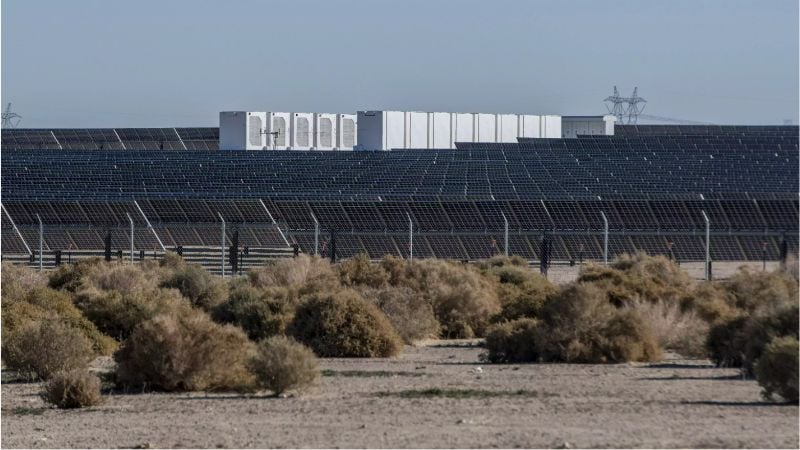
Baldy Mesa solar and storage facility. Image used courtesy of AES
Amazon’s Carbon Emissions
Amazon’s most recent sustainability report estimated its CO2 emissions at 71.27 million metric tons. While that figure represents a 0.4% reduction from 2021, the company’s total emissions have increased by 40% since its first sustainability report in 2019.
Shipping and fulfillment, data centers, and facility operations represent the company’s largest CO2 emitters. Its shipping services comprise long-distance transport—including air, sea, and trucking—and local delivery. While some electric vehicles are used, the company’s and its subcontractor’s fleets are mostly internal combustion engines. Globally, the transportation sector contributes about one-third of global carbon emissions.
Amazon’s data centers are also energy-intense, and when powered by fossil-fuel power plants, they result in emissions. The company’s facilities—including its headquarters buildings in Seattle and Arlington, Virginia, and hundreds of fulfillment centers, sorting stations, and delivery centers—are major energy users.
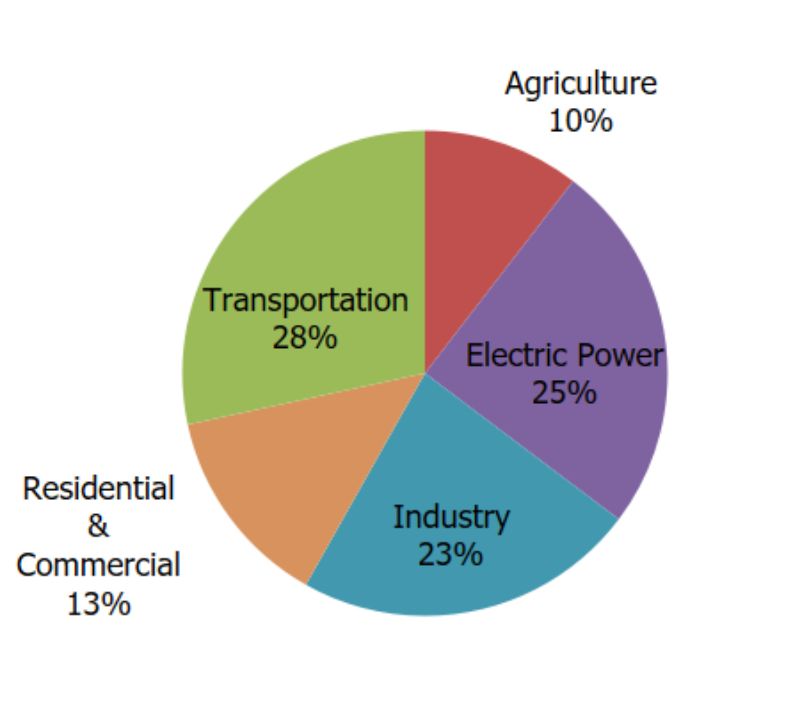
Greenhouse gas emissions by sector, 2022. Image used courtesy of Environmental Protection Agency
Yet, the company reports its carbon reduction success is better than expected. In 2022, renewable energy generated about 90% of the electricity it used. It plans to reach 100% by 2025, five years ahead of its original goal.
The company continues to work on reducing carbon emissions from other operational activities, including transportation and shipping.
AI and Carbon Offsets
Amazon Web Services (AWS), which the company markets to clients, features generative AI, cloud storage, code building, and data analytics. Its AI and machine learning can be used in any energy application to optimize operations, monitor energy use and emissions, forecast demand, and perform predictive maintenance analysis. AWS can also manage Internet of Things components and deploy drones for equipment monitoring and maintenance.
Amazon claims AWS can lower a company’s carbon footprint. A company-commissioned report in 2019 found that infrastructure using AWS was 3.6 times more energy efficient than average and lowered carbon footprints by 80%. With renewable energy, the carbon footprint was reduced by 90%.
Amazon counts these AWS-powered carbon offsets toward its sustainability goals. Carbon offsets rely on reducing greenhouse gas emissions from non-company activities to compensate (or offset) carbon impacts from the company’s operations.
Amazon Sagemaker is the specific AWS service optimizing the battery storage units at Baldy Mesa. Using machine learning, it will analyze about 33 billion data points annually, based on grid conditions, to determine when operators should store energy or exchange it on the energy market.
The Climate Pledge and Decarbonization Efforts
Amazon’s strategy to achieve net zero emissions centers on its Carbon Pledge, a three-pronged effort involving regular greenhouse gas reporting, CO2 elimination strategies, and carbon offsets. Partners include 400 companies and organizations, such as Alaska Airlines, JetBlue, Scheider Electric, Philips, Mercedes Benz, the Clean Energy Buyers Alliance, and the U.S. Agency for International Development.
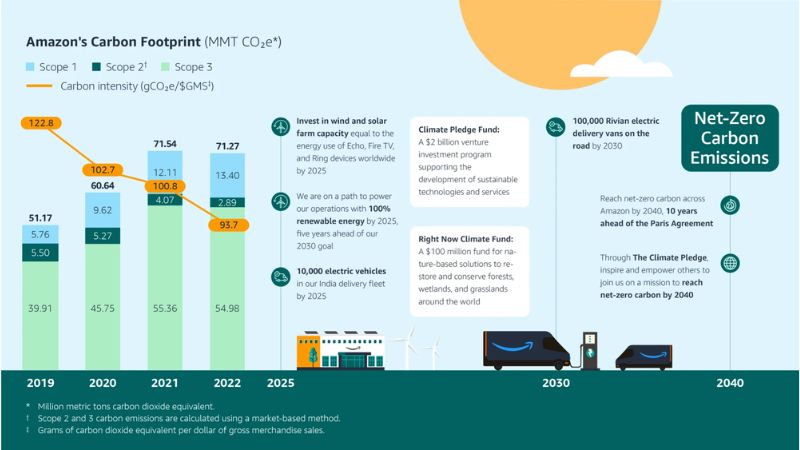
Net-zero goals. Image used courtesy of Amazon
Amazon’s $2 billion sustainability plan is focused on energy efficiency, electrifying delivery services, using eco-friendly building materials, and neutralizing carbon emissions.
The company claims it’s the world's largest buyer of renewable energy. It’s involved in over 500 solar or wind projects worldwide and provides renewable power to about 7.2 million homes in the U.S. annually.
Corporate Renewable Energy Projects
Other mega-corporations are also making strides in developing renewable energy projects and meeting sustainability goals.
Meta. Facebook and Instagram’s parent company claims it has already reached 100% renewable energy use for its operations worldwide. Like Amazon, Meta develops energy projects for community use and grid support. In the U.S., it supports 86 solar and wind projects, contributing 9.8 GW of renewable energy across 24 states.
Apple. Renewable energy supplies about 18 GW to power Apple’s operations, including manufacturing. The company says its global supply chain, comprising more than 320 suppliers, uses another 16.5 GW of renewable energy. Apple is also developing renewable energy projects to offset the energy consumers use to charge devices. Apple aims for carbon neutrality by 2030.
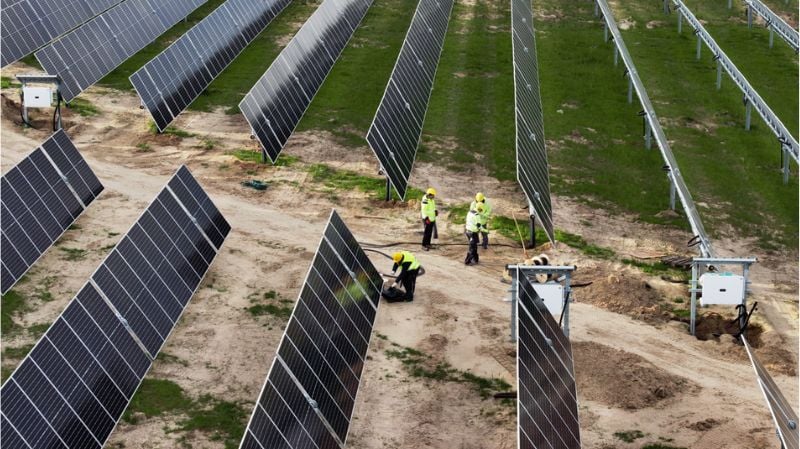
Apple solar project in Spain. Image used courtesy of Apple
Walmart. Walmart uses renewable energy for about 36% of its operations and plans to transition to 100% by 2035. The company has 600 projects operating or in development in 10 countries. It’s also participating in clean energy purchase agreements and 26 subscription-based community solar projects in six states. Hundreds of Walmart stores use rooftop solar for their own needs and local grid use.
Microsoft. Rather than aim for carbon neutrality, the technology giant wants to be carbon-negative by 2030. Like Amazon, the company is counting on carbon offsets to reach and exceed its net-zero goals. In 2023, Microsoft increased its renewable assets to more than 19.8 GW. It has projects in 21 countries worldwide.