
 Facebook
 Google
 GitHub
 Linkedin
Three Wheels, Zero Emissions, and One Bold Bet on E-Mobility
Trinova’s electric leaning trike promises motorcycle agility and electric vehicle range without the fear factor.
For many urban commuters, motorcycles offer the dream of slipping through gridlock, but that’s often not the reality. Poor weather, safety concerns, and licensing barriers keep most drivers stuck in oversized cars. Trinova, a California-based startup led by ex-Fisker and Karmann engineer Markus Scholten, wants to change that with a new class of vehicle: a high-performance, electric, self-balancing three-wheeler that handles like a bike, feels like a car, and fits in a bike lane.
Watch the three-wheeled Trinova in action. Video used courtesy of IEEE Spectrum
Scholten’s design, dubbed Trinova, blends twin inboard electric motors (each around 65 kW) with an enclosed two-passenger cabin and a chassis light enough to weigh under 340 kg. The result is a vehicle that leans into corners like a motorcycle, stays upright when stopped, and delivers a projected 200 km of real-world range, all within an 85 cm-wide body designed to legally lane split where motorcycles can.
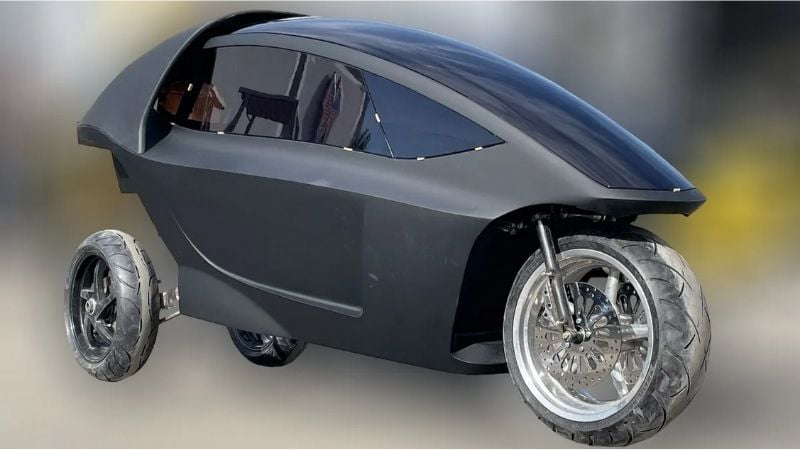
The Trinova was born from founder Markus Scholten’s personal vendetta against gridlocked traffic. Image used courtesy of Trinova EV
EV Designed for Commuters
From the outset, Trinova wasn’t designed to be an entry-level runabout. With a target top speed of 120 mph, 0-60 acceleration in 3.5 seconds, and aggressive cornering (thanks to a computer-controlled leaning system), the Trinova borrows more from performance bikes than microcars.
Aided by Zero Motorcycles’ dual electric motors and a projected 10-14 kWh battery pack, the Trinova hits an estimated 130-150 Wh/mi, nearly half the consumption of a Tesla Model 3. On the street, that translates to over 100 miles per charge. Scholten is eyeing a future version that tows a Samsonite-style modular range extender to add more miles on the go.
And while the vehicle can be driven with a motorcycle license, its fully enclosed design and optional convertible roof make it weather-ready. This is part of Scholten’s long-standing goal to offer the freedom of two wheels with the safety and comfort of four. Trinova claims that the vehicle combines the agility of a bike with the safety and comfort of a compact EV, addressing a commuter segment often underserved by both two- and four-wheeled platforms.
The Trinova’s speed. Video used courtesy of Trinova Mobility
Leaning Into Safety
Trinova’s stability comes from its hydraulically actuated tilt mechanism, which senses steering angle and speed to adjust lean dynamically up to 55° in corners, similar to MotoGP bikes. The lean reduces lateral G-force on the passenger, improving both handling and ride comfort. In slow-speed conditions, like parking lots, the system keeps the vehicle stable without the rider needing to put a foot down.
Scholten’s team is also exploring integrating LiDAR-based proximity sensors to support safer lane-splitting. Such a system could alert the rider to nearby vehicles drifting across lanes, eventually enabling semi-autonomous lane navigation, which is crucial in congested cities where visibility and reaction time are limited.
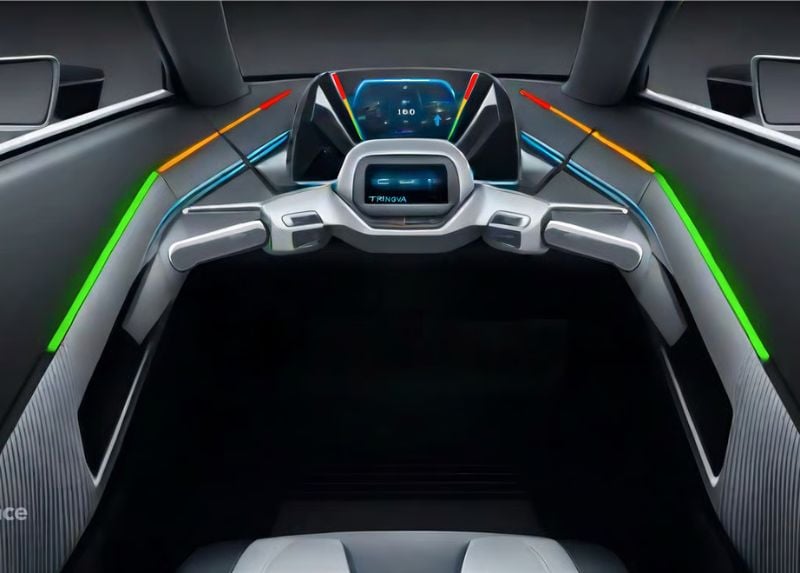
AI technology analyzes the road and provides warning lights for safety. Image used courtesy of Trinova EV
Beyond safety, space is a major selling point. Trinova claims that over 1,400 of its vehicles could fit in the same area as 360 traditional cars, offering a real path to decongesting urban roads.
EV Born From a Personal Vendetta
Trinova’s design traces back to Scholten’s early sketches and a frustrating post-interview commute from Tesla’s LA design studio, where gridlocked traffic left him watching motorcycles zip by. That moment, coupled with inspiration from GM’s 1980s Lean Machine concept and his bicycle-racing past, cemented the idea: build a commuter EV that’s leaner, faster, and smarter.
The Trinova is still pre-production, with hand-built models planned for 2026. However, the prototype already exists in multiple working variants, including one based on a repurposed Aprilia engine and others using Zero’s electric drivetrain. Scholten’s long-shot ambition is to take Trinova to the Isle of Man TT, where no traffic jam can get in the way.





Price will be critical, the Renault Twizzy (admittedly not as narrow) failed in this commuter market mostly due to price (IMHO). This looks more useable mind you and you don’t have to pay extra for doors!