
 Facebook
 Google
 GitHub
 Linkedin
Tesla Launches Huge Solar-Powered Supercharger Station
The off-grid facility debuted with 84 of the 168 V4 stations complete. The Megapack storage units could soon use Tesla-made LFP batteries
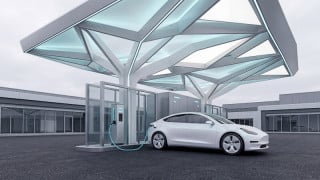
Tesla’s latest electric vehicle charging station will use the sunny California skies to power its Superchargers. The 168-stall facility on 30 acres near Lost Hills, California, is powered solely by 11 MW of solar energy and Megapack batteries. Half the charging stations have opened, with the remainder slated to be operational by the year’s end.
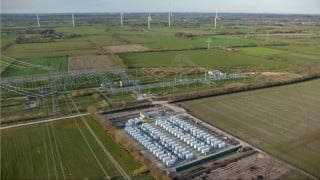
Tesla states the charging stations are grid-independent, relying instead on power generated by solar canopies and an adjacent solar farm. Ten 3.9 MWh Megapacks (39 MWh total), each equipped with an inverter, will store excess energy for use during cloudy days or at night. When completed, the facility will include lounges for EV drivers.
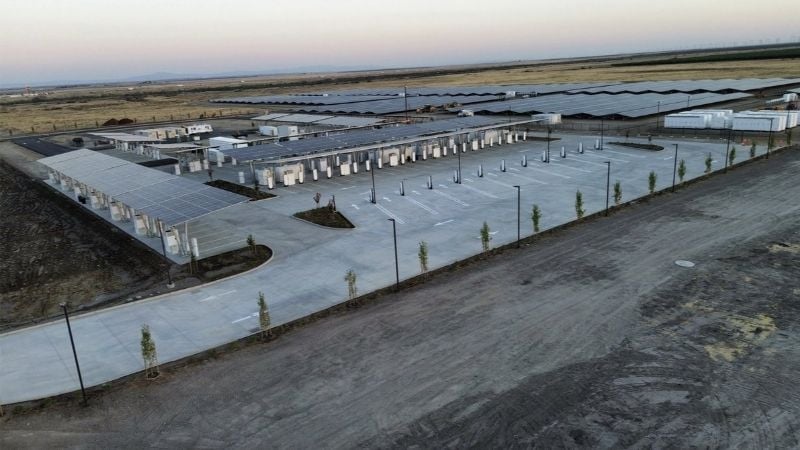
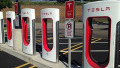
Supercharger stations in Lost Hills, California. Image used courtesy of Tesla
Charging Off-Grid
The California facility, dubbed Oasis, is the first of Tesla’s 7,000 worldwide charging locations to be fully solar-powered. According to Max de Zegher, Charging Director at Tesla, the 1.5 MW grid connection was not sufficient for the station’s needs, and the company did not want to wait for substation upgrades. Tesla already sells home chargers that can use rooftop solar and the Powerwall, a home battery version of the Megapack.
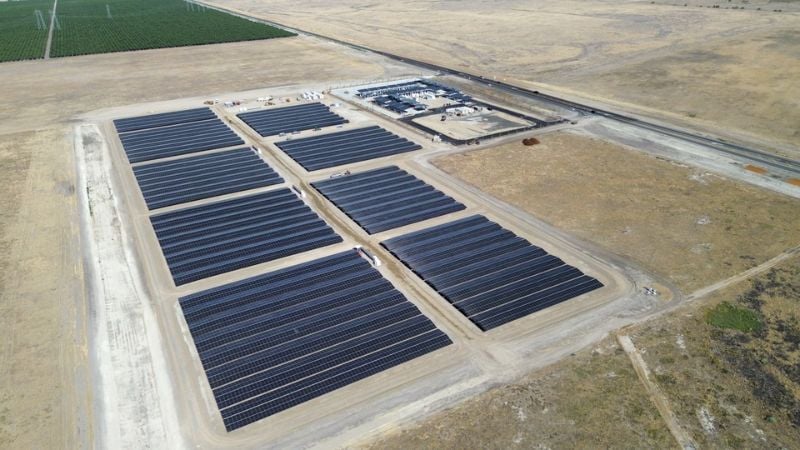
The solar farm at the Lost Hills Supercharger station. Image used courtesy of Tesla
The project was announced in October 2024. The company worked with Kern County and the local utility, Pacific Gas and Electric, for permits and approvals.
The Megapack uses lithium-ion batteries and is manufactured at the Tesla Megafactory in Lathrop, California. It produces about 10,000 Megapack units annually. The Megapack is intended for utility-scale use but can be scaled down for microgrids. The Lost Hills Supercharger facility will use full-size Megapacks.
V4 Superchargers
The Oasis charging station uses V4 Superchargers, Tesla’s latest DC fast charging iteration. Premiering in 2023, the V4 can charge up to 250 kW for Tesla Model S, 3, X, and Y. The Cybertruck can charge up to 325 kW with a V4.
The chargers also have a longer charging cable to provide access to charging portals on non-Tesla EVs. The V4 Supercharger uses the North American Charging Standard. Others may need an adapter.
The station also features 12 pull-through sites for large EVs and EVs pulling trailers.
Tesla is reportedly planning a second 168-stall Supercharger station in Coalinga, California, and a 200-stall facility in Florida.
A Switch to LFP Batteries?
Megapacks may not be using lithium-ion batteries for long. The company’s plant in Nevada is set to manufacture lithium iron (LFP) phosphate batteries. LFP batteries are cheaper, safer, and longer-lasting than lithium-ion chemistries.
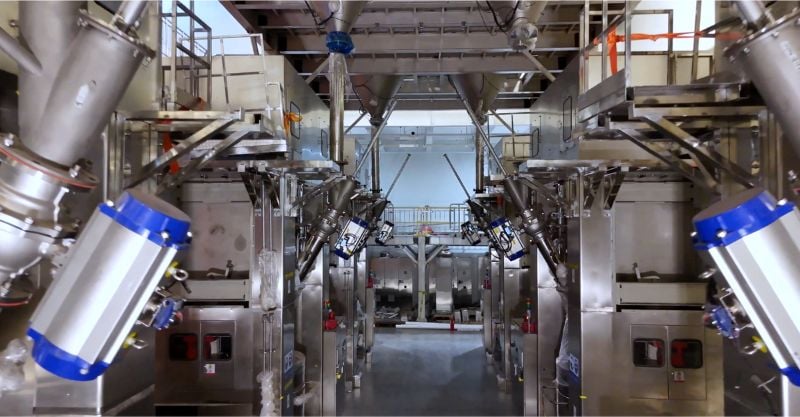
Tesla’s LFP battery gigafactory in Nevada. Image used courtesy of Tesla via X
While Tesla has been working for some time on a dry coating process for electrodes for its 4680 electric vehicle battery cells, the Nevada plant uses the more common wet coating method. Dry coating can be faster and less expensive, but the technology is not fully developed.
Tesla uses LFP batteries in its EVs, but they are made by CATL in China. The Nevada plant’s batteries will be used only in Megapacks and Powerwalls.


That “Ten 3.9 MW Megapacks (39 MW total)” should really be using the units “MWh” (reference: https://www.tesla.com/megapack). There is a difference!