Facebook
 Google
 GitHub
 Linkedin
Battery Wars: LG vs. Tesla
Tesla and LG Energy Solution are competing to implement a cost-cutting technology for lithium-ion battery manufacturing.
As technologies mature, the development emphasis changes from performance enhancements to cost reductions. This is the case with lithium-ion batteries, which power electric vehicles and various modern electronic devices.
How are batteries manufactured? Video used courtesy of Tesla
In 2013, a lithium-ion battery pack cost approximately $650 per kWh. By 2023, this cost had dropped to $139 per kWh, representing a significant 79 percent decrease over ten years. In addition, lithium-ion battery packs decreased from over $160 per kWh in 2022 to $139 per kWh in 2023, marking a 14 percent drop within a single year.
Moving forward along the cost reduction curve requires battery makers to examine every step in the manufacturing process. One significant area has been adopting the dry coating process for lithium-ion battery cathode production. This process eliminates the solvent and drying steps required in traditional wet coating.
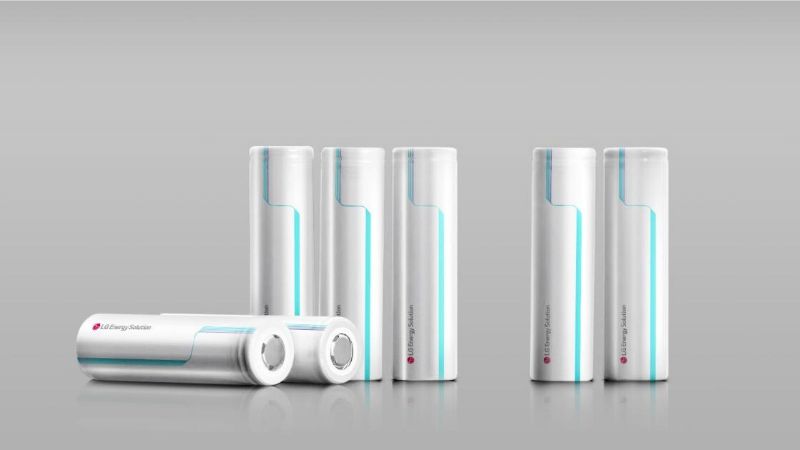
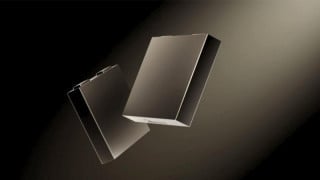
Cylindrical lithium-ion batteries. Image used courtesy of LG Energy Solution
Making Dry Coating
Two companies have bet heavily on the dry coating process. After acquiring Maxwell Technologies in 2019, Tesla aimed to leverage the dry coating technology that Maxwell had developed to manufacture capacitors to produce its 4680 battery cells more efficiently and cost-effectively. The dry coating process was expected to significantly reduce manufacturing time and costs by eliminating the need for solvents and drying ovens.
Tesla sold Maxwell Technologies in 2021 but kept the dry coating process tech—the reason it bought Maxwell in the first place. Tesla’s process is in limited production, making dry coating anodes for the 4680 cells for its Cybertruck. The cathode for production batteries is still sourced from suppliers and produced using a conventional wet coating process.
LG Energy Solution has been working on dry coating technology for about a decade and plans to pilot the technology by 2024, with full-scale production targeted for 2028. LG's process can be applied to both cathodes and anodes, regardless of particle size, which is a significant technical achievement.
Wet or Dry?
The dry coating process involves mixing dry powders of active cathode material, binder, and conductive additives and directly applying this dry mixture onto the metal current collector foil. Pressure and minor temperature changes are applied to make the dry material adhere to the foil, which reduces the need for a separate drying step. The dry-coated electrodes are then calendered (pressed) at higher pressure and temperature than wet-coated electrodes to ensure proper adhesion and uniformity.
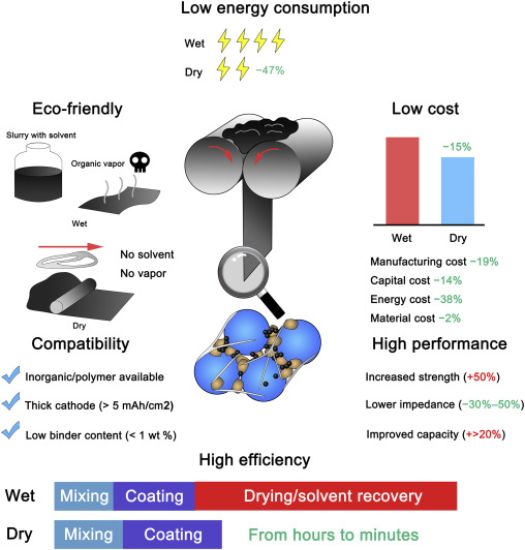
Dry vs. wet coating. Image used courtesy of Science Direct
The method eliminates toxic solvents like N-methyl-2-pyrrolidone (NMP) typically used in wet coating, making it more environmentally friendly and potentially reducing energy consumption by about 39 percent and cutting battery production costs by at least 10 percent.
Dry coating allows for the production of thicker electrodes with higher energy density and reduced cracking. The process is faster and requires less factory space compared to traditional methods. However, challenges include achieving uniform coating, ensuring strong adhesion, and scaling up for mass production.
LG vs. Tesla
While Tesla has made significant strides with its dry coating process, it faces stiff competition from LG Energy Solution, which has a longer development history and a more comprehensive application of the technology. Both companies are at the forefront of this innovation, which promises to advance battery manufacturing by reducing costs, improving performance, and minimizing environmental impact.
| Aspect | Tesla's Dry Coating Process | LG Energy Solution's Dry Coating Process | ||
| Development Timeline |
Started in 2019 with Maxwell acquisition; ongoing challenges |
Began a decade ago; pilot by 2024, full-scale by 2028 | ||
| Technical Challenges | Significant issues with cathode coating |
Addressed both cathode and anode coating |
||
| Cost Reduction | 10-20% |
|
||
| Environmental Impact | Eliminates solvents, reduces energy use |
|
||
| Current Status | Progressing, but not yet fully resolved |
Leading in development, on track for 2028 |
Tesla's dry coating process is still undergoing optimization and scaling. The company is focusing on improving the manufacturing processes to achieve volume production of the improved 4680 cells by the end of the year. Elon Musk has given the battery team an ultimatum to resolve the remaining challenges with the dry coating process by the end of 2024. If successful, this could significantly reduce production costs and enhance Tesla's competitive edge.
Meanwhile, with a more comprehensive approach, LG Energy Solution is well-positioned to lead in dry coating technology, potentially setting new industry standards for cell production by 2028.
The Other Guys
Tesla and LG also face competition for dry coating supremacy from other battery manufacturers.
Samsung SDI is actively developing dry coating technology for its 46-series cylindrical batteries. The company aims to replace the traditional wet process to improve efficiency and reduce costs. Volkswagen, through its subsidiary PowerCo, is also exploring dry coating technology. The company views this technology as reducing energy consumption and production costs.
Chinese battery giants CATL and BYD are rapidly growing and investing heavily in new technologies, including dry coating. LG Energy Solution is particularly focused on competing with these Chinese firms, which have gained significant market share and are known for their aggressive expansion and cost-competitive production methods.
LG Could Win
LG Energy Solution may have several advantages in dry coating technology for lithium-ion battery production. LG began working on dry coating technology about 10 years ago, giving it a significant head start over competitors. Its dry electrode manufacturing process can be applied to both cathodes and anodes, regardless of cathode particle size. This is particularly challenging for cathodes with smaller particles. The company has secured core patents related to the dry coating process, which they consider essential for the future growth of the EV market.
LG estimates that its dry method can reduce battery manufacturing costs by 17 percent to 30 percent and plans to establish a pilot production line for its dry-coating process by Q4 2024. The plan is to begin full-scale production in 2028, making LG one of the first to provide a concrete timeline for commercialization.
These advantages position LG Energy Solution to potentially lead in dry coating technology implementation. The achievement could improve their competitiveness against Chinese rivals and other major players in the battery industry.