Facebook
 Google
 GitHub
 Linkedin
Subsea HVDC Will Supply Wind Energy to 2 Million in the UK
National Grid Electricity Transmission and SP Energy Networks will team up to lay a 196 km subsea HVDC between Scotland and England.
Electric vehicle charging infrastructure is spreading, offshore wind farms are increasing, and solar panels are evolving to capture more sun energy. In 2023, approximately 22% of U.S. power came from renewables, according to the Energy Information Administration. Experts anticipate this growth will continue in the coming years.
However, transmission infrastructure is lagging, and some renewable developments must wait long periods for grid connection. In the U.K., a subsea transmission project will ensure that offshore wind energy is not wasted. National Grid Electricity Transmission and SP Energy Networks will connect Scotland to England with a 196 km high-voltage cable to help power up to 2 million homes.
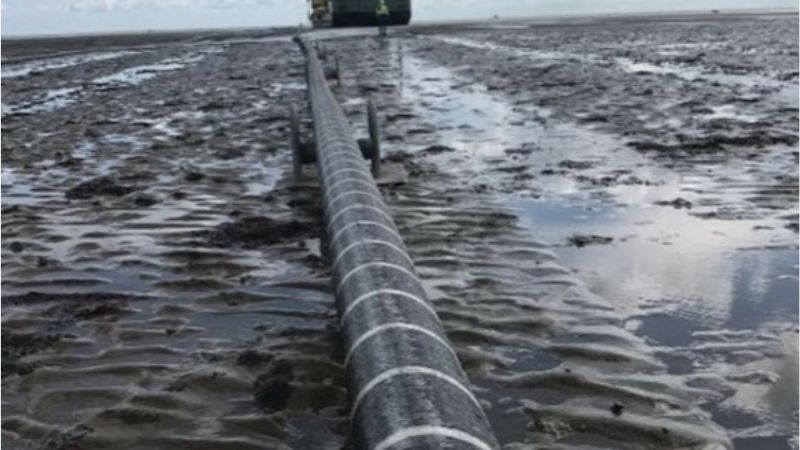
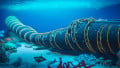
Laying a subsea cable. Image used courtesy of National Grid
The Transmission Capacity Problem
The rush to build renewable energy projects has outpaced transmission line growth, and this discrepancy has created a critical challenge. Many renewable energy projects have geographical restrictions that compound the problem. For example, an offshore wind farm in the Atlantic will need subsea cables to transfer energy to dense residential areas. Wind farms in remote southern California deserts need transmission lines to move the captured energy to its targeted locations.
Historically, fossil fuel-based energy systems have been centralized, with large power plants located near fuel sources like coal mines or natural gas fields, and electricity was distributed through a network of established transmission lines. This structure allowed for predictable generation and simpler management, as operators could adjust output to meet demand on a relatively stable grid.
The rise of renewable energy projects has introduced decentralization and variability. Because they are often located far from major consumption centers, substantial investments must be made to integrate these new resources effectively into existing transmission infrastructure. That investment has been sluggish.
Why Transmission Infrastructure Lags
Investment in transmission infrastructure is sluggish due to permitting processes that are often lengthy and involve multiple jurisdictions, causing significant delays. Regional grid operators tend to prioritize localized infrastructure upgrades, which are easier and more cost-effective, over complex interregional projects requiring extensive collaboration and cost-sharing agreements among utilities. These dynamics lead to a reactive rather than proactive approach to transmission planning.
Without substantial policy reforms and streamlined processes, building out transmission support for renewable energy integration will continue to lag. The combination of inadequate infrastructure and policy problems will continue to lead to significant renewable energy waste.
The Specs of Eastern Green Link 1
National Grid and SP Energy Networks’ £2.5 billion project will ensure energy from existing offshore wind farms is used. The Eastern Green Link 1 is a 196 km high-voltage cable supporting up to 2 million homes. The project will efficiently transport energy long distances via two converter stations that transform AC to DC. The project will configure a combination of underground onshore cables, converter stations, and subsea cables to connect East Lothian, Scotland, and County Durham, England.
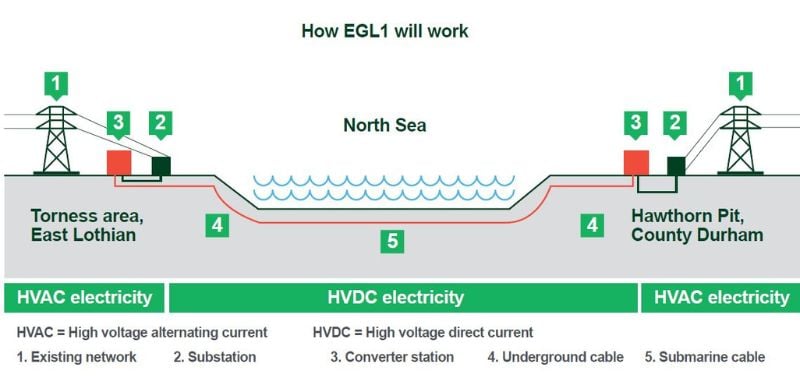
Diagram of Eastern Green Link 1. Image used courtesy of Eastern Green Link 1
The HVDC connection will include two electrical cables and a fiber optic cable, spanning 176 kilometers beneath the sea, constituting most of its 196 km total length.
On land, the cables will be directly buried, placed within protective ducts, or mounted on cable bridges, depending on the site’s characteristics. Once the installation is complete, the areas will be restored to their original condition.
For the underwater portion, two techniques are used to position the cables beneath the seabed: simultaneous laying and burial or post-laying and burial. The method selection depends on the seabed's surface conditions. In the simultaneous approach, a single vessel performs laying and burial in one operation. In contrast, the post-lay method involves one vessel to position the cables and another equipped with specialized tools to embed them under the seabed.
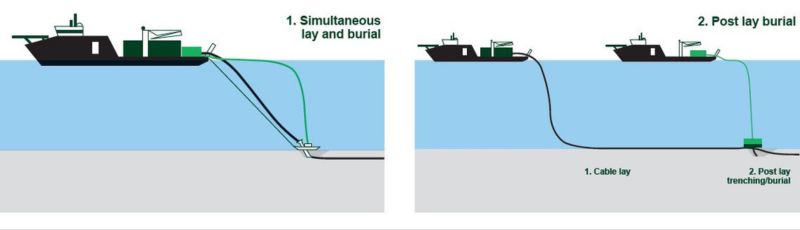
Cable lay illustration. Image used courtesy of Eastern Green Link 1
National Grid and SP Energy Networks are planning three more links, potentially powering over 8 million homes with renewable energy.
As renewable energy innovation continues, infrastructure needs to evolve, too, and the Eastern Green Link 1 is a prime example of ensuring infrastructure adaptations capitalize on existing renewable energy capacity.