Facebook
 Google
 GitHub
 Linkedin
ReVolt’s Carbon-Free Power Platform Electrifies Movie Sets
The battery-electric mobile power platforms use high-density DC-DC modules and can replace diesel gensets on movie locations to reduce noise and emissions.
Film production has long depended on portable diesel generators to feed lighting, cameras, motion control, comms, and basecamps. Sets are getting more electrically intensive, and using gensets can lead to engineering constraints and environmental problems. Noise can dictate equipment placement, and exhaust may limit airflow and working distance. The variable “dirty” output forces extra filtering ahead of sensitive loads.
ReVolt Holdings’ battery-electric alternative reframes the movie set as a DC microgrid on wheels, pairing an 800 V traction-style pack with modular power conversion to present clean AC at multiple voltages without the decibel and emissions penalties of combustion.
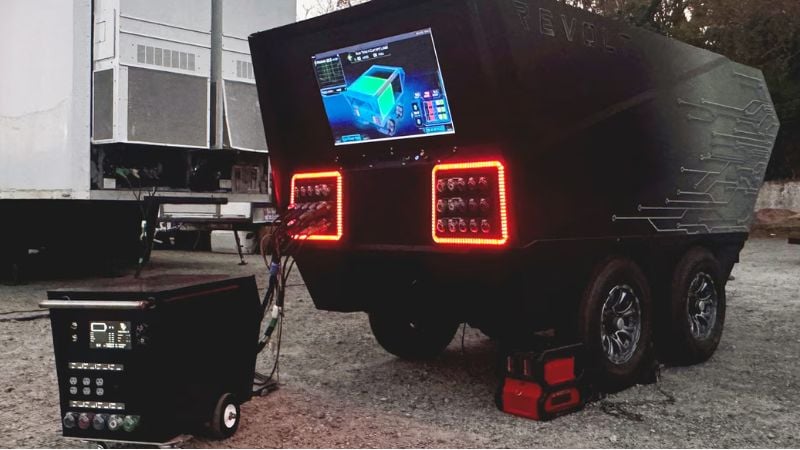
The portable systems power cameras, sound, lighting, and more on a movie set.
From Diesel Gensets to DC Microgrids on Wheels
ReVolt’s fleet spans compact units for specialty rigs to high-capacity platforms sized for backlot and on-location basecamps. The WeVolt unit targets small-footprint three-phase loads, while the larger Mule class delivers 120 kW continuous with pack capacities configured into the hundreds of kilowatt-hours and native outlets at 480 V, 208 V, 240 V, and 120 V. This is enough to displace a yard of trailerized gensets for core set infrastructure.
The system is designed for continuous power while charging, so crews can backfill energy from the grid or renewable sources without interrupting supply. ReVolt reports fielded systems powering cameras, lighting, SFX, and basecamps for major studios with near-silent acoustics and zero on-site CO2.
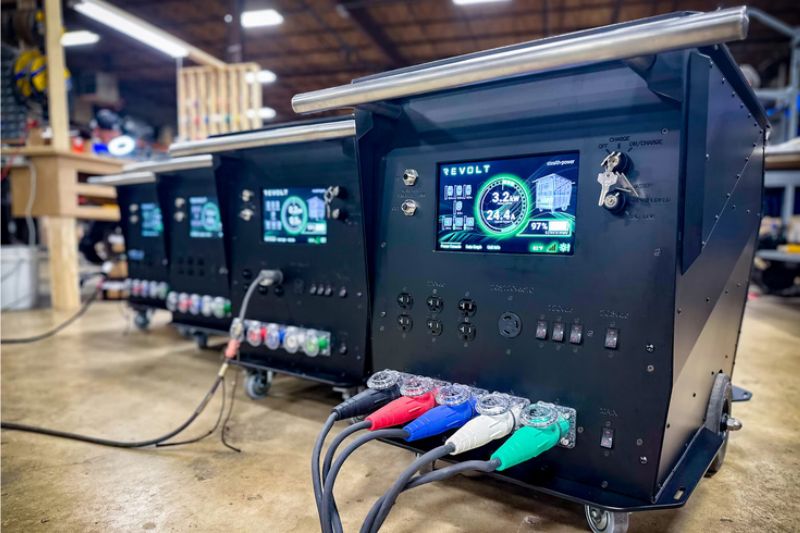
The WeVolt is the ReVolt’s smallest option for industrial-grade three-phase power.
In operation, eliminating generator noise and fumes allows units to move closer to the action, shrinks cable runs, and reduces the associated copper losses, connectors, and labor. Industry groups have pushed this transition for years to cut emissions and acoustic impact on location. Electrified sets are gaining traction as the technology matures.
800 V to 48 V to Point-of-Load
Under the hood, ReVolt uses Vicor’s BCM bus converters, DCM isolated converters, and PRM regulators to translate an 800-V battery backbone into the low-voltage rails and tightly regulated outputs that film equipment requires. A BCM4414 stages down the HV DC link to an isolated ~48 V distribution bus (up to 35 A in a 4.35 x 1.4 x 0.37 in VIA module), providing the high power density and galvanic isolation needed for safe, compact packaging.
Downstream, DCM modules service 24 V loads, while PRM non-isolated buck-boost regulators generate point-of-use setpoints with reported efficiencies to ~96%, minimizing thermal burden and enabling the “no-heatsink” approach ReVolt emphasizes across the platform. In some configurations, the BCM acts as a battery emulator for the 48-V domain, allowing ReVolt to trim auxiliary pack mass without compromising ride-through or transient behavior.
The most immediate difference crews notice is acoustic. Where a ~10 kW diesel is typically sited a football field away to keep ~75 dB out of the mix, ReVolt units operate at “computer-fan” levels beside the gear they power. The company also identifies pure-sine output and stable voltage advantages for digital lighting and motion-control rigs that would otherwise need additional filtering behind a genset.
From a carbon and air-toxics standpoint, moving loads off nonroad diesel engines cuts not just CO2 but NOX and particulates at the worksite, aligning with studio sustainability targets and permitting requirements.