 Facebook
 Google
 GitHub
 Linkedin
Reaching Higher: 1,197-Foot Wind Turbine Sets World Record
German engineering company GICON has developed the world’s tallest wind turbine to capture more energy.
In eastern Germany, a wind turbine has reached new heights—1,197 feet (365 meters), including the blades. According to GICON, the developers, this makes it the world's tallest wind turbine. It’s also Germany’s second-tallest structure, dwarfed only by Berlin’s TV tower.
GICON built the pilot turbine in Schipkau for the Federal Agency for Disruptive Innovation (SPRIND). It’s built to answer one question: What happens if we start building wind farms up instead of out?
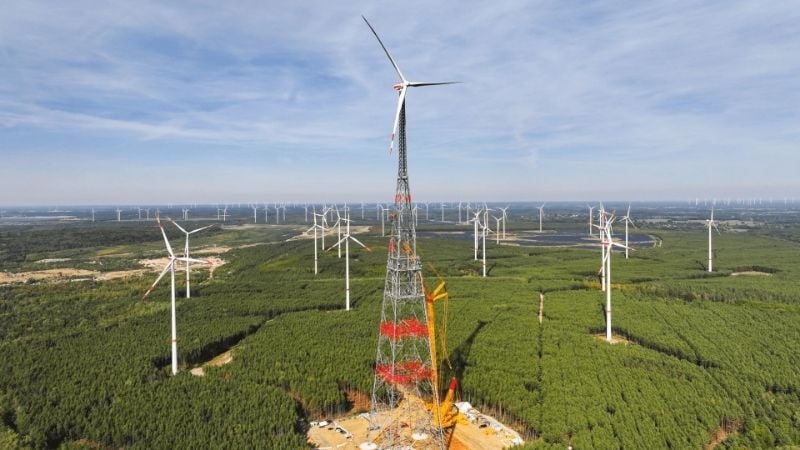
The GICON high-altitude wind turbine. Image used courtesy of GICON
Why Height Matters
Wind becomes stronger and steadier at high altitudes. Conventional turbines mostly operate at lower elevations, leaving the stronger wind above them uncaptured. GICON’s design reaches the stronger winds at higher elevations. The company says that once it’s running, the turbine could produce roughly twice as much electricity as a conventional turbine with the same rotor diameter.
Production capacity is still an estimate and does not account for peak power. The pilot turbine’s rated capacity is 3.8 MW, with future projections exceeding 7 MW.
The Engineering Behind the Record
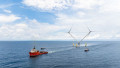
Building a turbine this high required an unconventional approach. No standard crane can reach the top of a tower this tall, so GICON designed a telescoping lattice tower.
Watch the turbine construction up close and in action. Video used courtesy of GICON
After the turbine was assembled at a manageable height, an inner tower lifted it up through the surrounding structure to its final position. This method enabled hub heights of up to 300 meters, beyond what traditional tower-and-crane methods allow.
A Second Layer of Clean Energy
The opportunity to expand wind energy capture is equally as exciting as the tower record. Space is one of the biggest limitations on expanding renewable energy. Good sites are limited, and new wind farms often meet local resistance.
GICON and SPRIND’s turbine proposes a workaround: add taller turbines above existing wind farms to capture energy at multiple elevations. This strategy would generate more energy from the same amount of land, the same grid connections, and already developed sites. Current assessments suggest Germany could host as many as 4,000 of these turbines within existing wind farms.
The company also points to steadier generation. Higher winds are more consistent, and when paired with solar and storage, these turbines could become part of hybrid power plants that supply communities and industry more evenly through the year. It’s a plan to extract more from what is already built, not just to build more.
The pilot is in Germany's Lausitz region, a former coal area positioning itself as a leader in renewable energy. This makes the turbine not just a world record in clean energy, but a milestone for an area once defined by fossil fuels.
Operation Plans
After the turbine structure is complete, the official commissioning is planned for November. Only then will real operating data show whether the extra height delivers the expected energy gains and whether the benefits justify the added engineering complexity.
If it performs as expected, the turbine could mark a turning point in how we capture wind energy. It’s much like how cities are tackling urban sprawl—another sustainability pain point—the answer isn’t to spread out over more land; it’s to expand up. Taller buildings house more people on the same footprint, and taller turbines could generate more power on the same ground.