Facebook
 Google
 GitHub
 Linkedin
Hurricane Ready: World’s Largest Dual-Rotor Wind Turbine
Wind generators could capture hurricane winds and turn weather challenges into energy solutions.
Wind energy is reaching far and wide to capture the renewable energy potential in harsh environments. Offshore wind farm installations, ultra-high-altitude wind turbines, and increasingly innovative rotor designs are all pushing wind tech into the net-zero emissions future.
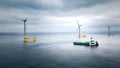
Watch the OceanX twin-turbine wind generator in action. Image used courtesy of Minygang
To capture high-speed winds out to sea, the Mingyang Group based in China has successfully launched OceanX, the largest single-platform offshore wind turbine.
The OceanX, the world’s largest dual-rotor wind turbine, has been installed 191 nautical miles from shore near Guangdong, China. This turbine is special for its size and ability to withstand storm conditions and continually adjust position depending on wind direction.
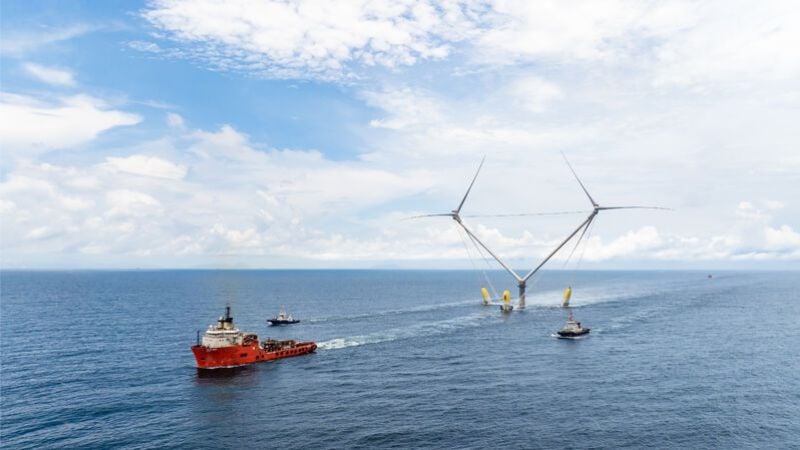
OceanX. Image used courtesy of Mingyang
Dual Rotor Challenges: Rotor Alignment, Mechanical Strain, and Wake Effects
OceanX is a design feat partly because of its incredible size, especially considering that even modestly sized dual-rotor wind turbines present several engineering challenges. Conventional single-rotor wind turbines can only capture about 50% of the wind’s potential energy. Mingyang Energy designed the dual rotor innovation to capture the remaining 50%. However, with the additional rotor, complexities arise.
One key challenge is ensuring both rotors adjust to changing wind directions efficiently. Standard wind turbines use yaw systems to rotate the nacelle to face the wind, but with dual rotors, synchronizing this adjustment can be complicated.
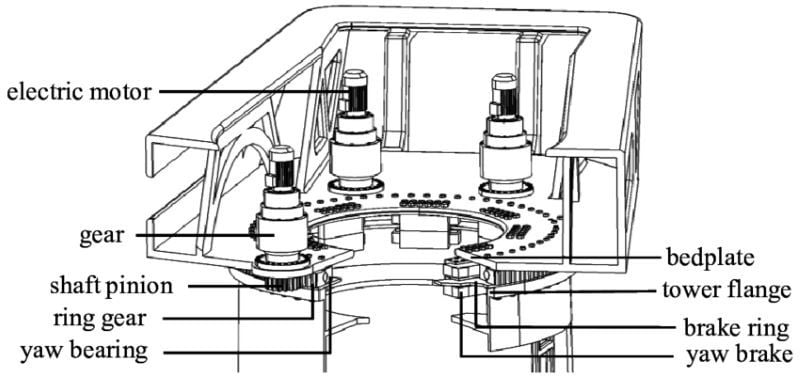
Yaw system diagram for single rotor turbine. Image used courtesy of Kim and Dalhoff
Both rotors must align precisely to avoid energy losses and mechanical strain. Any discrepancy can result in increased wear or lower power efficiency.
One core issue is maintaining the precise angular synchronization between the rotors. If one rotor is misaligned by even a small degree, it can lead to uneven load distribution, increased aerodynamic drag, and mechanical stress. This imbalance reduces efficiency and accelerates wear on the blades, bearings, and gearbox. To address this, engineers must develop highly responsive and coordinated yaw mechanisms to manage the additional complexity two sets of rotors pose.
Additionally, the increased aerodynamic interactions between the two rotors create challenges in controlling wake dynamics. For example, the first rotor’s wake influences the airflow that the second rotor receives, which can lead to turbulence and reduced power output. This complexity makes designing a robust control system crucial to maintaining stability in varying wind conditions. These design challenges contribute to slower adoption and development of dual-rotor turbines compared to their single-rotor counterparts.
The Specs and Impact of OceanX
Despite the obstacles, the Mingyang group was able to make their vision of a gigantic dual-rotor offshore wind turbine a reality. Located 700 kilometers from China’s southeast coast, OceanX has twin rotors that counter-rotate. The blades are approximately 182 meters in diameter.
Using high-performance concrete to create a single-point mooring system, the Minyang group crafted an offshore turbine designed to withstand typhoons and category 5 hurricanes.
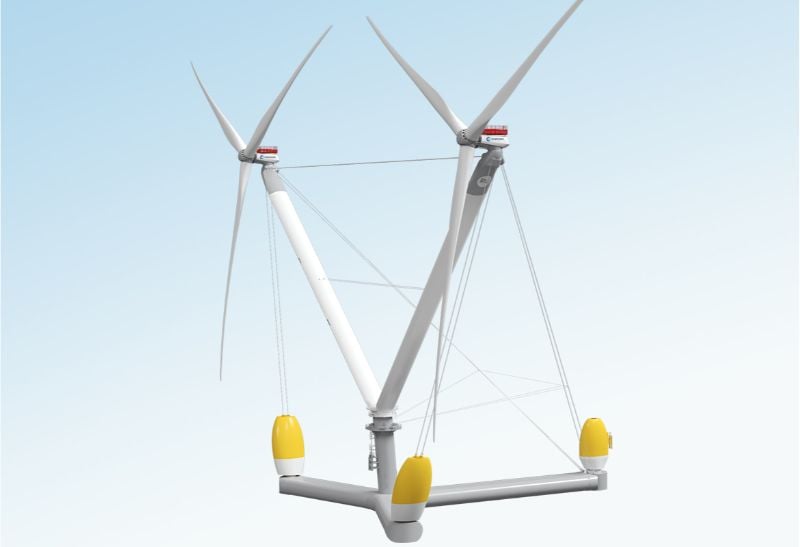
OceanX system. Image used courtesy of Mingyang
The gigantic turbine aims to capitalize on extreme weather, transforming threats to energy continuity into a boon for consumers. OceanX can produce 54,000 MGh annually, enough energy to power 30,000 homes.
The combination of size and stability means OceanX can perform well in harsh maritime environments that would likely damage conventional offshore turbines. The platform can withstand a turbulence intensity of 0.135, improving the safety and longevity of this record-breaking turbine.
According to the U.S. Environmental Protection Agency, tropical cyclone intensity has increased in the past 40 years, and so building innovative structures like OceanX to capture the energy created by extreme weather events is a novel approach to dealing with climate change by embracing some of the unfortunate challenges it presents.
OceanX pushes the boundaries of offshore wind turbines. Many innovations have already been implemented, but new advancements have yet to be realized to capture the full potential of wind power—even the power created by a hurricane.