Facebook
 Google
 GitHub
 Linkedin
DC Anti-Backflow: Comparing Active ORing and Diode ORing for Reverse Current Protection
Reverse-current protection has become an integral part of overall power-system architecture. Selecting the appropriate ORing strategy requires balancing efficiency, thermal behavior, reliability, maintainability, and installation requirements. The goal is to develop redundant DC power systems that are more efficient and more robust throughout their operational lifetime.
This article is published by EEPower as part of an exclusive digital content partnership with Bodo’s Power Systems.
As industrial DC power systems continue to increase in power density, redundancy has evolved beyond a simple means of improving system availability. Modern control cabinets, telecommunications infrastructure, and industrial automation systems are expected to maximize uptime while simultaneously reducing energy consumption, cabinet temperatures, and maintenance effort. These changing design priorities have brought renewed attention to one aspect of redundant power architectures that often receives little consideration during the early stages of system design: reverse-current protection.
Connecting multiple power supplies in parallel is a well-established method of increasing available output current or implementing N+1 redundancy. Under normal operating conditions, the supplies share the load and operate transparently. During a fault, however, the situation changes. If one supply fails low or develops an internal short circuit, healthy supplies can feed current back into the failed unit. Instead of supporting the load, the faulty supply becomes an additional load itself, increasing stress on the remaining power sources and potentially destabilizing the complete DC bus.
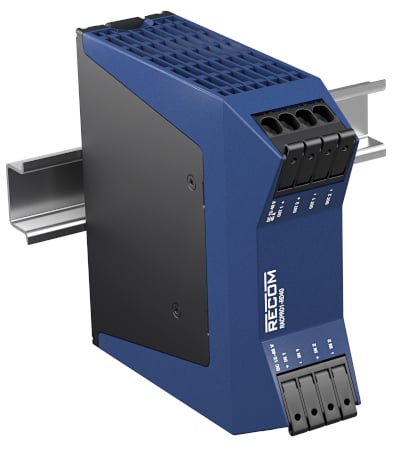
Figure 1. RECOM RACPRO1-RD40 redundancy module for DIN-rail mounting. Image used courtesy of Bodo’s Power Systems [PDF]
Preventing this reverse current is the purpose of DC anti-backflow protection, commonly implemented through ORing circuits. Although the concept is straightforward, the choice of ORing technology has a significant influence on efficiency, thermal behavior, and long-term system reliability. What was once considered a relatively simple protection circuit has therefore become an important engineering decision in modern high-power DC installations.
Traditional diode ORing has served industry reliably for decades. Its popularity comes from its simplicity: a diode placed in series with each power supply naturally blocks reverse current whenever the source voltage falls below the common bus voltage. The solution requires very few components, operates without control circuitry, and offers predictable behavior across a wide range of applications.
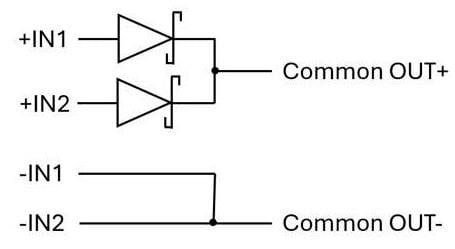
(A) Schottky diode reverse current protection
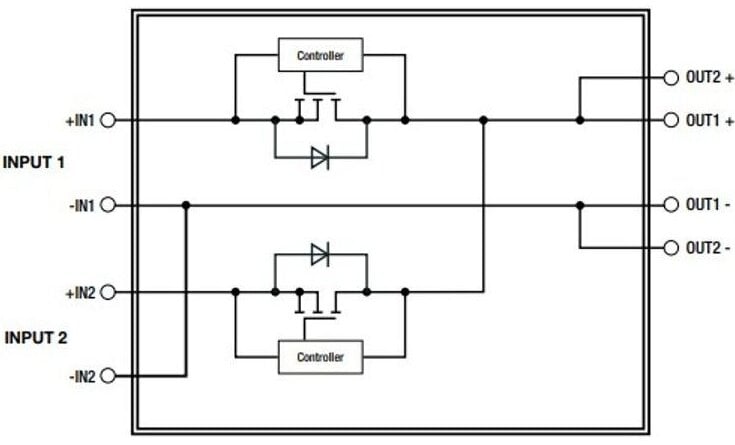
(B) Recom RACPRO01-RD40 redundancy module
Figure 2. Simple Schottky ORing circuit (A, upper part), and (B, lower part) more efficient MOSFET-based ORing module. Image used courtesy of Bodo’s Power Systems [PDF]
However, every diode introduces a forward voltage drop. While this loss may appear modest, its effect becomes increasingly significant as output current rises. The resulting power dissipation generates additional heat inside the control cabinet, reduces overall efficiency, and may require larger copper areas, heat sinks, or forced-air cooling. Consequently, the design challenge extends beyond electrical protection and becomes part of the system’s thermal management strategy.
These limitations have accelerated the adoption of active ORing solutions. Instead of relying on a semiconductor junction, active ORing uses low-resistance MOSFETs controlled as ideal diodes. Because conduction losses are primarily determined by the MOSFET’s on-resistance, voltage drop and heat generation can be reduced dramatically compared with conventional diode solutions. Lower losses improve efficiency while also reducing thermal stress on surrounding components and allowing more compact cabinet layouts.
Beyond efficiency, active ORing offers advantages that are increasingly valued in industrial environments. Modern controllers can detect reverse-current events, react rapidly to fault conditions, and provide diagnostic information that supports maintenance and system monitoring. As industrial systems become more connected and greater emphasis is placed on predictive maintenance, these additional functions can contribute to higher overall system availability.
In practice, the decision between diode and active ORing is rarely determined by a single parameter. Current level, efficiency targets, available installation space, cooling concept, maintenance philosophy, and expected service life all influence the final architecture. For lower-current systems where simplicity and cost remain the primary objectives, conventional diode ORing often continues to represent the most appropriate solution. Where power density and efficiency become dominant design criteria, active ORing offers measurable benefits.
Mechanical integration also plays an increasingly important role. Industrial designers are expected to maximize the available DIN-rail space while simplifying installation and future maintenance. Compact redundancy modules with flexible mounting options, direct installation alongside compatible power supplies, and tool-less wiring help reduce installation effort and improve serviceability without increasing cabinet size.
One practical implementation of this approach is RECOM’s RACPRO1-RD40 redundancy module. Rather than focusing solely on reverse-current protection, the module demonstrates how MOSFET-based active ORing can be integrated into a compact DIN-rail solution for modern 12 V, 24 V, and 48 V systems. A wide input range, high efficiency, low voltage drop, and straightforward installation illustrate how current engineering requirements for electrical performance and practical usability can be addressed within a single industrial product.
Ultimately, reverse-current protection should no longer be viewed simply as a protective accessory. It has become an integral part of overall power-system architecture. Selecting the appropriate ORing strategy requires balancing efficiency, thermal behavior, reliability, maintainability, and installation requirements. By considering these factors together rather than in isolation, engineers can develop redundant DC power systems that are not only more efficient, but also more robust throughout their operational lifetime.
This article originally appeared in Bodo’s Power Systems [PDF] magazine.