Facebook
 Google
 GitHub
 Linkedin
Li-Ion Meets Supercapacitor: Hybrid Combines Best of Both Worlds
Abracon’s hybrid supercapacitors blend supercapacitors’ fast charge/discharge rates with lithium-ion batteries’ long-term storage potential.
The energy storage industry has rapidly evolved in recent years due to the growing demand for efficient and sustainable power solutions across various sectors. As renewable energy sources and electric vehicles develop, advanced energy storage technologies have become vital.
Traditional batteries and capacitors have long been the mainstays of energy storage, but each has limitations. Batteries offer high energy density but are plagued by slower charge/discharge rates and limited cycle life. Capacitors, on the other hand, provide rapid power delivery but lack energy storage capacity. This dichotomy has created a significant gap in the market for solutions that can offer high energy and power density.
Abracon’s AHCR lithium-ion supercapacitors (LiC) combine the best of both worlds, making them suitable for electric vehicles and other high-power electronics.
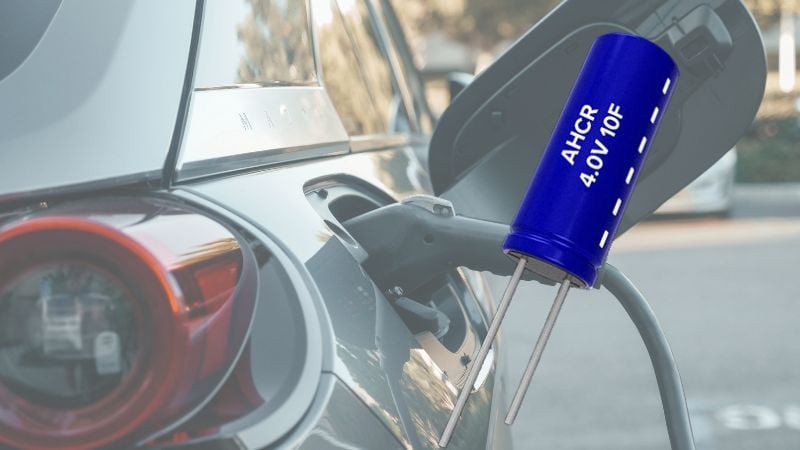
Lithium-ion supercapacitor. Image adapted courtesy of Canva and Abracon
Abracon’s ACHR LiC
Abracon's AHCR lithium-ion supercapacitors are a product family combining the benefits of lithium-ion batteries and electric double-layer capacitors. These hybrid devices offer the high energy and power density required for sustained power and rapid charge/discharge capabilities.
The AHCR series features a nominal voltage of 4.0 V, a capacitance range from 10 F to 1200 F, and an impressive cycle life of over 50,000 cycles. The LiCs’ energy density is notable, with the 100 F model achieving 33.85 Wh/kg and some variants reaching up to 50.78 Wh/kg.
Performance-wise, the AHCR LiCs exhibit low leakage current, as small as 1μA for lower capacitance models, and a low self-discharge rate of less than 5% after 72 hours. Depending on the capacitance, they can handle continuous currents ranging from 0.04A to 5.0A, with peak currents up to 50 times the rated capacitance.

The ACHR family wave profile. Image used courtesy of Abracon
Architecturally, these LiCs come in a radial/can package type with through-hole pins for stability. They are available in various sizes, with diameters ranging from 6.3 mm to 18 mm and lengths from 12 mm to 60 mm, allowing for flexible integration into different designs.
Abracon claims its LiCs are particularly well-suited for power backup, microenergy storage, and IoT energy harvesting applications.
Hybrid Supercapacitors
Lithium-ion hybrid supercapacitors are an energy storage technology that bridges the gap between traditional supercapacitors and lithium-ion batteries. These devices combine supercapacitors' high power density and rapid charge/discharge capabilities with lithium-ion batteries' higher energy density characteristics.
LiCs typically comprise a lithium-doped carbon anode and an activated carbon cathode, with an organic electrolyte containing lithium salts. This unique architecture allows energy storage through electric double-layer capacitance at the cathode and lithium intercalation at the anode. The result is a device that can deliver both high power and relatively high energy density.

Comparing energy storage options. Image used courtesy of the authors
LiCs' unique aspect is their ability to provide a balance of characteristics that neither traditional supercapacitors nor lithium-ion batteries can offer alone. They can deliver quick bursts of power like supercapacitors but with a higher energy density, similar to some lithium-ion batteries. This makes them particularly suited for high-power and extended energy storage applications.
LiCs are important because they can potentially address energy storage challenges in various fields. Their real value shines in scenarios where rapid charge/discharge cycles are needed, but traditional supercapacitors lack sufficient energy density. Applications include regenerative vehicle braking systems, grid stabilization for renewable energy sources, and power backup systems for electronics.
Evolving Energy Storage
As demand increases for more versatile and efficient power solutions, hybrid technologies like LiCs will play an increasingly important role in various industries. Combining rapid charge/discharge capabilities with higher energy density opens up possibilities for applications in renewable energy integration, electric vehicles, and advanced electronics. With its new LiC ACHR family, Abracon hopes to provide engineers with the solutions necessary to meet these evolving energy demands.