Facebook
 Google
 GitHub
 Linkedin
Optimizing Carbon Coating To Improve Lithium-Ion Battery Efficiency
Researchers are using an X-ray imaging technique on lithium-ion batteries that reveals important new information about the variable rates of lithium intercalation reactions in lithium iron phosphate nanoparticles. These variations are correlated with carbon coating thickness that engineers can adjust to improve efficiency.
A study led by Martin Bazant, the E.G. Roos Professor of Chemical Engineering and a professor of mathematics at MIT, shows how using an X-ray imaging technique can reveal critical insight about how lithium iron phosphate (LFP) nanoparticles behave inside lithium-ion (Li-ion) batteries.
.jpg)
X-ray imaging of nanoparticle behavior in a lithium-ion battery. Image used courtesy of Nanowerk
The electric vehicle (EV) market is growing rapidly and will play a critical role in our pivot to sustainable energy. To facilitate this growth, engineers are striving to develop many different facets of EV technology and EV market conditions.
Some engineers have been studying and improving the electrolyte solution used in lithium-ion batteries. Others are using AI to help calculate ideal charging station locations to incentivize retail market participation. Still more are fine tuning how lab testing can better mimic driver behaviors so that battery testing is a stronger indicator of how Li-ion batteries will perform in the field.
Now, a team of scientists has zoomed in, as it were, on a new frontier of Li-ion research: the nanoparticle level.
The Role of X-ray Imaging in Capturing Intercalation
Intercalation, the electrochemical reaction of lithium ions as they flow between the electrolyte solution and electrodes of a Li-ion battery, is a key mechanism that drives the discharging and charging processes. Much research has focused on various battery components, but Bazant and his team wanted to more fully understand how nanoparticles are behaving during intercalation.
Their goal was to examine how lithium ions were flowing in and out of particles and to see if there was any discernible pattern in variations of ion concentrations.
Without the use of X-ray imaging, the team would not have been able to detect the surprising pattern of ion concentration variation that they ultimately discovered. Bazant describes how they used X-ray imaging technology to create what he calls “beautiful X-ray movies of nanoparticles at work.” His team analyzed 63 LFP particles as they charged and discharged.
But there had always been a major obstacle to the utility of this X-ray imaging technique. The unfortunate reality was that the imaging was so information dense that it was difficult to use, and that density obscured any patterns that might prove meaningful. The overall functionality was captured by these X-ray movies, yet the details of that functioning remained elusive and impossible to parse.
Now, though, the team has been able to apply image learning to these movies. The result is that these images have become a treasure of data points that can be shaped into new insights that can improve Li-ion engineering.
How Carbon Coating Thickness Impacts Reaction Rates
What the team saw through this X-ray imaging and the image learning they applied to it was that different areas of the LFP nanoparticles were exhibiting different lithium intercalation rates.
After examining the particles pixel-by-pixel at every point in the particle, the team could discern that some regions exhibited fast reactions and others were significantly slower. This heterogeneity is significant because it indicates a gap in efficiency and suggests that it might be possible for engineers to manage this efficiency and maximize it at the nanoparticle level.
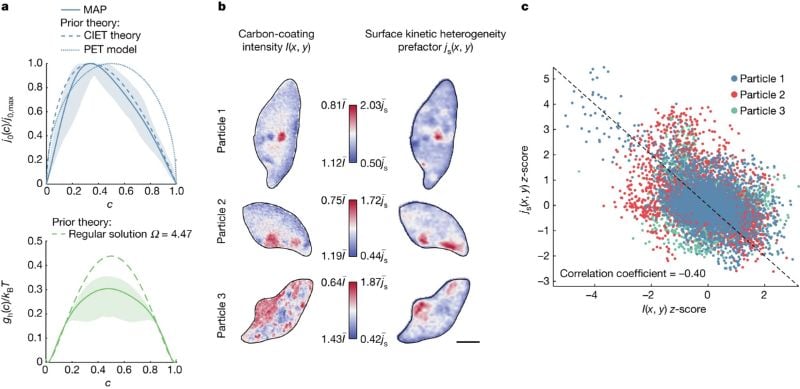
Pixel-by-pixel analysis of heterogenous reactions. Image used courtesy of Bazant, et al. (Creative Commons)
The team was ultimately able to observe a critical correlation between these differing reaction rates and the carbon coating thickness on the surface of the LFP particles. This connection between reaction rate and the carbon coating that engineers apply opened the door to more precise management of carbon coating thickness for the purpose of substantially improving efficiency.
Bazant and his team noted that this revelation would not have been possible without the X-ray imaging technique they used and stated that this is, in fact, the first study of its kind to directly link a property of the battery material with the carbon coating in such a compelling way.
This insight offers significant potential for the next phase of Li-ion engineering that will keep improving efficiency and elevating battery performance.