Facebook
 Google
 GitHub
 Linkedin
GaN-Powered Reference Kit Targets Solar Race Cars and EVs
Power Integrations has launched a reference design kit integrating its high-efficiency PowiGaN-based InnoSwitch3-AQ IC for lightweight, thermally constrained automotive applications.
As solar car competitions push the boundaries of vehicular efficiency, electrical powertrain systems must evolve to meet extreme constraints, such as tight packaging, thermal limitations, wide load variability, and low overhead margins for conversion losses. At the same time, the racecar environment provides a unique proving ground for technologies that could transition to mainstream electric mobility or off-grid renewables.
To meet that challenge, Power Integrations has released the RDK-85SLR, a complete reference design kit featuring its InnoSwitch3-AQ IC with integrated PowiGaN switch technology. The kit targets auxiliary power supply systems in solar vehicles, delivering compact, high-efficiency DC-DC conversion without external heatsinks.
Announced to coincide with the 2025 Bridgestone World Solar Challenge, the launch positions Power Integrations at the intersection of automotive GaN adoption and the next generation of student-led vehicle electrification.
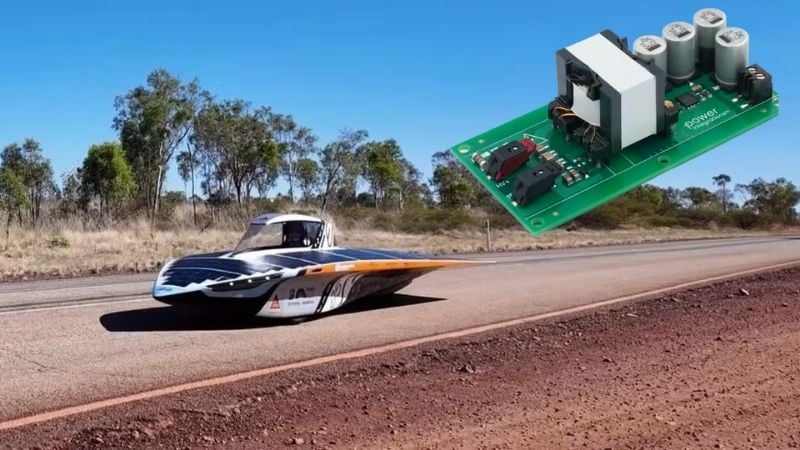
The RDK-85SLR reference kit is designed for solar car race teams. Adapted from images used courtesy of Power Integrations and Mr. Green's Blog
GaN Switching Without Heatsinks
The InnoSwitch3-AQ is a wide-input DC-DC controller IC with an embedded 750 V PowiGaN switch, synchronous rectification, and lossless current sensing. When operated within the RDK-85SLR kit, it delivers a regulated 46 W output, peaking at 80 W during transient loads, with a 95% conversion efficiency across the full load range from 5 to 60 W. That level of performance, particularly in a compact form factor without forced air or heatsinks, reflects the high switching speed and reduced conduction losses made possible by gallium nitride.
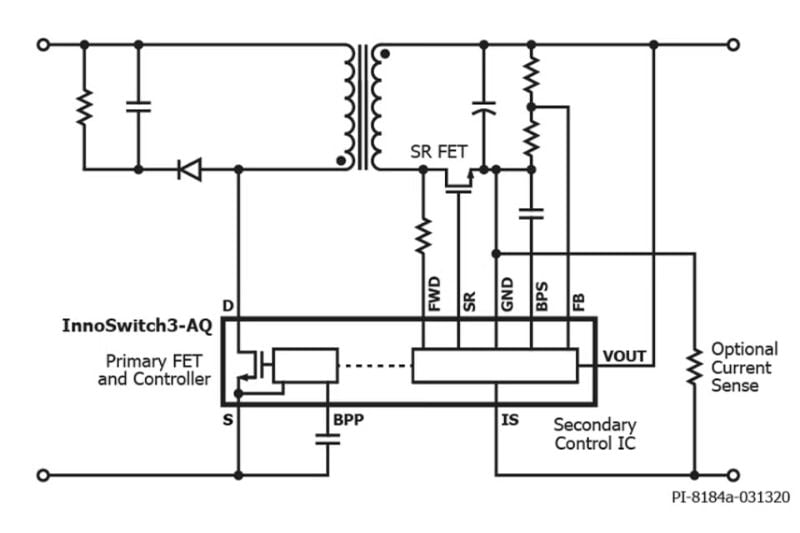
The InnoSwitch 3-AQ schematic. Image used courtesy of Power Integrations
Thermal efficiency is another major constraint for solar race teams, where every cubic centimeter and gram matters. Eliminating bulky thermal management systems means lighter cars, simplified integration, and improved reliability under the demanding environmental conditions of long-distance solar racing.
The InnoSwitch3-AQ is also AEC-Q100 qualified, making it directly transferable to production-grade automotive systems. Its valley switching discontinuous conduction mode helps minimize electromagnetic interference, yet another crucial factor in compact, high-frequency vehicle platforms.
Validated by ETH Zurich
The RDK-85SLR design was validated in competition by ETH Zurich’s aCentauri team, whose #85 “Silvretta” Challenger-class car implemented the design in the 2023 Bridgestone World Solar Challenge. aCentauri’s lead electrical engineer stated in a press release that the judges were “astounded to see an auxiliary power supply without a heatsink.” The team reported no performance degradation during the 3,000 km outback endurance race, confirming the system’s ruggedness under fluctuating loads and ambient temperatures.

The eCentauri’s solar car, the Silvretta. Image used courtesy of eCentauri
As a result, Power Integrations structured the kit to serve both as a design reference and a hands-on educational platform. In addition to the populated 46 W supply, it includes four InnoSwitch3-AQ ICs, an unpopulated PCB for custom layouts, and a full design report with schematics, PCB layout, and transformer build instructions. A complete bill of materials and thermal profiles support integration into competitive vehicles or development programs.
To encourage broader adoption, Power Integrations is offering the kit free to registered student race teams, reinforcing its commitment to technical education and renewable transportation R&D.
Beyond the Race Track
While optimized for solar racing, the RDK-85SLR kit serves as a bridge to GaN-based auxiliary power in electric vehicles. The move to 750 V and higher bus voltages, which is already being adopted in premium EV platforms, demands power conversion solutions that are resilient to voltage transients and can use high-frequency switching.
PowiGaN, Power Integrations’ proprietary GaN platform, is designed to meet these demands. It reduces parasitic capacitance and inductance by integrating gate drivers, switching elements, and control logic into a single package. This way, it avoids the efficiency bottlenecks and EMI issues that can plague discrete implementations.
The solar race application gives Power Integrations a visible, real-world proving ground for its 750 V class GaN solutions: technologies that could soon scale up to the company’s 900 V and 1700 V PowiGaN roadmap targeting traction inverters, onboard chargers, and distributed solar-to-battery converters.