Facebook
 Google
 GitHub
 Linkedin
Playing Nice: System Interoperability Key to Smart Grid
Effective grid digitalization requires interoperability among systems, networks, and assets. Achieving interoperability is complex and involves technical and practical considerations. This is the fifth and final part in a series examining technical challenges to grid digitalization in depth.
Decentralization and electrification are driving the energy transition, significantly impacting electricity distribution grids. Grid digitalization involves using digital technologies to improve the energy supply’s productivity, security, and efficiency. It is a fast-moving process involving operational strategies, digitalization investments, performance optimization, renewable energy integration, and evolving consumer demands.
Since so many moving parts exist, identifying and prioritizing barriers is critical to a more intelligent power grid. One technical barrier is a key puzzle piece—interoperability. This process allows many systems to connect, communicate, and work in smart, digitalized power grids.

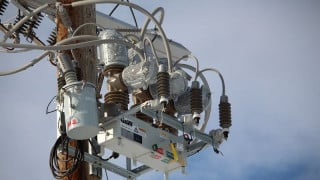
Smart grid. Image used courtesy of Adobe Stock
Interoperability in Smart Grids
Interoperability is the seamless end-to-end connectivity of hardware and software. Interoperability exists in any system where the physical and the digital worlds connect. In the energy industry, interoperability combines the endpoint (energy consumers)—where the energy is supplied from the distribution grid—with a real-time analysis of energy usage. Interoperability improves grid reliability as the connection between physical and digital environments enables the attainment and transfer of more useful information to the energy suppliers and grid operators, thus allowing more accurate energy readings and grid operations improvements.
Interoperability can also strengthen the energy market because efficient interoperability between consumers’ smart meters and the distributed power grid can promote competition in retail markets by lowering the entry barriers for suppliers to use advanced data-driven services. This can help avoid excessive administrative costs and allow much more efficient access to a customer's data to provide better services.
Common Information Model: The Information Sharing Framework for Smart Grids
Smart grids with interoperability collect system information and transfer it to energy management systems through an end-to-end connection. Achieving interoperability requires an information exchange across different domains, so the International Electrotechnical Commission (IEC) established the Common Information Model (CIM) tool to exchange information within power systems.
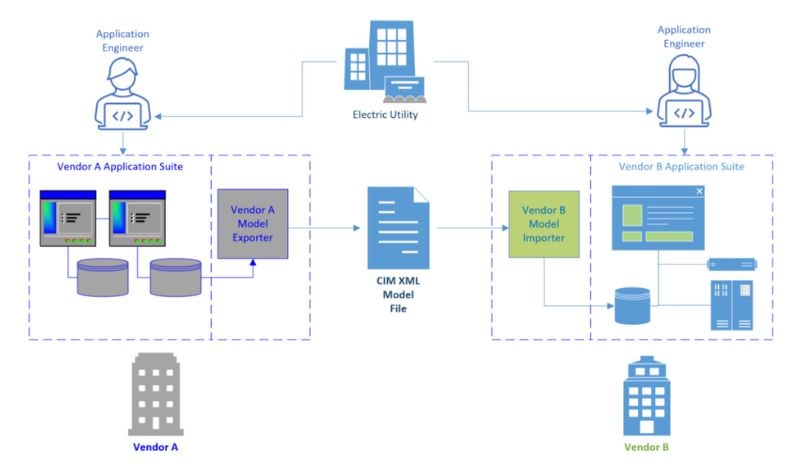
Visualization of information exchange via CIM. Image used courtesy of Pacific Northwest National Laboratory
CIM is a framework allowing for accurate data sharing, merging, and transformation into reusable information. The architecture is vendor-neutral as it works on open standards and uses standard application programming interfaces (APIs), so many suppliers can use it. However, while smart energy meters have become common, technical barriers still exist for building interoperable energy management systems using CIMs. In many locations worldwide, CIMs provide consolidated network data only on portions of the grid or at specific voltage ranges. Interoperability will ensure that CIMs can be extended to encompass the whole grid.
Practical Issues of Extending Common Information Models
Extending CIM frameworks is a challenge. The standard CIM’s API is the most basic information model. However, as the power network changes, varying business requirements can arise. In these situations, the information model must be extended to accommodate different information, and the standard CIM does not provide this.
Changes in power systems—integrating distributed resources, implementing network management systems, or changing legacy applications—should be extended within the CIM to fit energy companies’ needs. However, the CIM’s model reflects the underlying business model and, therefore, cannot represent every information exchange use case that arises.
Yet, the distribution network is changing by integrating distributed resources, utilizing consumer smart meter data, and managing assets and human resources. Support is needed to integrate different distribution management system applications into CIMs.
Poor CIM Harmonization
Other issues involve power grid harmonization and securing interoperability between heterogeneous systems. Harmonization achieves technical equivalency and enables different standards to interchange and overlap functionally. Harmonization requires an architecture documenting key points of interoperability and associated interfaces.
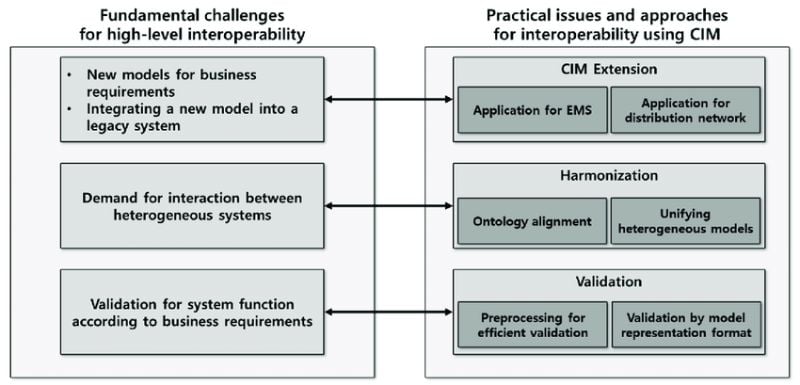
Harmonization in smart grid architectures and processes. Image used courtesy of the authors
Smart grid infrastructure uses automated controls and monitoring to improve efficiency, stability, and safety based on real-time information and communication technology. CIMs are used alongside the IEC data model IEC 61850 in energy management applications. Whereas CIM is used to build an EMS, IEC 61850 is used in substation system automation. While the two models overlap, they have been built independently with different standards, so the information exchange between them is incompatible. To overcome this and establish a more robust harmonization between energy models and, in turn, a more robust power system operation, new data interfaces must be created to bridge the two standards.
Data Validation
Validating the information exchanged from applications and entities within the power industry is essential. Since the system comprises many components, interoperability will lead to numerous data exchange processes. If not validated, data from multiple entry points could lead to poor data affecting the whole digital ecosystem. As more of the grid becomes digitalized and interoperability increases, the need for validation will increase, and data preprocessing/data minimization will become important for more efficient and robust data validation.
CIM validation ensures the exchanged information conforms to the model. This is done through messages via applications or system users using subsets of the CIM for application use cases. However, information about synchronization between system users is lacking, so the message specifications can cause interface differences, further preventing information sharing and decreasing interoperability between applications within the energy ecosystem using the CIM. Going forward, validation for the different message specifications will be vital for integrating multiple systems, services, and objectives together in the CIM.
Smart Meter Data Challenges
While many technical interoperability challenges surround the CIM, a few other factors about consumer data need highlighting, as they present their own barriers in facilitating efficient data communication from the consumer to the supplier.
Open-data standards are not always adopted uniformly, and the differences can lead to fragmented data formats, locked data, and inconsistent data, limiting interoperability in digitalized solutions. For smart meter data, specifically, customer consent mechanisms are absent for energy data download and sharing. Information about poor detail levels (granularity) in data collection operations is also lacking. The companies performing these processes often delegate aspects to other people or departments, making it harder to build a cohesive ecosystem.
All these factors specifically impact smart meter interoperability, which is just one part of the wider digitalized power grid. If widespread digitization is to be achieved, achieving interoperability will be fundamental.