Facebook
 Google
 GitHub
 Linkedin
Briefs: Bigger Batteries, Faster Development, and a Stable Grid
OmniOn Power, Onsemi, About:Energy, EFT Mobility, BYD, and Hitachi are advancing their products and services with leadership changes, partnerships, acquisitions, and innovations.
Global companies are striving for better performance, faster improvements, and bigger energy storage and management solutions. The latest news in power electronics includes a CEO Change, AI data centers, drone batteries, the world’s largest battery energy storage system, and grid stabilization in a gold mine.
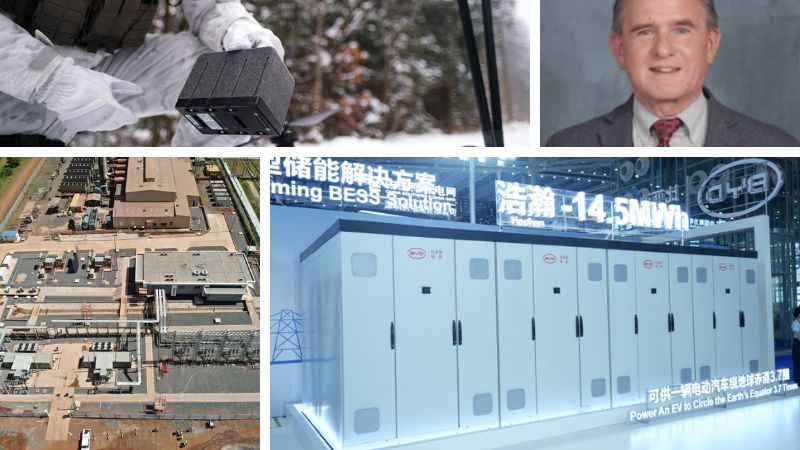
The latest business deals include a drone battery system, a new CEO, grid stabilization tools, and a huge battery energy storage system.
OmniOn Appoints French as President and CEO
OmniOn Power has selected David French as its new president and CEO.
French has more than 40 years of experience in leadership positions in the semiconductor and electronics industries. He managed NXP’s Mobile and Computing Business Unit and was CEO of Cirrus Logic, a global provider of mixed-signal audio solutions. He also held senior roles at Analog Devices and Texas Instruments.

OmniOn’s new CEO, David French. Image used courtesy of OmniOn Power
French will replace Jeff Schnitzer, who resigned in August.
Onsemi Acquires Vcore Power Technology to Boost AI Data Center Applications
Onsemi has signed an agreement with Aura Semiconductor to acquire rights to its Vcore power technologies and associated intellectual property licenses. Onsemi states that the acquisition will strengthen its power management portfolio and accelerate its goal of addressing the entire power tree in AI data center applications.
Onsemi aims to meet the power demands of AI infrastructure with scalable and practical designs. The company’s silicon and silicon carbide technologies provide solutions for solid-state transformers, power supply units, 800 VDC distribution, and core power delivery.
About:Energy and EFT Mobility Partner on Drone Battery Design
About:Energy is teaming up with EFT Mobility to develop a battery testing platform for drones. The collaboration aims to enable faster, more reliable battery cell comparison and selection in AboutEnergy’s modeling platform during early design phases for EFT Mobility.
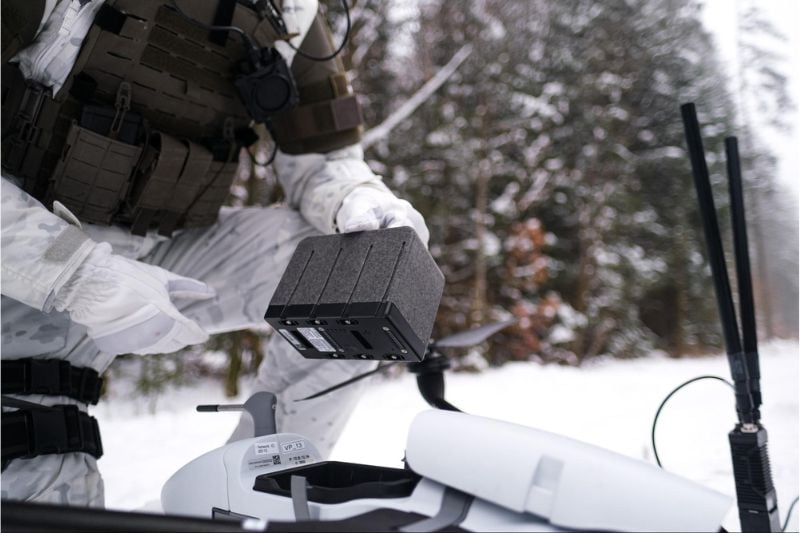
An EFT drone battery. Image used courtesy of EFT Mobility
Munich-based EFT Mobility, part of Quantum Systems Group, specializes in battery systems for uncrewed drones used in industrial, military, and commercial applications. The company uses simulation to provide faster assessment of high-performance battery cells. Working with About:Energy’s platform, EFT Mobility reduced cell shortlisting time by six months by rapid cell comparisons in power, flight-time, payload, and thermal rade-offs. Pack development accelerated by three months, and thermal issue detection improved by 20%.
BYD Rivals Tesla With Largest 14.5 MWh DC BESS
BYD claims it has created the world’s largest single-unit DC battery energy storage system (BESS), with a 14.5 MWh capacity exceeding the 6-7 MWh industry standard. The Chinese company introduced the BESS, dubbed HaoHan, at the International Digital Energy Expo in Shenzhen. HaoHan uses BYD’s 2,710 Ah Blade Batteries, the world’s largest energy cell.
By contrast, Tesla’s Megapack 3 offers a 5 MWh capacity per unit. It is combined in a Megablock of four units for a total capacity of 20 MWh. Each of HaoHan’s 20-foot units has a capacity of 10MWh. Both BYD and Tesla use lithium iron phosphate batteries.
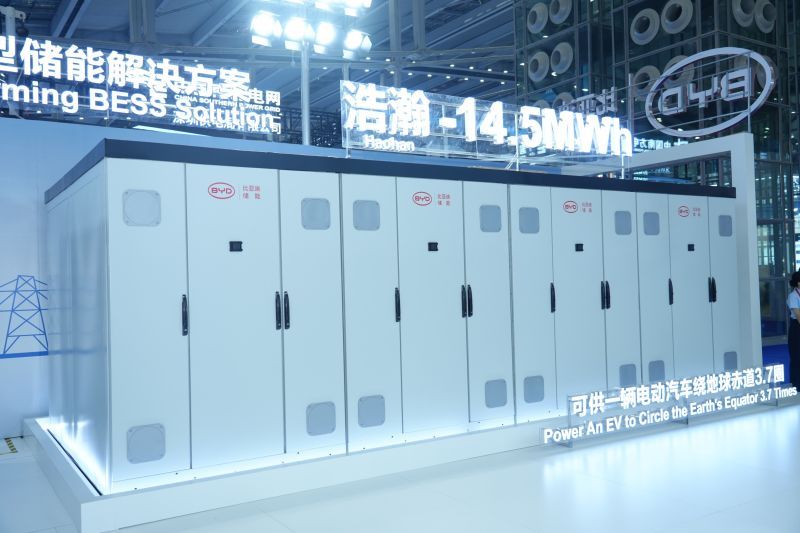
The HaoHan BESS unit. Image used courtesy of BYD
HaoHan’s energy density also doubles the average BESS, with 233 kWh per cubic meter. BYD states that the required units for a 1 GWh storage plant would be reduced by one-third. BYD also claims the HaoHan lowers failure rates and maintenance costs.
The company will use HaoHan in a 12.5 GWh system in Saudi Arabia and other GW-scale projects by the year’s end.
African Gold Mine To Use Hitachi Energy’s Power Converter
Geita Gold Mine (GGML) in Tanzania will use Hitachi Energy’s power electronic converter, featuring a PCS 6000 STATCOM system, to stabilize the mine’s connection to the national grid. The system will replace 80% of the GMML’s fossil-fuel gensets and reduce carbon emissions by 50 kilotons per year. The national grid uses 45.5% renewable energy sources.
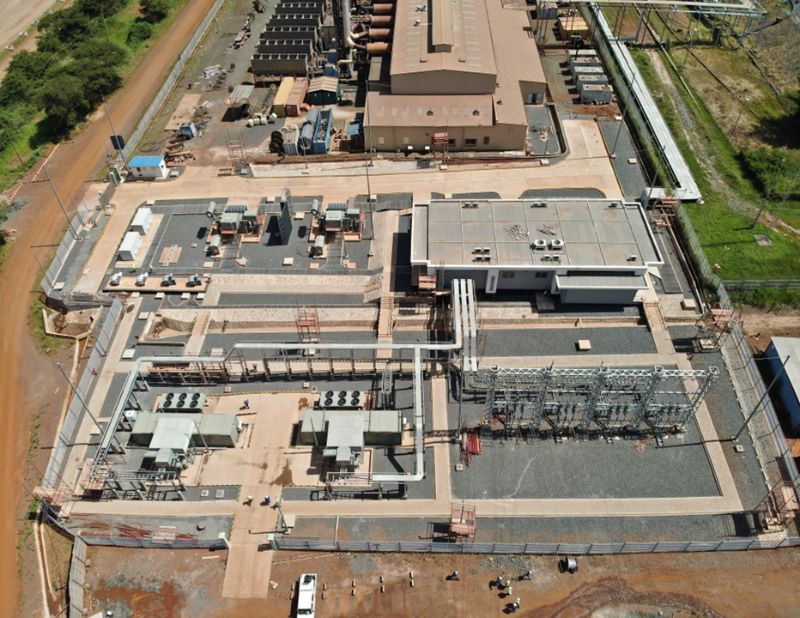
Hitachi Energy’s power converter at the GMML. Image used courtesy of APO Group
The PCS 6000 STATCOM provides numerous functions, including voltage stabilization, voltage balancing of asymmetrical loads, and harmonic filtering. The system uses MicroSCADA for monitoring and control in real time.