Facebook
 Google
 GitHub
 Linkedin
Beaming: A Look Back at Space-Based Solar Power
From technological advances to increased investment, space-based solar progressed significantly this year.
At first glance, it looks like science fiction. However, 2024 has been a significant year for space-based solar power (SBSP), with several major developments and investments pushing the technology closer to reality.
How does space-based solar work? Video used courtesy of Caltech
NASA, the U.S. Air Force, and other government entities worldwide are working on SBSP projects. Private companies are also exploring SBSP initiatives.
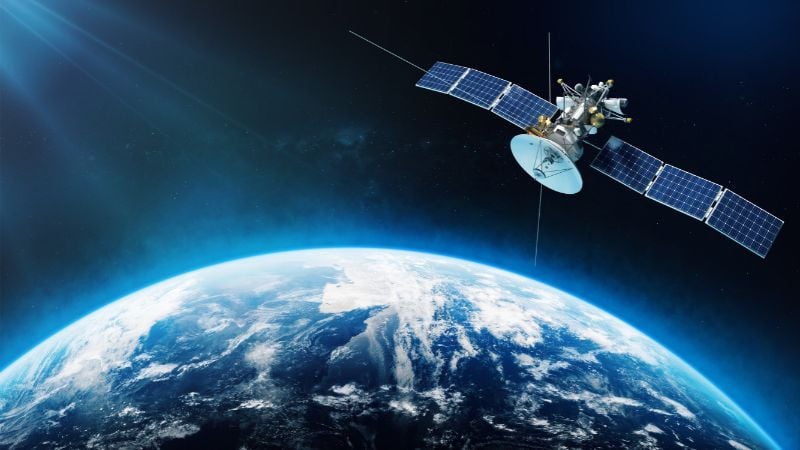
Satellite orbiting Earth. Image used courtesy of Adobe Stock
Space-Based Solar: The Basics
Here’s how space-based solar works. Large photovoltaic panels on satellites in space capture sunlight continuously. These satellites are typically positioned in geostationary orbit to maintain alignment with Earth-based receiving stations. Solar panels convert sunlight into DC electricity fed into a large antenna array that transmits signals to the satellite.
The transmitting antenna converts the DC electricity into electromagnetic waves at microwave frequencies. These microwaves are then beamed toward Earth and received by a ground-based antenna called a rectenna (rectifying antenna). The rectenna converts the microwave energy back into DC electricity, and this DC power is then converted to AC power for distribution through the power grid.
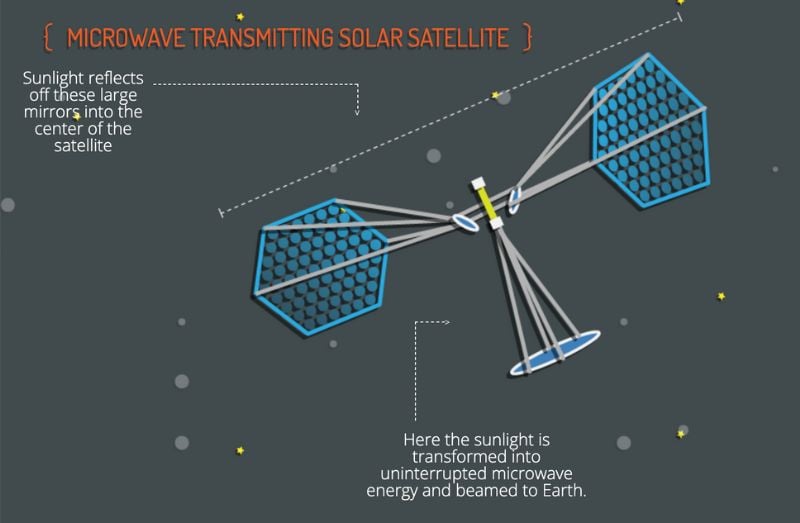
Space-based solar. Image used courtesy of the Department of Energy/Sara Gerrity
Why Is SBSP Attractive?
Several key features make SBSP attractive. The microwave beam can penetrate the atmosphere with minimal energy loss, even in heavy rain (less than 5% loss). The system allows for precise targeting of the energy beam to specific locations on Earth, making it possible to provide electrical power in remote places.
Microwave frequencies are preferred over other options (like lasers) due to their lower atmospheric losses and better efficiency in various weather conditions. The microwave beam is designed to be low-intensity and safe for humans and wildlife as the technology aims to provide continuous power. Depending on how they are positioned, satellites in space can access sunlight nearly 24/7, unlike ground-based solar panels.
While the concept is promising, challenges remain in scaling up the technology, improving transmission precision, and addressing the large infrastructure requirements in space and on the ground.
Technical Progress
The past year has seen several significant breakthroughs in space-based solar power technology.
Oxford-based Space Solar achieved a major milestone by demonstrating the world's first 360-degree wireless power transmission. They successfully lit up an LED sign by beaming energy wirelessly through the air from all angles, showing that the steerable power beaming capability is crucial for SBSP satellite design. This success also validates computer modeling, allowing confident scaling from half a meter to hundreds of meters in diameter.
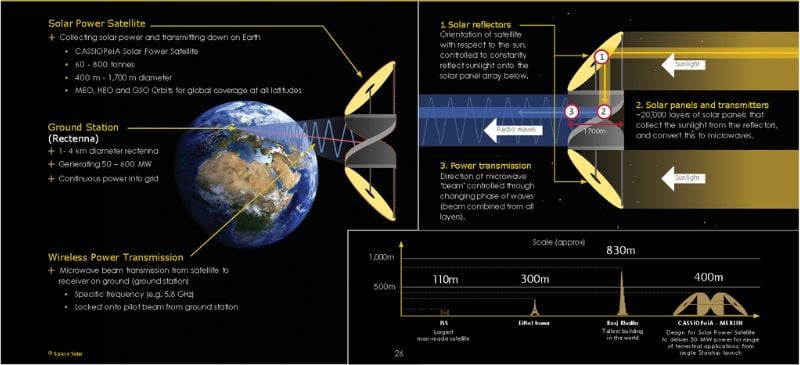
Space Solar’s technology. Image used courtesy of Space Solar
Space Solar is also making rapid progress on its SBSP system, with plans to launch its first prototype satellite within three years. The company aims to install the first commercial solar farm in space within the next ten years, delivering 180 MW to the grid—enough power for a large town.
Space Solar also collaborated with Transition Labs to provide Reykjavik Energy with electricity from the first-ever space-based solar power plant, operational by 2030 with an initial capacity of 30 MW.
In another development, for the first time, Caltech's space solar power prototype has shown its ability to wirelessly beam power through space and direct a detectable amount of energy toward Earth.
International Efforts
While China and the United States are leading the race for SBSP, Japan is also making significant strides. The competition is intensifying as these countries recognize SBSP’s potential to provide renewable, reliable energy and achieve strategic advantages in space technology.
China appears to be at the forefront of SBSP development. The Chinese government constructed a ¥200 million testing base in Chongqing in 2019 and plans to launch small to medium-sized solar power stations into the stratosphere by 2025. Originally, China planned to build a megawatt-level power station in space by 2030 but recently announced an accelerated program in 2023, moving the launch date to 2028. The target is a commercially viable solar space station by 2050.
In the U.S., NASA was previously skeptical about SBSP, and it issued a report at the beginning of 2024 that questioned its viability. Nevertheless, NASA has resumed research into SBSP technologies, and the U.S. Space Force and Department of Defense are exploring SBSP for military applications. Partnerships between private companies and government agencies, such as the $100 million collaboration between Northrop Grumman and the U.S. Air Force Research Laboratory, are likely ways forward.
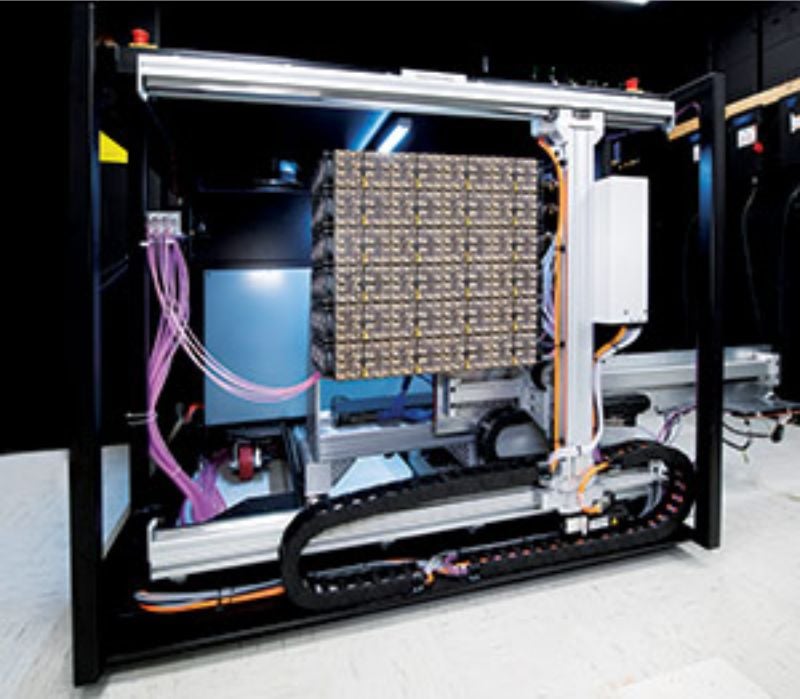
Testing space-based photovoltaic cells. Image used courtesy of Northrup Grumman
Japan made significant progress in SBSP technology by successfully demonstrating wireless power transmission using microwaves. The country has included space-based solar systems in its future space exploration vision and plans to conduct space-based tests soon.
Other notable SBSP participants include the United Kingdom, which has invested over £4 million in SBSP technology, aiming to supply up to a third of the U.K.'s energy within two to three decades. India is exploring SBSP as part of its emerging space program. Russia is involved in SBSP research and development, while the European Space Agency aims to lead a trillion-dollar SBSP industry.
Economic Viability
In moving toward viability, SBSP’s first cost consideration is efficiency. At present, solar panels are only 20-30 percent efficient at converting sunlight into electric power. In addition, the conversion of the electrical energy produced by the solar panels to microwaves and converting the microwaves back into electrical energy at the receiving end will also cause losses. The current estimates are that a SBSP system will have a total efficiency of about 5 percent. The European Space Agency estimates a total system efficiency of 10 to 20 percent will make the SBSP concept economically feasible. While there is work to be done, it isn’t a stretch to think overall system efficiency could be doubled.
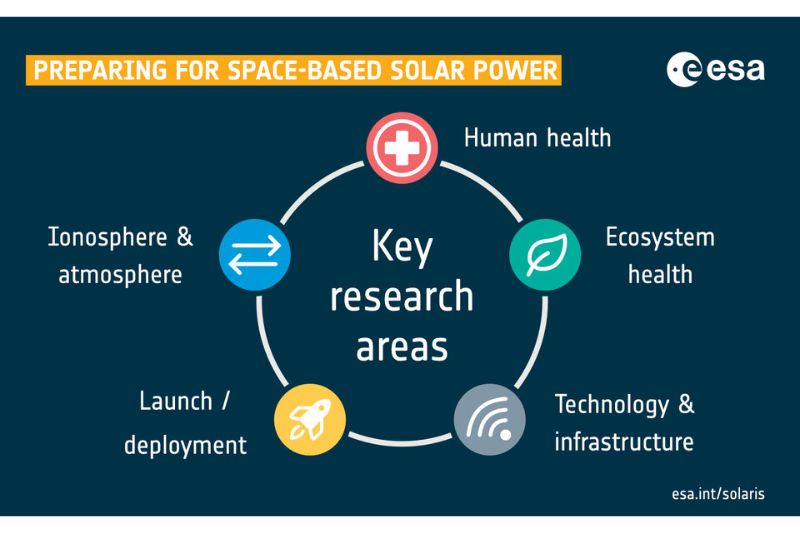
The European Space Agency research focuses on SBSP. Image used courtesy of ESA
Space-based solar power may be cheaper than nuclear or biomass energy by 2040, although it may still be more expensive than conventional solar or wind energy. Space Solar estimates its system will provide electricity at about one-quarter the current cost of nuclear power.
Traditional terrestrial solar farms cost approximately $0.98 per watt to build, resulting in a levelized cost of electricity (LCOE) of around $40-50 per megawatt-hour (MWh). LCOE is used to compare lifetime costs and generation output across different technologies. A lower LCOE typically results in lower average electricity prices. The LCOE for nuclear power is around $155 per MWh.
For SBSP, satellite launch costs account for about 70 percent of total system costs. Current estimates range from $1,000 to $6,000 per kg to place a satellite in orbit. This cost must decrease significantly—to around $200 to $400 per kg—for SBSP to be competitive.
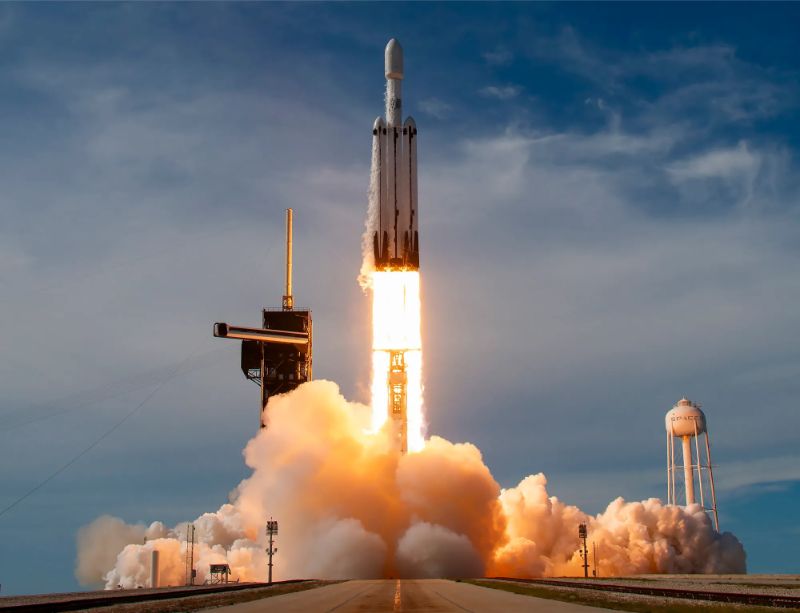
SpaceX satellite launch. Image used courtesy of NASA
On the ground, large-scale ground receivers will be needed, resulting in a high upfront capital cost on the order of $276 billion for a 2-GW system. Improvements in solar cell efficiency, hardware lifetimes, economies of scale, and learning curve effects as more systems are built will bring down the costs. Estimated costs to build a SBSP system are around $900,000 to $1,300,000 per megawatt, and NASA estimates an LCOE 12-80 times higher than terrestrial alternatives by 2050, while others say under the most optimistic scenarios, SBSP could potentially achieve cost parity with terrestrial renewables by 2050.
Challenges Ahead
Despite the progress exhibited in 2024, significant challenges remain:
- Infrastructure requirements: Each satellite needs to span at least one kilometer, with ground-based receiving stations requiring even larger areas.
- Technological advancements: Sophisticated autonomous robots will be needed for assembly and maintenance, and more efficient microwave transmission systems are required.
- High costs: NASA estimates the total project cost to exceed $280 billion.
Moving forward, improving transmission precision, addressing infrastructure challenges, and improving solar panel and microwave transmission efficiencies will be crucial in determining space-based solar power viability on a larger scale.