Facebook
 Google
 GitHub
 Linkedin
Wolfspeed Launches 1200 V SiC Six-Pack Power Modules Targeting E-Mobility
The Gen-4 modules aim to increase current capability and extend e-mobility inverter lifetime.
Wolfspeed has released 1200 V silicon carbide (SiC) six-pack power modules built on Wolfspeed’s YM automotive-qualified K-Pack module line, which integrates SiC MOSFETs into a direct-cooled pin-fin baseplate structure. Designed for high-power inverter platforms in e-mobility propulsion systems, the modules aim to improve power-cycling capability and provide 15% higher inverter current capability at operating temperature compared to the competition.
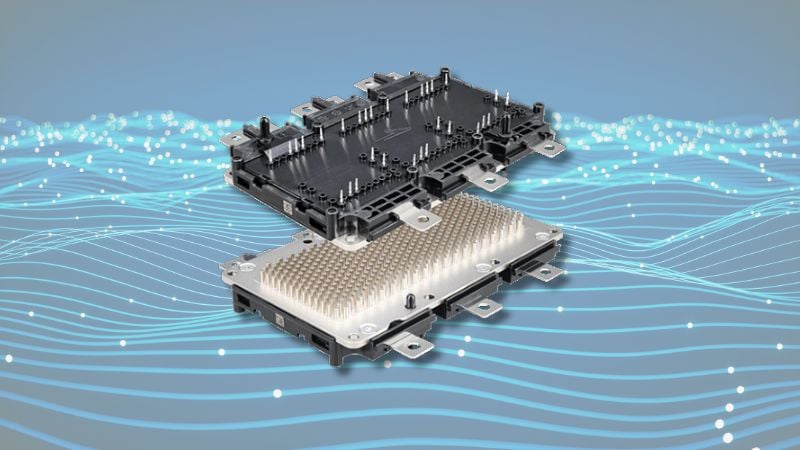
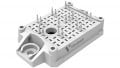
Wolfspeed’s new YM Six-Pack module. Image used courtesy of Wolfspeed
YM Six-Pack SiC Modules: Electrical Performance
Wolfspeed’s 1200 V six-pack SiC modules combine the company’s latest Gen 4 MOSFET technology with the YM package architecture. Wolfspeed claims the devices achieve three times as many power cycles at their rated operating temperatures as the best-in-class competitor modules with a similar footprint.
The enhanced cycling capability results from several packaging changes, including sintered die-attach layers, copper clip interconnects, and an epoxy encapsulation system. Each element is intended to reduce thermo-mechanical fatigue and stabilize electrical contact resistance over repeated thermal excursions.
The major upgrades to this module all come in the form of energy savings. For starters, the modules provide a 22% reduction in RDS(on) at 125°C relative to Wolfspeed’s previous generation. This specification is important because lower channel resistance at high temperature directly relates to conduction losses during high-load operation.
Wolfspeed also reports a ~60% reduction in turn-on energy (EON) across operating temperatures, which results from Gen 4 MOSFET charge-carrier dynamics and packaging parasitic reduction. Similarly, the modules incorporate a soft-body diode structure that produces 30% lower switching losses during reverse conduction and cuts VDS overshoot by about 50% during reverse-recovery events when compared with the company’s prior generation.
The fourth-generation solutions will come in multiple 1200 V variants, including operating currents (IT) of 300 A, 450 A, 600 A, or 700 A. With these options and capabilities, the company states that the new modules can be direct replacements for IGBT-based assemblies within existing inverter housings.
Woflspeed’s Approach to Power Cycling
Power cycling is particularly important for silicon carbide devices because SiC fundamentally changes the mechanical stress landscape inside a power module. Unlike silicon, SiC has a much higher thermal conductivity and a significantly higher Young’s modulus. These traits improve electrical performance but also intensify the forces that develop as temperatures rise and fall.
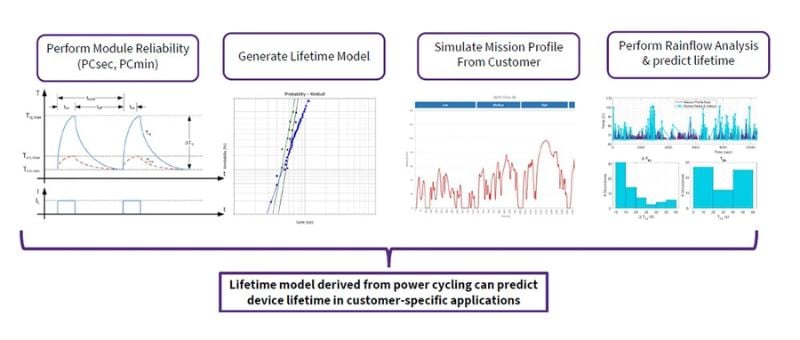
Power module lifetime modeling process. Image used courtesy of Wolfspeed
Rapid heat flow creates steeper internal temperature gradients, and the stiffer material transfers larger mechanical loads to surrounding layers. As a result, SiC modules experience more severe thermo-mechanical strain under identical operating conditions.
And, because SiC devices operate at higher temperatures and switching speeds, they expose packaging structures to stresses not typically captured by legacy qualification standards designed around silicon. Woflspeed’s white paper notes that a module may pass all conventional reliability tests yet fail prematurely when faced with the mission-specific conditions characteristic of SiC-based systems. These elevated stresses make it important to understand how SiC modules respond to repeated thermal excursions, especially in applications where devices may cycle thousands of times per day.
Power cycling testing directly addresses this gap by recreating the thermal pulses that occur during acceleration, braking, inverter ramping, and high-frequency switching, which impose the most demanding conditions on mechanical interfaces. Therefore, it becomes a proxy for real-world lifetime.
Design Opportunities for E-Mobility Inverters
Wolfspeed’s modules offer system designers an opportunity to revisit inverter operating points and cooling strategies. With substantially lower switching energies and reduced diode recovery stresses, the devices may support architectures that prioritize higher switching speeds or tighter thermal envelopes. Customer sampling is already underway, with distributor availability expected in early 2026.