Facebook
 Google
 GitHub
 Linkedin
Weidmuller Power Supplies Target Industrial Power Distribution
The second-generation PROeco II line focuses on high efficiency for automation and process industries.
Weidmuller has introduced a series of power supplies emphasizing dependable, high-efficiency power distribution across a range of industrial settings. Dubbed the PROeco II and building on the original PROeco line, these second-generation units may offer improved electrical performance and installation flexibility as a scalable solution for OEMs and system integrators.
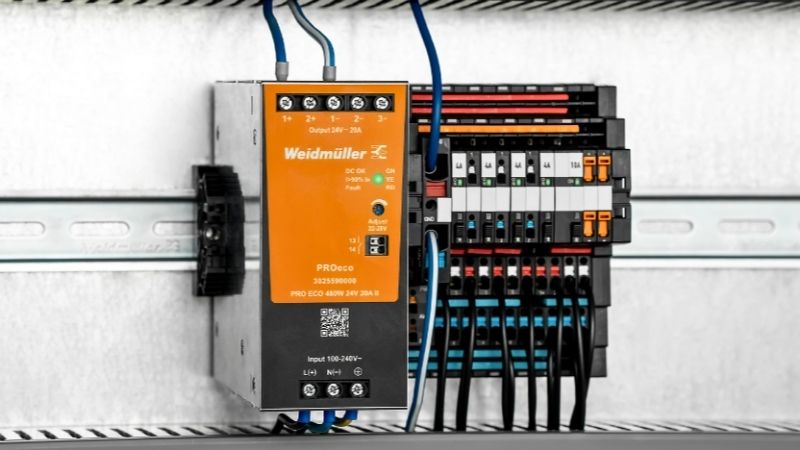
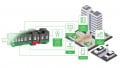
The Weidmuller PROeco II line. Image used courtesy of Weidmuller
PROeco II Performance and Characteristics
According to Weidmuller, the PROeco II line strongly emphasizes electrical efficiency and durability. With conversion efficiencies reaching up to 95% and idle power consumption kept “extremely low,” the power supplies aim to reduce operating costs and thermal strain on surrounding components.
Designed for field performance, each unit in the PROeco II series can start at ambient temperatures as low as -40°C, whereas the upper bound of the temperature range is not currently available. The series supports input voltages from 85-264 VAC or 110-370 VDC for single-phase units, and 3 × 320-575 VAC or 450-800 VDC for three-phase models. It offers nominal DC outputs of 24 V or 48 V. It spans current capacities from 3 A to 40 A, delivering output power from 72 W to 960 W. All models support parallel operation of up to three units and include relay contacts and LED indicators for real-time DC OK status monitoring. Mean time between failure (MTBF) exceeds one million hours across the range.
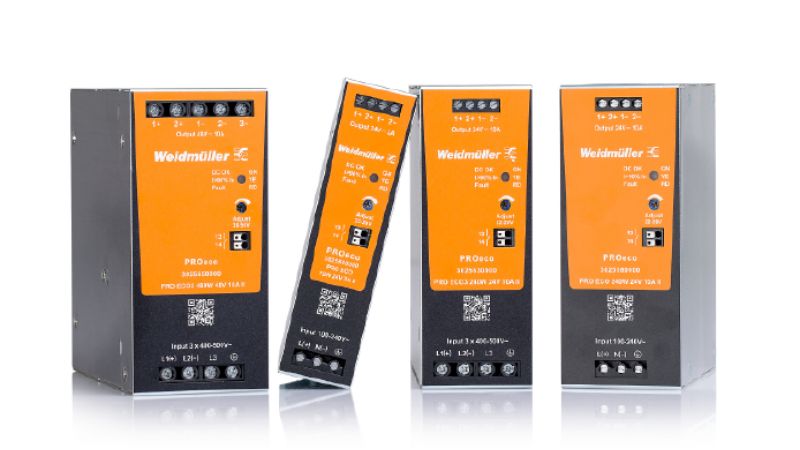
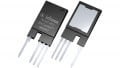
The PROeco II series. Image used courtesy of Weidmuller
Space efficiency is another clear focus of this product line. For example, the narrowest PROeco II model measures just 32 mm in width and 100 mm in depth, which the company claims is a 15% space reduction from the previous generation, freeing up DIN rail real estate for other control components. Global certifications include CE, cULus, UKCA, and IECEE CB Scheme.
MTBF in Industrial Supplies
Thermal stress and component quality, tightly coupled to electrical and environmental operating conditions, primarily influence MTBF in industrial power supplies.
A significant MTBF determinant is internal temperature rise, which directly affects electrolytic capacitors and semiconductors’ aging rate. The Arrhenius equation predicts that for every 10°C increase in operating temperature, many components’ failure rate nearly doubles. Designs minimizing power dissipation through high-efficiency conversion topologies and low-loss magnetic materials can substantially extend MTBF by reducing the thermal load on critical components.
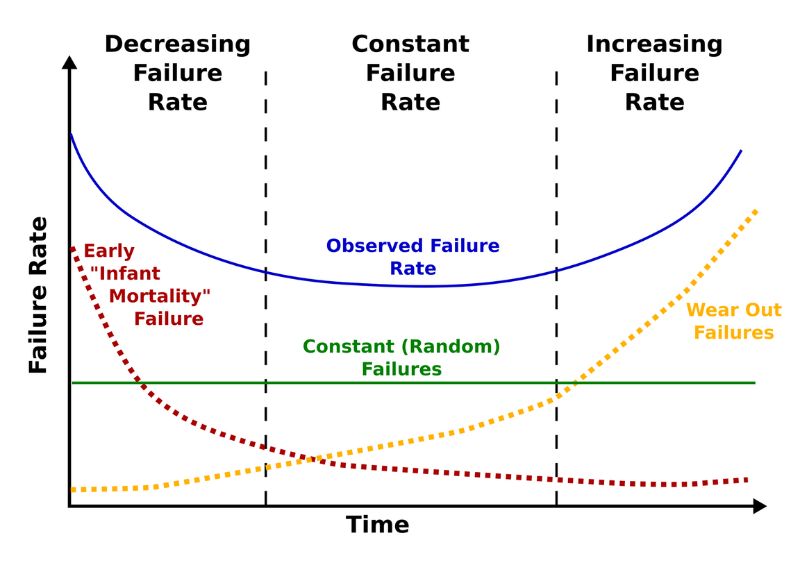
The “bathtub” curve of device failure. Image used courtesy of Wikimedia Commons
Component selection also has an impact. Capacitors with higher temperature ratings and longer endurance specifications significantly improve statistical reliability models. Similarly, using MOSFETs and diodes with low reverse recovery times and high avalanche energy ratings improves resilience under transient load conditions. Derating, or intentionally operating components below their rated voltage, current, and thermal limits, further contributes to MTBF by lowering the electrical stress imposed during normal operation.
A final factor is load profile. Operating the power supply at or near its rated maximum output introduces cyclic thermal and electrical stress that accelerates fatigue mechanisms in solder joints and thin-film substrates. Designs incorporating current sharing or parallel operation capabilities must precisely manage current balancing, as unequal loading can lead to localized overheating and component degradation.
Quantifying MTBF typically involves statistical analysis based on component failure rates derived from established databases (e.g., MIL-HDBK-217F or Telcordia SR-332). However, these projections assume stable environmental parameters, while real-world installations experience deviations from nominal conditions and can markedly reduce actual field reliability.
Durable Industrial Infrastructure
As automation systems continue to grow more compact and interconnected, Weidmuller hopes that PROeco II’s mix of performance and durability makes it a competitive choice for power engineers. The power supplies are currently available through Weidmuller’s distribution network and online catalog.
Related Content