Facebook
 Google
 GitHub
 Linkedin
Toshiba Intros Quad-Channel Digital Isolators For Industrial Use
Toshiba has expanded its digital isolator line-up with the DCL54xx01A series, delivering data rates up to 150 Mbps, a 150 kV/μs CMTI rating, and operation up to 125°C.
Isolators rated for standard 85°C or 105°C operation often become the limiting component in industrial control cabinets, where switching power stages and motor drives push ambient temperatures well past what consumer-grade parts can handle.
Toshiba Electronic Devices & Storage Corporation has launched a series comprising ten quad-channel digital isolators, the DCL54xx01A family, rated for 125°C operation and data rates up to 150 Mbps. These can raise the ceiling for designers working on industrial equipment such as PLCs, motor drives, and switching power supplies.
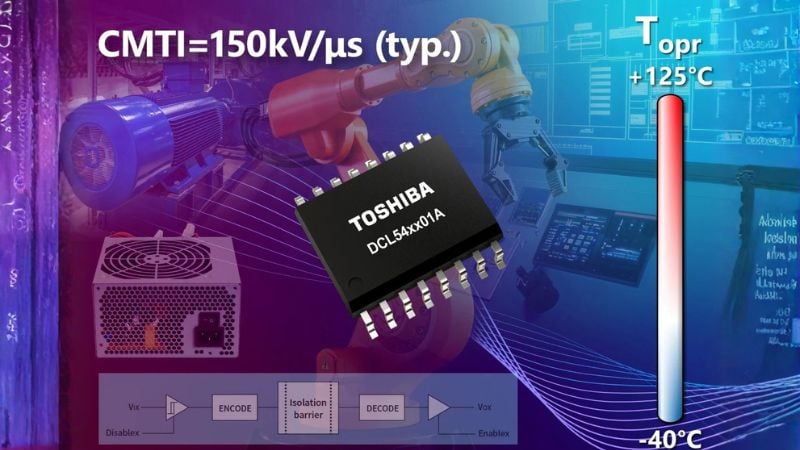
The DCL54xx01A series targets motor control, industrial power supplies, and other high-noise industrial equipment. Image used courtesy of Toshiba
Built for Heat and Noise
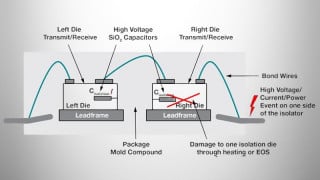
Digital isolators provide galvanic isolation between low-voltage control circuitry and higher-voltage power stages, eliminating any direct conductive path across the barrier. That's a basic requirement in equipment like PLCs, motor controllers, and inverters, where a fault on the power side shouldn't be able to reach back and damage the control logic. The catch is that industrial environments are electrically noisy. Fast-switching power devices generate common-mode transients that can corrupt data crossing an isolation barrier if the isolator isn't built to reject them.
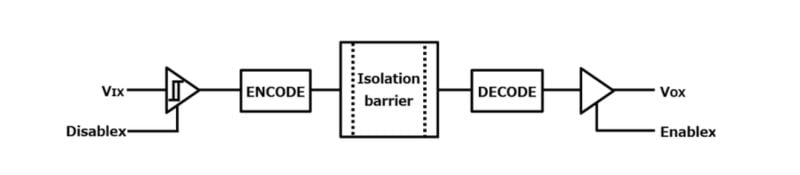
Simplified internal architecture of the DCL54xx01A. Image used courtesy of Toshiba
The DCL54xx01A series uses its magnetic-coupling isolation technology to hit a typical common-mode transient immunity (CMTI) rating of 150 kV/µs, which should help the parts maintain signal integrity even sitting next to a noisy switching power stage.
Sizing Up the Specs
On the electrical side, the parts run from a supply voltage of 2.25 V to 5.5 V and are rated for 5000 Vrms isolation for a full minute. The series offers a typical propagation delay of just 10.9 ns and pulse-width distortion of 0.8 ns, tight enough to reduce concerns about timing skew in most control-loop applications.
The full temperature range is from -40°C to +125°C, and the devices ship in an SOIC16-W package, a footprint already common across industrial isolator families, enabling easier drop-in replacement for existing designs.
Filling Out the Isolator Lineup
The series comes in three channel-direction configurations—4:0, 3:1, and 2:2—so designers can match the part to the amount of data that needs to flow in each direction across the barrier, rather than wiring around a fixed configuration.
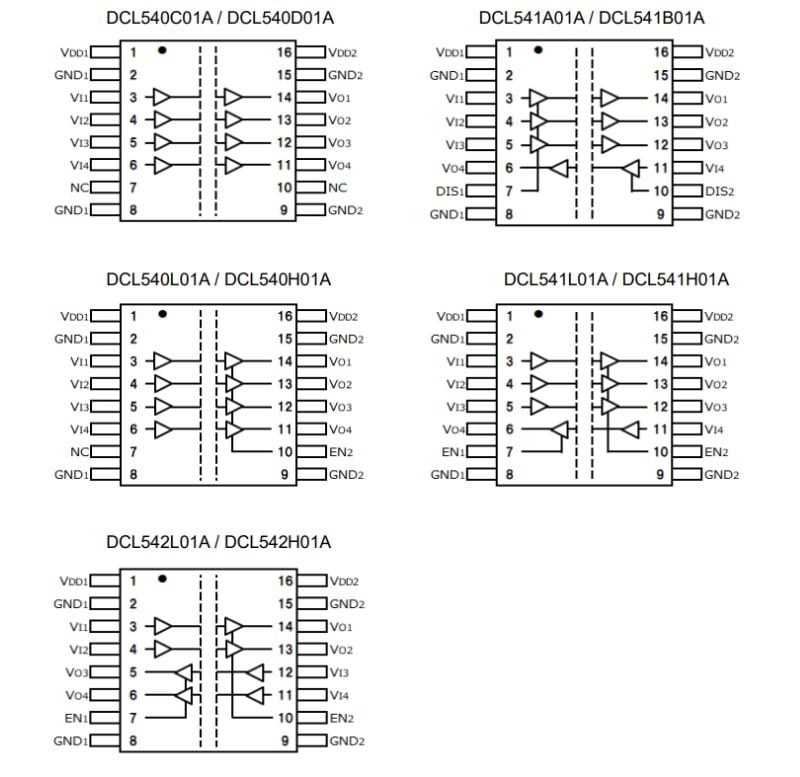
Pin configurations showing the five available channel-direction variants. Image used courtesy of Toshiba
Toshiba also offers variants with different default output states, which determine whether a channel's output holds high or low if its input pin is left floating while both supplies remain powered, along with separate enable-control options.
These new parts sit above Toshiba's existing DCL341x0B series, which tops out at 25 Mbps in a smaller SSOP16 package. Between the two families, Toshiba now covers a wider spread of speed, package size, and temperature rating, useful when an industrial platform needs isolators for both a fast fieldbus interface and a slower auxiliary signal on the same board.
Certification, Layout Notes, and Applications
The DCL54xx01A family carries UL 1577 and cUL certifications, with VDE approval under DIN EN IEC 60747-17 listed as planned. The datasheet also specifies a minimum external clearance and creepage distance of 7.6 mm, and calls out a firm layout requirement: a 0.1 µF decoupling capacitor must sit within 10 mm of each side's supply and ground pins, or the device may not switch correctly.
Target applications named in the announcement include PLCs, I/O interface modules, motor control systems, inverters, and switching power supplies, essentially the core building blocks of factory automation gear.
Full specifications and part-number options for the DCL54xx01A series are available on Toshiba's product page.
Looking Ahead
The 125°C rating is the detail worth watching here. As more industrial power stages move to SiC and GaN devices, which switch faster and operate at higher junction temperatures than legacy silicon, the isolators next to them are under growing pressure to keep up on both noise immunity and thermal margin.
Expect isolator vendors to keep pushing operating temperature and CMTI ratings upward together, since one without the other doesn't solve the actual problem designers are running into on the factory floor.