Facebook
 Google
 GitHub
 Linkedin
Toshiba Adds Dual Comparator for Industrial Overcurrent Detection
The TC75W series features faster propagation delay and targets robots, PV inverters, and UPS systems with rail-to-rail input/output and 1.8 V minimum operations.
Toshiba Electronic Devices & Storage has extended its TC75W series of CMOS dual comparators with the TC75W71FU, a small-signal device aimed at overcurrent detection in industrial equipment.
The part pairs faster propagation delay with a full rail-to-rail input and output range and a minimum operating supply of 1.8 V, a combination that Toshiba is positioning for designers of industrial robots, photovoltaic (PV) string inverters, uninterruptible power supplies (UPS), and instrument transformers.
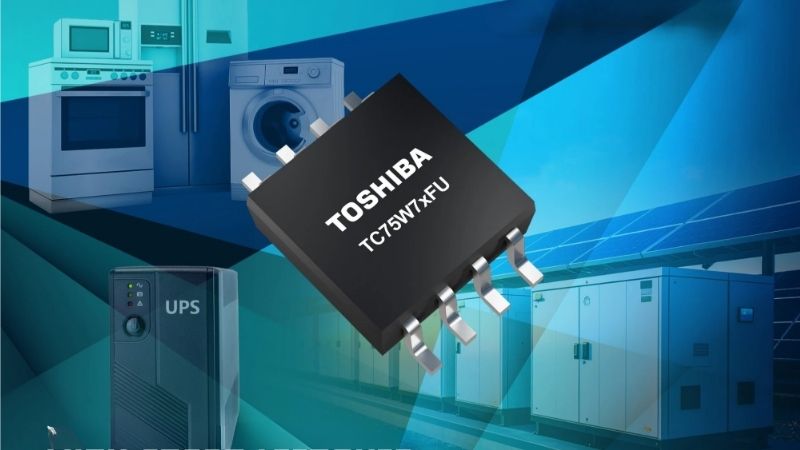
TC75W series. Image used courtesy of Toshiba
Comparator Speed and Overcurrent Protection
Overcurrent events in switching power stages are violent and short. When an industrial servo drive detects a shorted winding, or a PV string inverter encounters a shoot-through across its half-bridge, the fault current can rise from nominal to destructive in well under a microsecond.
The comparator sitting on a shunt or current-sense transformer has a simple job: flip its output the moment the sensed voltage crosses a reference threshold so the gate driver or controller can safely pull the transistors off.
In practice, propagation delay is what separates a clean shutdown from a blown SiC MOSFET. A general-purpose op-amp pressed into comparator duty can take several microseconds to slew, by which point the fault energy has already been deposited into the silicon.
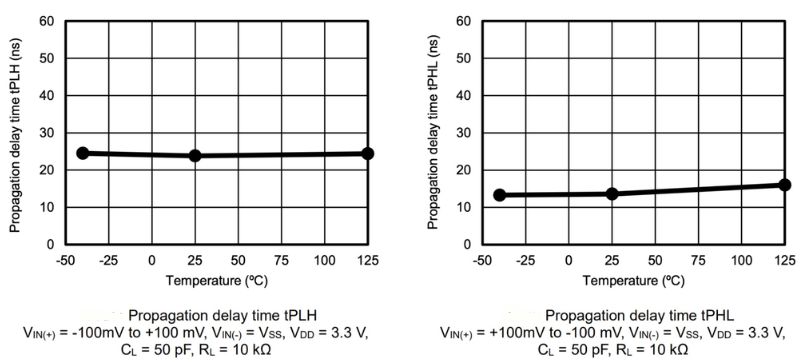
Propagation delay time. Image used courtesy of Toshiba
Dedicated CMOS comparators in the TC75W class respond in tens of nanoseconds, giving the rest of the protection chain enough margin to act before the SOA boundary is crossed. That speed also lets designers tighten the overcurrent threshold without nuisance tripping, which, in turn, can allow smaller, cheaper power semiconductors for the same fault tolerance.
Industrial current sensing often happens close to the negative rail (low-side shunt) or near the positive rail (high-side shunt with a level shifter). A comparator that can only see signals a volt or two away from each rail forces the designer to add bias networks that eat headroom and add error. A rail-to-rail input stage removes that constraint, and a rail-to-rail output stage means the digital fault flag can swing cleanly into a 3.3 V or 5 V logic input without an external pull-up network.
Inside the TC75W71FU
According to Toshiba, the TC75W71FU achieves a maximum propagation delay of 45 ns for low-to-high transitions and 30 ns for high-to-low transitions, compared with 550 ns and 250 ns, respectively, for the existing TC75W56FU.
Toshiba states that the speed increase is intended to allow industrial systems to shut down immediately during an overcurrent event and improve operational safety. The device offers a full rail-to-rail input and output range, allowing operation from GND up to VCC, and supports a minimum operating supply voltage of 1.8 V, with a specified supply range of 1.8 V to 5.5 V and a junction-temperature range of -40 to 125 C.
The comparator pair is housed in an SOT-505 (SM8) package, which could suit both industrial and consumer applications, including home appliances and power supplies.
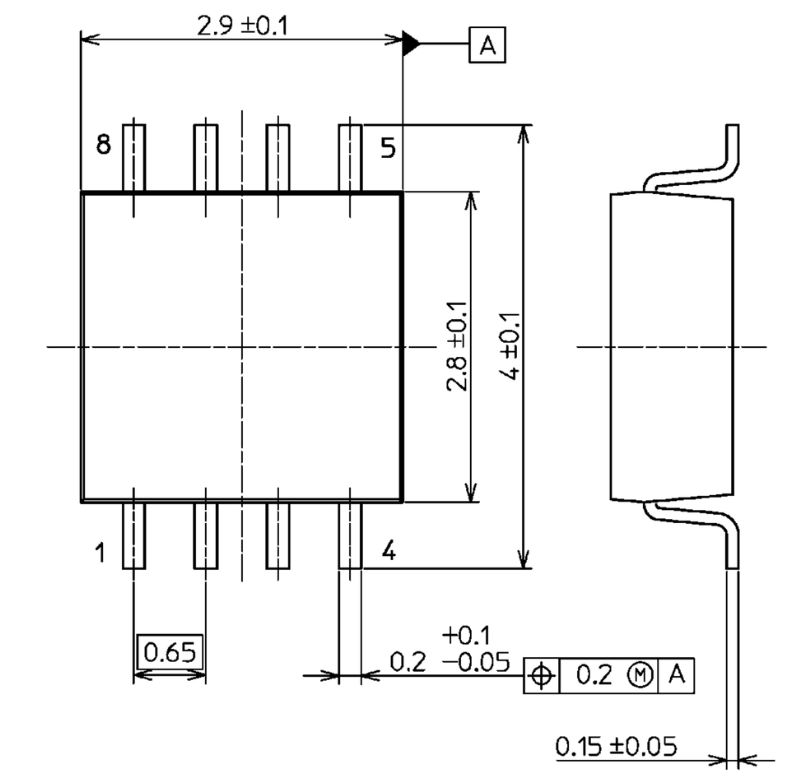
Package dimensions. Image used courtesy of Toshiba
The dual-channel layout puts two independent comparators in a single package, useful for monitoring both polarities of a bidirectional shunt or for implementing a two-level "warning plus trip" scheme on a single current sense.
Toshiba has also outlined two follow-on parts in the same series: the TC75W72FU, which adds increased hysteresis for better noise immunity, and the TC75W73FU, which adds hysteresis plus an open-drain output so the comparator can drive signals into voltage domains outside its own supply rail.
Robots, PV, UPS, and Transformers
In an industrial robot, a comparator of this class typically sits on the DC-bus shunt or on each phase shunt of the servo inverter, providing a hardware-fast trip path that runs in parallel with the MCU's ADC-based current loop. A faster comparator response shortens the time the IGBT or SiC stage spends in fault, a major contributor to long-term reliability degradation under repeated overload cycles.
PV string inverters and UPS systems share a similar topology and a similar problem: large electrolytic or film capacitors on the DC bus that can dump enormous fault energy into a shorted switch.
The 1.8 V minimum supply matters here because the auxiliary control rail in a UPS is often derived from the battery string and can drop well below 5 V during a deep discharge before the inverter cleanly shuts down. A comparator that keeps working at low rails keeps the protection circuit alive precisely when it is most needed.
For instrument transformer monitoring, the TC75W71FU's rail-to-rail input is the relevant feature, allowing direct comparison of low-level secondary signals against a programmable threshold without a level-shifting front end. Toshiba says it will continue to expand the TC75W lineup to address a wider range of customer needs.