Facebook
 Google
 GitHub
 Linkedin
TDK Upgrades 3-Phase DIN-Rail Mount Power Supply Series
The DRB models offer expanded AC/DC input ranges, reinforced isolation, and coated PCBs.
TDK has improved the functionality and performance of its TDK-Lambda DRB series of AC-DC power supplies.
The upgraded three-phase DIN rail models now span output power levels from 120 W to 960 W, with an extended nominal AC input voltage range of 380 to 500 V and a DC input range of 450 to 810 V. The power supplies are intended for solar panels, batteries, and other rectified bus voltage applications.
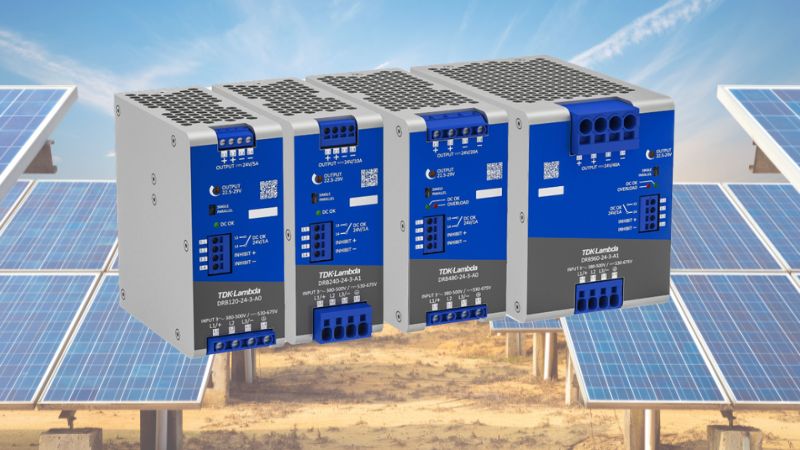
The DRB series power supplies. Image used courtesy of TDK
Power Supply Expanded Capabilities and Electrical Design
TDK’s enhanced DRB120-3 to DRB960-3 power supplies retain the original functional range of 120 to 960 W while introducing several technical improvements.
Each unit now accommodates a broader AC input range of 380 to 500 VAC (±10%) and a DC input range of 450 to 810 VDC, with input surge handling up to 620 VAC for 5 seconds. Whereas the models were originally confined geographically, the new input ranges augment their capabilities to operate in regions such as China, Africa, and South America.
The series offers output voltages of 12, 24, 48, or 72 V with peak power ratings up to 150% of nominal for durations between 5 and 600 seconds, depending on model. For instance, the DRB960-24-3 delivers 1440 W peak for 5 seconds. Efficiency levels reach up to 96.3%, with minimal no-load power consumption of 1.6 W in standby mode.
The upgraded DRB series also introduces UL 2231-2 compliance through reinforced 6.5 kVDC isolation between primary and secondary sides, up from previous models’ 3.51 kVDC ratings. Coated PCB models (-A6 and -A7 suffixes) further extend deployment options to meet IEC 60068-2-60 and IEC 60068-2-11 standards for operating in environments with corrosive gases and salt mist. Other mechanical attributes include aluminum casing, DIN TS-35 rail compatibility, and operating temperature ranges from -25°C to +70°C with derating.
Balancing Peak Load Handling with Operating Efficiency
Designing power supplies to handle short-duration transient loads involves a clear tradeoff. In many industrial systems with capacitive input circuits, for example, sudden inrush currents or brief power surges are common. To maintain stability, the power supply is designed to deliver more than its rated output without causing voltage dips or triggering protection mechanisms. However, building in too much headroom for these rare events can hurt the system’s efficiency during regular operation.
One solution is for designers to include headroom in their designs. For example, they might select a power supply rated for higher output than the system typically requires. While this strategy will improve reliability during startup surges or load steps, it can also lead to lower efficiency during standard operation, as the supply may run well below its optimal load point. The extra margin also adds cost and size, which must justify the application’s transient profile and uptime requirements.
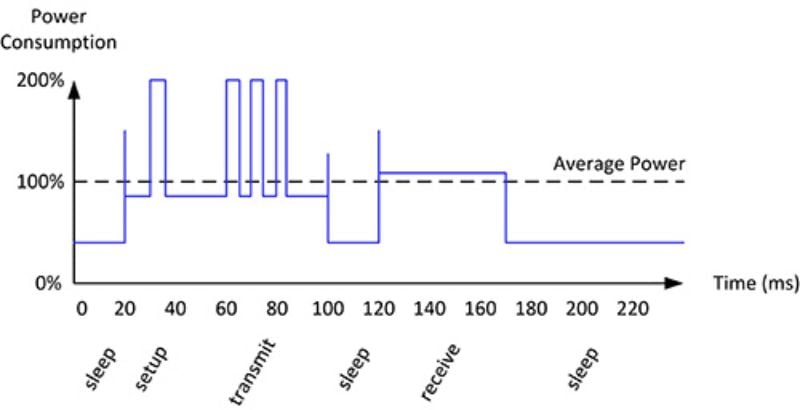
Peak versus average power demands from a load. Image used courtesy of Recom
Another technique is implementing fast-response control loops that maintain output voltage stability via current-mode or digital feedback. Designers should carefully tune the associated compensation networks so the control loop maintains stability during fluctuations. However, the tuning process can also introduce tradeoffs, such as increased switching noise or higher quiescent power consumption during steady-state operation.
To better handle peak loads, designers might also turn to faster PWM controllers and low-resistance MOSFETs that, while effective, can similarly lead to slightly lower efficiency under normal operating conditions due to greater switching losses.
Ultimately, optimizing for both peak load tolerance and operational efficiency comes from a nuanced understanding of the system’s load profile. Designers must consider worst-case scenarios and transient events' statistical frequency and duration.
Outlook and Availability
TDK has already begun distributing the new DRB models, with a full transition to the upgraded product line expected by the end of 2025.