Facebook
 Google
 GitHub
 Linkedin
ST Rolls Out Battery Management IC for Lithium Packs Up to 10 Cells
The L9962 integrates cell monitoring, balancing, protection, and a 3.3-V LDO in a 7 mm x 7 mm package and draws just 2 uA in deep sleep
STMicroelectronics has released the L9962, a lithium battery-management IC designed for portable equipment, light electric vehicles, and backup energy storage systems.
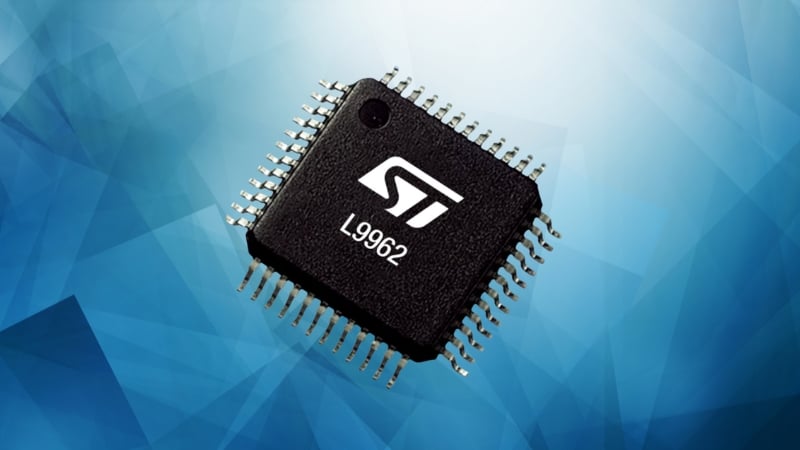
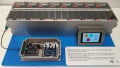
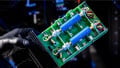
The L9962.
The chip handles cell monitoring, passive balancing, overcurrent protection, and thermal management for packs containing four to ten series-connected Li-ion or Li-polymer cells, while integrating enough ancillary functions to meaningfully reduce external component count in battery-pack designs.
Precision Monitoring With Ultra-Low Standby Power
At the core of the L9962 is a 12-bit analog-to-digital converter that continuously measures individual cell voltages on a programmable loop cycle. The host system can configure the voltage-measurement interval via the device's I2C interface and read back state-of-charge and state-of-health data from the same bus. A high-accuracy current-sense amplifier enables stack-current measurement using Coulomb counting, achieving 0.25% accuracy across the full operating temperature range. That precision lets the host microcontroller maintain reliable fuel-gauge calculations even as the battery pack ages and cell characteristics drift.
Products that spend extended periods in transit or storage need their management circuitry to stay out of the way. The L9962's standby current drops to 5 uA, while deep-sleep mode pulls just 2 uA—figures that matter, among other things, for medical devices such as portable defibrillators, where a battery pack sitting on a shelf for weeks or months can't afford significant self-discharge from its own BMS. The integrated 3.3-V low-dropout regulator, which powers external components such as the host microcontroller and indicator LEDs, remains active in standby mode so the system can resume operation quickly without a cold-start sequence.

Block diagram of the L9962.
Cell balancing activates automatically when the L9962 detects overvoltage or undervoltage conditions on individual cells, applying a 70-mA balancing current to bring cells back into alignment. Balancing can be simultaneously activated on all cells. A plausibility check compares total stack voltage against the expected sum based on the number of cells, adding an extra layer of data integrity to catch wiring faults or measurement anomalies.
Integrated Protection and Reduced External Circuitry
The L9962's built-in protection covers major failure modes. Overcurrent detection monitors both charge and discharge paths, while a dedicated short-circuit discharge protection circuit responds quickly to catastrophic fault conditions. Thermal monitoring uses an external NTC thermistor for ratiometric over-temperature and under-temperature detection, and integrated battery-pack fuse management adds a final layer of safety against fire and explosion hazards.
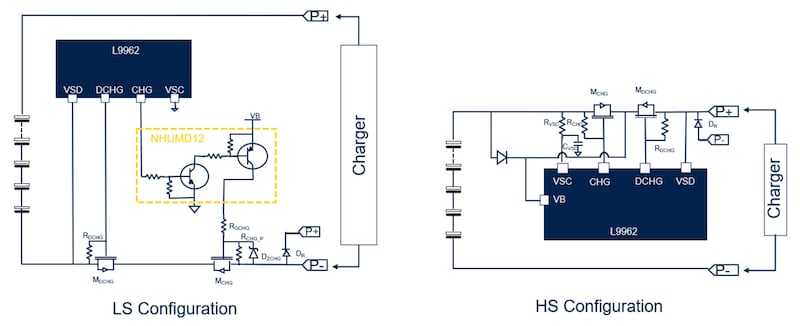
Application circuit in LS/HS configurations.
Several of these integrated functions directly replace external components that a discrete BMS design would otherwise need. Configurable high-side and low-side pre-drivers also manage battery-pack safety relays without additional driver ICs, while the onboard 3.3-V LDO eliminates the need for a separate voltage regulator to power the system microcontroller. Additionally, the integrated current-sense amplifier replaces external sensing circuitry, simplifying the overall board layout and reducing bill-of-materials cost.
The L9962 comes in a 48-pin TQFP package measuring 7 mm x 7 mm and supports single-point production-line calibration to streamline manufacturing. Target applications include cordless power tools, medical devices, e-bikes, scooters, and UPS units.
Expanding on the L9961 Foundation
The L9962 builds on STMicroelectronics' earlier L9961 BMS controller, which supports packs up to 25 V in a smaller 32-lead VFQFPN package. The L9962 extends cell support to ten series-connected cells, broadening the addressable voltage range for applications like light electric vehicles and higher-capacity power tools that need more cells in series.
Both devices share a common design philosophy of integrating enough analog and protection functionality to minimize external component count. The L9962's expanded cell range, larger package, and higher balancing current push it into applications with higher pack voltages and energy densities, where cell imbalance has more severe consequences.
All images used courtesy of STMicroelectronics.