Facebook
 Google
 GitHub
 Linkedin
Saft Launches New Generation Li-ion Cell
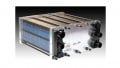
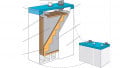
Saft announced the latest addition to its MP series of prismatic rechargeable Li-ion (lithium-ion) cells, a new generation, upgraded MP 176065 that is claimed to set new standards for cycle life, capacity and energy density.
The new MP 176065 has been designed specifically for ease of integration within the vast array of rechargeable battery packs required by modern military and professional applications. Its shape, terminals and safety features facilitate either parallel or series connection, while minimizing pack assembly costs and increasing reliability because cell-to cell wiring is reduced or, for many applications, eliminated completely. Electronic protection circuits provide monitoring of the health of individual cells within battery packs.
The cell is a major upgrade of the largest cell in the MP series, the standard MP 176065. It offers a useful increase in capacity to 7.0Ah (up from 6.8Ah). However, the most important benefit is a 20% increase in cycle life to 600 cycles (compared with 500 cycles) – after which the cell will still offer 70% of its original capacity. The cell is 6% lighter than its predecessor – a saving of 10g. This enables it to offer an increased energy density of 180 Wh/kg (up from 165 Wh/kg), and 385 Wh/l (compared with 375 Wh/l). The MP 176065 cell's improvements in cycle life and energy density have been achieved by a new aluminum casing that replaces the stainless steel design, together with optimization of the electrode loading and electrolyte composition. The new cell continues to be chargeable up to 4.2V ± 0.05V, at temperatures anywhere between -20 and +60°C, and at rates up to C. The cell can be discharged over a wide temperature range from -50 to +60°C, with continuous discharges up to 2C, and current pulses up to 4C.
The MP 176065 cell is UL1642 recognised and is completely maintenance free, and hermetically sealed at temperatures up to +75°C. It is designed to withstand the most common field abuses, such as mechanical shock and vibration, as well as external short-circuit, crushing, nail piercing and so on. The cell is intended to meet the needs of a wide variety of demanding, highperformance military, medical and industrial applications. Volume production will begin at the start of 2007 at Saft's dedicated Li-ion cell facility in Poitiers, France. Samples are already available on request.