Facebook
 Google
 GitHub
 Linkedin
Rohm Adds High-Accuracy Sense Apps for High-Voltage Designs
The BD1423xFVJ-C and BD1422xG-C series current sense amplifiers offer design simplicity for electric vehicle and other automotive systems.
As the automotive sector accelerates adoption of both 48 V architectures and more compact electronics, modern power delivery systems, especially in electric and hybrid vehicles, will need precise current control to maintain safety and efficiency.
Rohm has introduced two automotive-grade current sense amplifier families aimed at improving voltage tolerance and simplifying circuit integration.
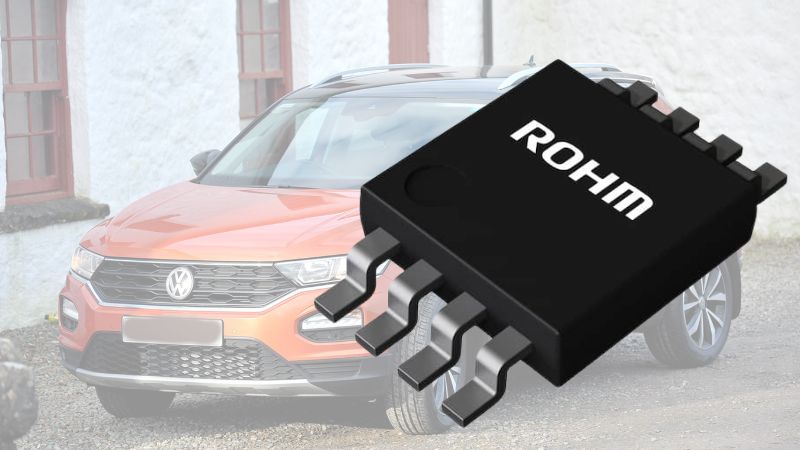
Rohm’s new sense amplifier for automotive use. Image used courtesy of Rohm
BD1423xFVJ-C and BD1422xG-C Series
Rohm’s new families are the BD1423xFVJ-C and BD1422xG-C, which target high-voltage environments and space-constrained, lower-voltage domains, respectively.
The BD1423xFVJ-C series supports common-mode input voltages from -14 V to +80 V, which puts it in the sweet spot for 48 V systems. Packaged in a TSSOP-B8J format, this series offers three gain options, 20 V/V, 50 V/V, and 100 V/V, through models BD14230FVJ-C, BD14231FVJ-C, and BD14232FVJ-C. These devices operate with a supply voltage from 2.7 V to 18 V and consume 300µ A (typical). Each variant provides a gain accuracy of ±1.0% and offset voltage within ±0.5m V so that high-fidelity current measurements can be made even under thermal variations.
For lower voltage automotive domains, the BD1422xG-C series covers input voltages from -14 V to +40 V and is offered in a compact SSOP6 package. Models BD14220G-C, BD14221G-C, and BD14222G-C also provide gains of 25 V/V, 50 V/V, and 100 V/V, respectively. These components draw 240µA (typical), support a 2.7 V to 5.5 V supply, and maintain similar gain and offset specifications as their high-voltage counterparts.
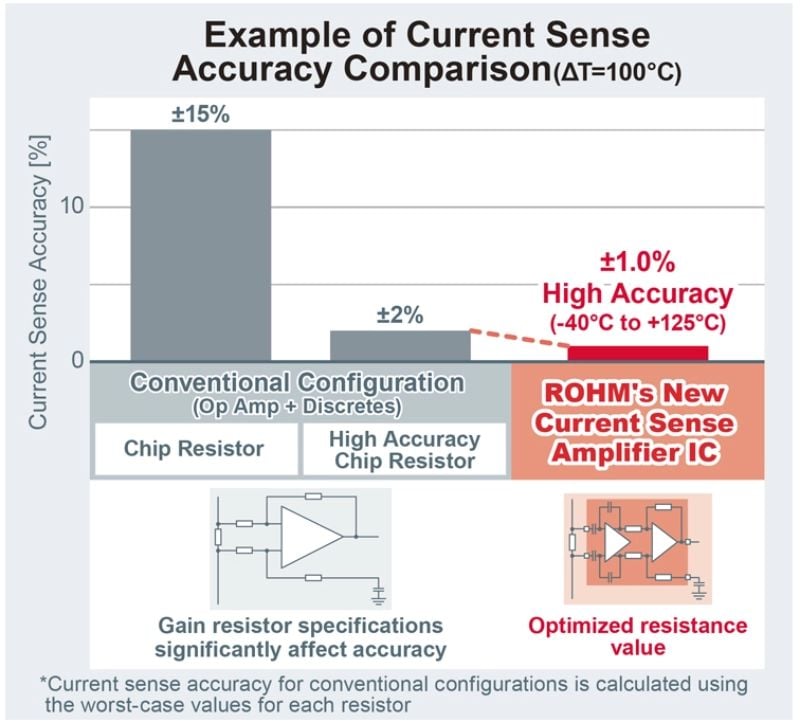
Example of current sense accuracy comparison. Image used courtesy of Rohm
Both series employ a dual-stage amplifier architecture with a chopper amp for the input stage and an auto-zero amp at the output. This configuration minimizes offset and ensures stable operation across temperature shifts. Integrating the primary sensing circuitry into a single package. Rohm simplifies board design as designers only need to connect a shunt resistor for accurate current detection.
Chopper and Auto-Zero Amplifiers in Precision Sensing
Current sense amplifiers frequently grapple with maintaining signal integrity amid low input voltages and environmental noise. Chopper and auto-zero amplifier topologies address this by offering high common-mode rejection and low offset characteristics.
A chopper amplifier modulates the input signal to a higher frequency, where low-frequency noise and DC offset are less impactful. After amplification, the signal is demodulated back, preserving its original characteristics while significantly reducing the influence of low-frequency disturbances and 1/f noise. This makes chopper amplifiers particularly effective for amplifying minute voltage drops across shunt resistors, which are typical in current sensing applications.
Auto-zero amplifiers function by periodically sampling and correcting offset voltage. They capture internal offset errors during a calibration phase and subtract these from the amplified signal in real-time. This mechanism maintains consistent accuracy over time and temperature.
Combined in a two-stage topology, chopper and auto-zero amplifiers provide real-time noise suppression and long-term stability.
Targeted for Automotive Architectures
By combining a wide input range with tight gain and offset tolerances, Rohm’s new devices facilitate reliable and consistent current monitoring despite electrical noise or temperature variation. Products and evaluation boards are available.