Facebook
 Google
 GitHub
 Linkedin
Pickering Launches LXI High-Current Switching Unit for Automated Test
The LXI-based switching platform provides a standardized 4U rack-mountable alternative to custom contactor assemblies for high-drain power supply testing and validation.
Pickering Interfaces has announced what it’s calling its highest-capacity switching product to date, the 60-191 LXI high-current and sense single-pole single-throw (SPST) switching family. Designed to route signals up to 80 A and 300 V, the new hardware streamlines the distribution, sequencing, and overall management of multiple high-current power supplies within automated test systems.
Eliminating Custom Switching Assemblies
Historically, engineers implementing high-current switching for automated power validation have had to rely on custom-built mechanical assemblies integrating discrete contactors and digital output modules. Pickering addresses this persistent hardware challenge by offering a fully tested, standardized LXI alternative packaged in a compact 4U enclosure.
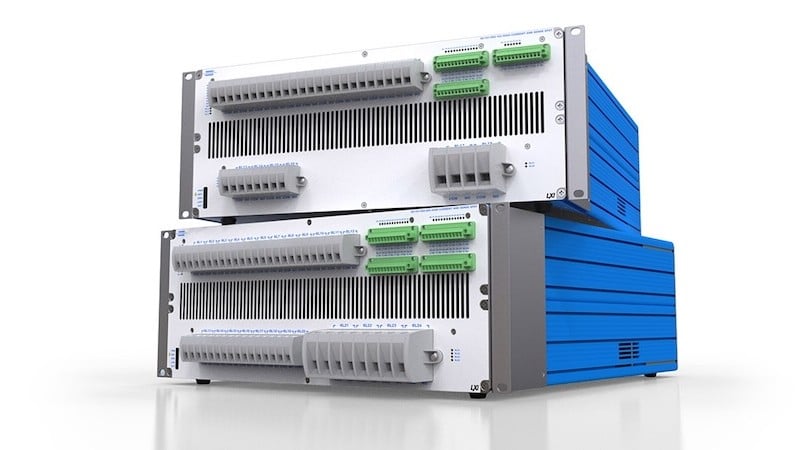
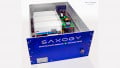
The 60-191 is an LXI high current and sense SPST switching unit.
The 60-191 family enables test and measurement teams to integrate high-current supplies into their benchtop and production systems more rapidly while significantly improving long-term maintainability.
Relay Configurations and Grouped Switching
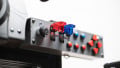
The 60-191 series is available in four standard configurations. A prominent setup, such as the 60-191-002-080 model, pairs up to twenty 40 A and four 80 A hermetically sealed SPST-NO contactors with a complementary number of 1 A SPST relays dedicated to low-current sense lines. High-current and sense-line attachments are facilitated through standard front-panel screw-terminal connections.
Typically installed between multiple high-current power supply units (PSUs) and a device under test (DUT), each switching unit can programmatically connect and disconnect the positive and negative outputs of each PSU, alongside their corresponding high- and low-sense lines.
Control engineers have the flexibility to operate each relay independently or manage two high-current and two low-current relays as a synchronized group using a single command. This grouping function dramatically simplifies the complex routing logic required for the four-wire connections commonly utilized by high-power PSUs. More information is available in the 60-191 series data sheet.
Hardware Triggering and Sequence Storage
To optimize network traffic and minimize host-to-instrument latency during automated testing routines, the new units feature advanced built-in scan list sequence storage. The internal LXI controller can store up to 5,000 predefined switching sequences, executing them reliably via software commands or configurable hardware triggers without requiring constant host intervention.
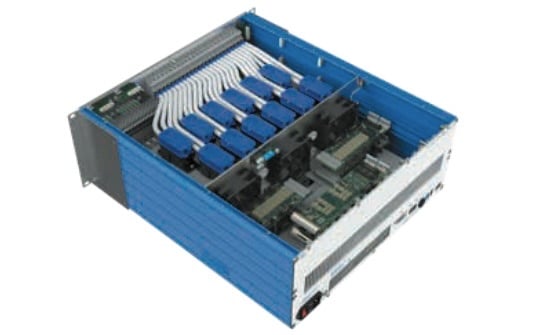
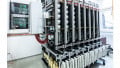
The 60-191-002-204 model of the LXI high current and sense SPST switching unit with top cover removed
Network connectivity is provided by an LXI 1.5-compliant 1000Base-T Ethernet interface, allowing remote configuration and control through a dedicated API or a built-in soft front panel. Furthermore, front-panel LED indicators display real-time switch status, while integrated relay cycle counting tracks mechanical wear, aiding engineers in balancing usage across different lines and scheduling preventive maintenance.
Software Support and Target Applications
The 60-191 switching units are supported by interchangeable virtual instrument (IVI) and direct I/O drivers for both Windows and Linux operating systems. The software ecosystem allows for seamless drop-in compatibility with major test development environments, including LabVIEW, Python, C/C++, C#, MATLAB, and Simulink.
By delivering high-power routing capabilities combined with synchronized four-wire control, Pickering says this hardware targets highly demanding power validation environments. The 60-191 family is particularly suited for electric vehicle (EV) battery testing, high-drain automotive electronics characterization, solar inverter verification, and energy-storage system evaluation, as well as specialized hydrogen-electrolysis and fuel-cell research.
All images used courtesy of Pickering Interfaces.