Facebook
 Google
 GitHub
 Linkedin
Optimizing Energy Systems With Advanced DC-DC Converters
Recent developments in DC-DC converters focus on improving power density, thermal management, and efficiency.
Electronic devices are shrinking in size and demanding more power. To meet these needs, DC-DC converter designers must overcome tradeoffs associated with enhancing power density, efficiency, and thermal management, all without sacrificing performance or cost.
Several companies are stepping up to the challenge with components featuring advancements in power conversion technology. These products could solve design needs for industrial and data processing applications.
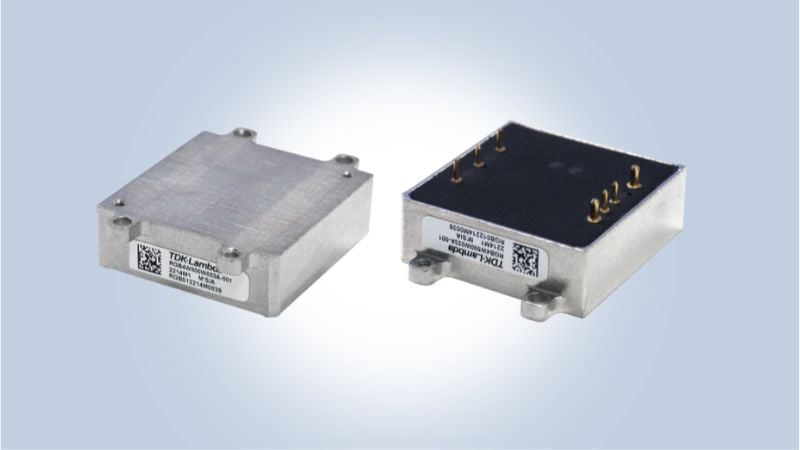
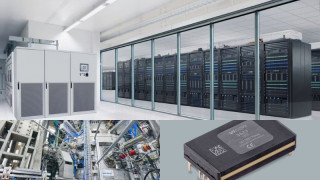
TDK Lambda’s RGB series. Image used courtesy of TDK-Lambda
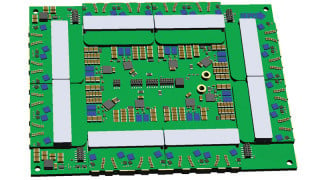
OmniOn's Answer to PCB Power Challenges
OmniOn Power’s FPLX-series DC-DC converters meet growing power density demands in PCB designs.
Part of the DLYnx III family, these converters are high-density point-of-load modules featuring a compact 10 mm x 10 mm footprint. They operate with a 6-14 V input range and provide output voltages of 0.45-3.6 V or 0.45-2.0 V. Coming in 15A, 20A, and 30A variants, these modules offer power densities of 97 A/in², 129 A/in², and 194 A/in², respectively. They achieve up to 88% efficiency for 12 V to 1 V conversion, with minimal derating under typical conditions.
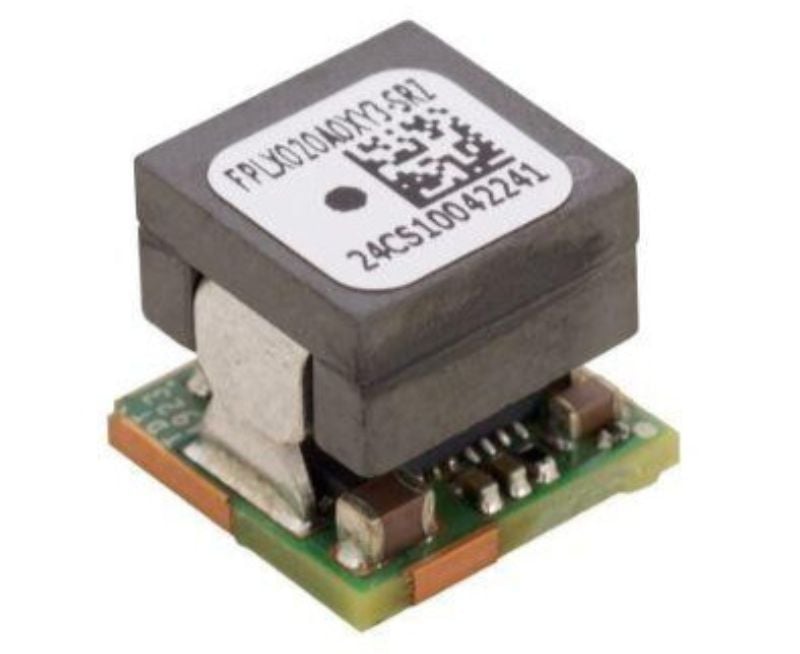
FPLX020A0XY3-SRZ DC-DC power module. Image used courtesy of OmniOn
Other notable features of the modules include switching between forced continuous conduction mode and diode emulation mode. The FPLX series is compatible with OmniOn's cloud-based Power Module Wizard for product selection and simulation and the Digital Power Insights solution for PMBus parameter configuration.
TDK's Efficient Converter for Harsh Industrial Applications
TDK-Lambda has launched its RGB series of non-isolated DC-DC converters for industrial applications.
With 400 to 750 W power ratings, these converters accept input voltages of 9-18 V, 18-32 V, or 18-60 V and deliver adjustable outputs of 0.8-8 V or 3.3-24 V with currents up to 60 A and efficiencies up to 98.5%. Standard features include voltage adjustment, remote on-off, remote sense, and an optional adjustable current limit.
These converters are also designed for harsh environments. They feature a 1/16th brick form factor (38.1 x 49.5 x 13.0 mm) that includes encapsulation for MIL-STD-810G shock and vibration compliance and can operate at case temperatures from -40°C to +115°C. The series complies with CE, UKCA, and IEC/UL/CSA/EN 62368-1 safety standards, making it suitable for medical, industrial, and battery-powered applications.
WE-MXGI Inductors
Würth Elektronik released its WE-MXGI series of power inductors to address the challenges of minimizing losses and maximizing efficiency in DC-DC converters.
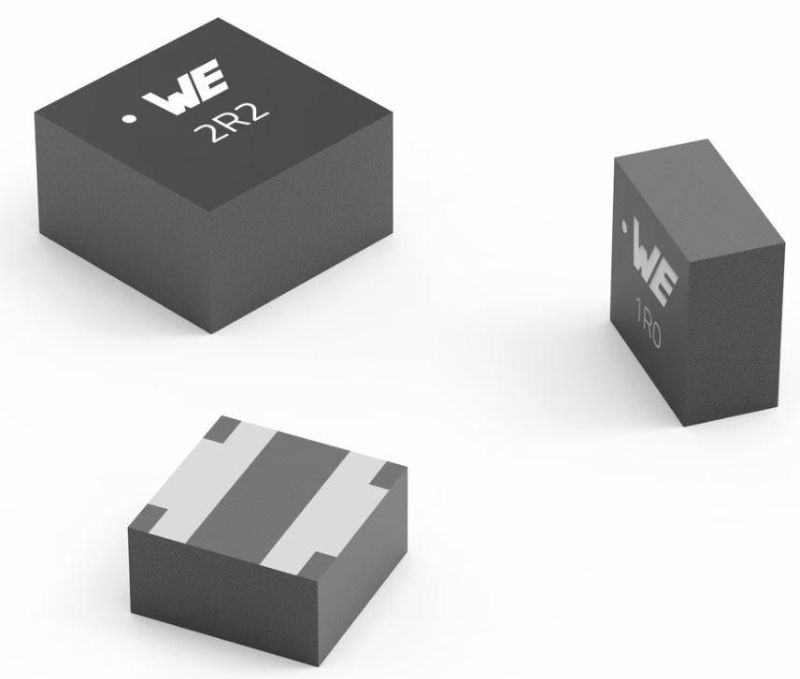
The WE-MXGI series power inductors. Image courtesy of the Würth Elektronik
Winding resistance and core losses directly impact power inductor performance, affecting efficiency and heat generation in DC-DC converters. The WE-MXGI series power inductors implement an innovative iron alloy material and optimized winding geometry to minimize core losses and winding resistance. For example, the 74438440200016 product exhibits winding resistances as low as 1.5mΩ while operating at voltages up to 80 V. Notably, these magnetically shielded SMT inductors are designed for high-frequency DC-DC converters based around GaN and SiC transistors. The same 74438440200016 device also features a resonant frequency of 197 MHz.
Available in 4020 and 5030 packages, the series offers inductances of 0.16-4.7 µH and 0.22-10 µH, with saturation currents up to 28 A. The series also operates at 80 VDC and temperatures from -40°C to 125°C.
Electronics for the Future
DC-DC converter technology’s ongoing evolution promises to support the ever-increasing need for high-performance electronics in consumer and industrial applications. The advances from OmniOn, TDK-Lambda, and Würth Elektronik demonstrate the industry’s biggest names are all pushing toward the same goals. With continued investment and effort into this area, the industry could enable more compact, powerful, and efficient systems.