Facebook
 Google
 GitHub
 Linkedin
Omron Introduces High-Capacity PCB Power Relays
The power relays feature bidirectional switching with low initial contact resistance.
The energy industry faces numerous challenges in the shift toward self-generated solar power as the main electricity source. While important for sustainability, this transition demands unprecedented reliability and safety from power electronics, placing increased importance on ubiquitous components like high-power PCB relays.
Omron’s series of high-capacity power relays is designed specifically for high-voltage DC circuits requiring high reliability, such as those used in renewable energy systems and electric vehicle bidirectional charging.
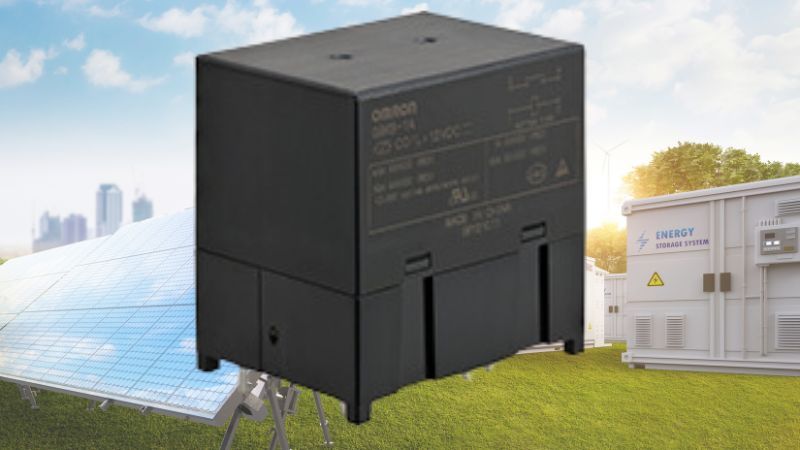
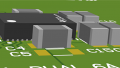
Power relay for renewable energy systems. Image adapted from Omron and Canva
Why Power Relays?
The increasing demand for renewable energy has expanded the role of electric vehicles (EVs) beyond transportation.
For example, vehicle-to-grid (V2G) and bidirectional charging have enabled EVs to receive power and supply it to the grid or other systems as needed. Integrating this technology with EVs involves complex configurations tailored to various applications. Vehicle-to-home (V2H) uses EVs to power homes during peak hours, reducing electricity costs by storing energy during off-peak times. Vehicle-to-building (V2B) extends this capability to entire buildings, providing emergency backup during outages.
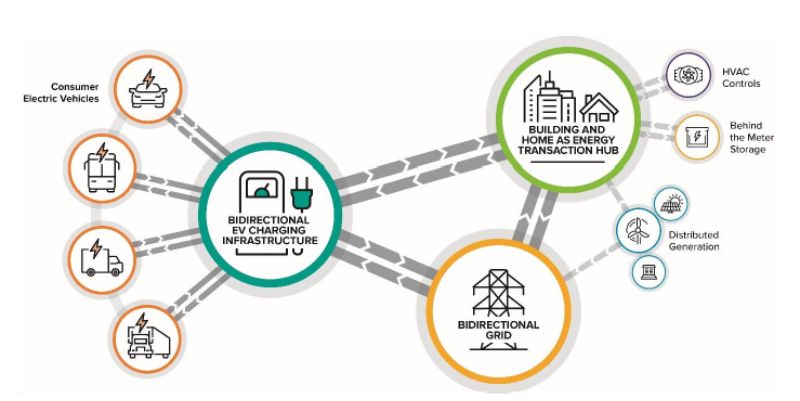
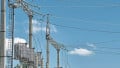
The concept of bidirectional charging. Image used courtesy of the Department of Energy
In these applications, relays are necessary to manage safe and efficient power flow to safeguard vehicles and users.
A relay is an electrical switch operated by an electromagnet to control high currents or voltages with a low-power signal. Therefore, contact resistance is one of the most important specifications in a power relay. It refers to the electrical resistance at the interface between the relay contacts when closed.
High contact resistance leads to inefficient power transfer, contact heating, voltage drops, and potentially malfunctioning connected systems. On the contrary, low contact resistance helps minimize energy loss, ensure reliable current flow, and prevent overheating. Achieving low contact resistance optimizes the relay's performance, efficiency, and lifespan but often comes at a tradeoff with the cost and complexity of materials and manufacturing processes. High-quality materials and precision engineering are required to maintain minimal resistance, which can increase production expenses.
Omron’s High-Capacity Bidirectional Power Relay
Omron recently introduced its G9KB PCB power relays designed for high-voltage DC circuits.
The G9KB series comes in various configurations and ratings, supporting up to 600 VDC and 50 A (standard model) and up to 800 VDC and 100 A (high-capacity model). This new lineup focuses on low contact resistance. To minimize this specification, Omron designed the family with silver alloy contacts, allowing the series to guarantee a contact resistance of 5 mΩ or less. Reliability is not sacrificed at the expense of contact resistance, as the G9KB series is rated at temperatures ranging from -40°C to 85°C and can withstand 600 VDC 1 A for 100,000 operations minutes.
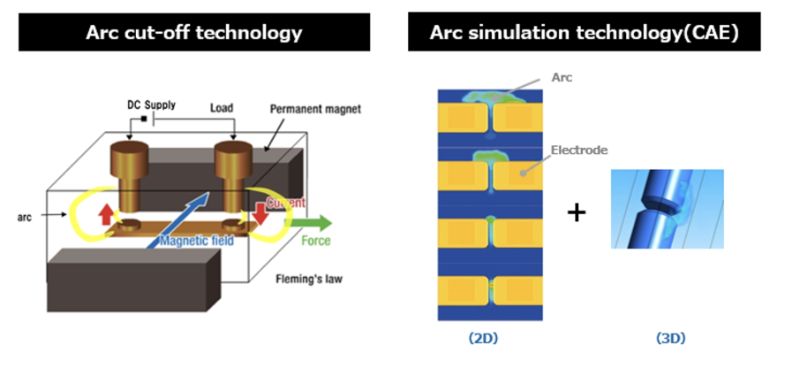
G9KB power relay technology. Image used courtesy of Omron
Moreover, Omron has obtained safety certifications (UL60947-4-1, EN61810-10) required for components used in solar power generation and electricity storage systems. According to Omron, the G9KB series is best suited for applications including stationary energy storage systems, power conditioners for energy storage, battery management systems, and rapid EV chargers.
From Roads to Grids
As high-power applications like vehicle-to-grid charging become more commonplace, the need for more reliable power electronics increases. With power relay solutions like the G9KB series from Omron, designers have another tool in their belt to balance performance with reliability and safety.