Facebook
 Google
 GitHub
 Linkedin
OmniOn Debuts High-Power DC-DC Bus Converters for AI Data Centers
The new QODN non-isolated Osprey bus converters offer high efficiency and compact footprints for demanding AI data center and high-density compute applications.
OmniOn Power has introduced new high-efficiency additions to its Osprey bus converter lineup, targeting the rigorous demands of modern AI infrastructure. The new QODN family of non-isolated DC-DC bus converters is specifically designed to support 12 V intermediate bus applications, 48 V distributed power architectures, and high-density computing platforms.
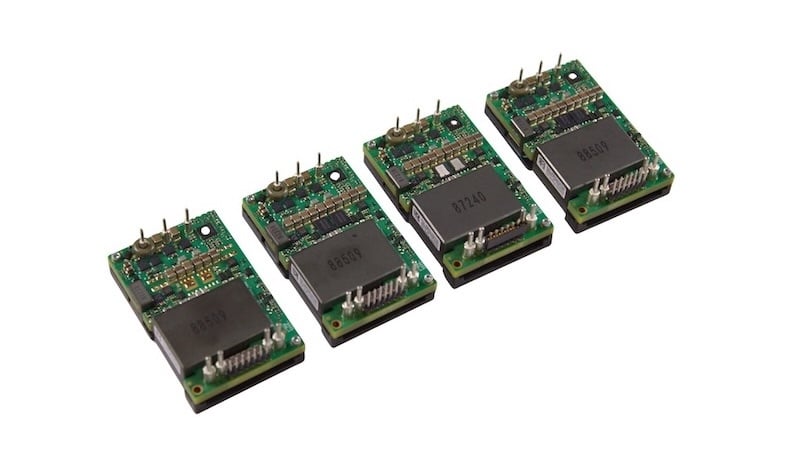
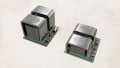
OmniOn’s new QODN Osprey bus converters
By optimizing power conversion losses, the converters help preserve thermal margins and ease cooling constraints in densely packed, always-on networking and AI setups.
Meeting the Demands of High-Density Compute
The exponential growth of AI accelerators, machine learning workloads, and GPU baseboards is driving a rapid increase in board-level power consumption. Highlighting the importance of minimizing these power losses, OmniOn Power representatives noted that even marginal improvements in energy efficiency can yield substantial cost savings when applied at the massive scale of modern AI data centers.
To address these power and thermal bottlenecks, the second-generation Osprey converters deliver up to a 1% efficiency increase compared to the company’s previous-generation QODE modules. Notably, this performance boost is achieved without requiring any additional board space.
The Osprey Bus Converter QODN family maintains the industry-standard modified DOSA quarter-brick footprint, measuring 58.4 mm x 36.8 mm x 14.5 mm. This ensures a straightforward migration path for hardware engineers upgrading from first-generation designs.
Key Features and Specifications
The Osprey bus converters offer a wide input voltage range of 40V to 60V, providing a tightly regulated 12V output. Incorporating synchronous rectification technology, a regulated control topology, and digital control, the units maintain high, flat efficiency curves across their operating bands to better support dynamic AI workloads.
Key design specifications and features include:
- Operating Temperature: The converters are capable of continuous operation in ambient temperatures ranging from –40°C to +85°C.
- Digital Interface: The devices feature an integrated PMBus interface that is Rev 1.2 compliant. This interface enables black-box fault logging and over-the-wire firmware updates via I2C. It also provides power-good signaling, remote on/off controls, and remote sense capabilities.
- Comprehensive Protection: The hardware includes built-in safeguards against output overvoltage and output overcurrent. It additionally protects the system against overtemperature and input under- and overvoltage conditions.
- Parallel Operation: An active current sharing control method facilitates reliable multi-module parallel configurations.
- Prebias Startup: The modules natively support prebias startup functionality out of the box.
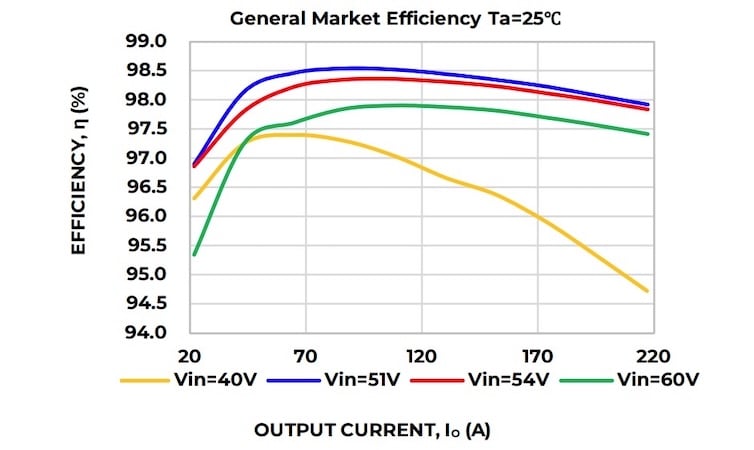
Converter Efficiency versus Output Current for QODN217A0B (12V, 217A) at 25℃
The QODN Converter Lineup
The new series is available in four distinct current and power configurations to meet varying operational requirements:
- QODN217: The module delivers 2,600W or 217A of output. It operates with a full-load efficiency of 97.9% at 54V. Peak efficiencies for this unit exceed 98.4%. Data sheet link here.
- QODN167: The converter supplies 2,000W or 167A of power. It achieves a full-load efficiency of 98% at 54V. Peak efficiencies for the module reach up to 98.5%. Data sheet link here.
- QODN136: This unit provides 1,600W or 136A of output. Full-load efficiency is rated at 98.1% at 54V. Peak efficiencies are rated up to 98.5%. Data sheet link here.
- QODN108: The model delivers 1,300W or 108A to the system. It offers a full-load efficiency of 98.1% at 54V. Peak efficiencies for this converter exceed 98.4%. Data sheet link here.
The QODN family’s combination of high efficiency and compact footprint makes it highly suitable for OCP-inspired hyperscale platforms, enterprise architectures, high-performance supercomputers, and automatic test equipment.
All images used courtesy of OmniOn Power.