Facebook
 Google
 GitHub
 Linkedin
NXP Unveils ‘Industry’s First’ UWB Wireless BMS
NXP's approach to electric vehicle battery management can extend range and decrease assembly costs.
NXP Semiconductors has introduced the "industry's first ultra-wideband wireless battery management system." Traditional battery management system (BMS) architectures, reliant on intricate wiring and labor-intensive assembly, can constrain performance and cost.
With electric vehicle adoption accelerating, manufacturers are looking for novel solutions to streamline production, extend vehicle range, and support a broader platform portfolio—all of which ultra-wideband (UWB) system promises to deliver.
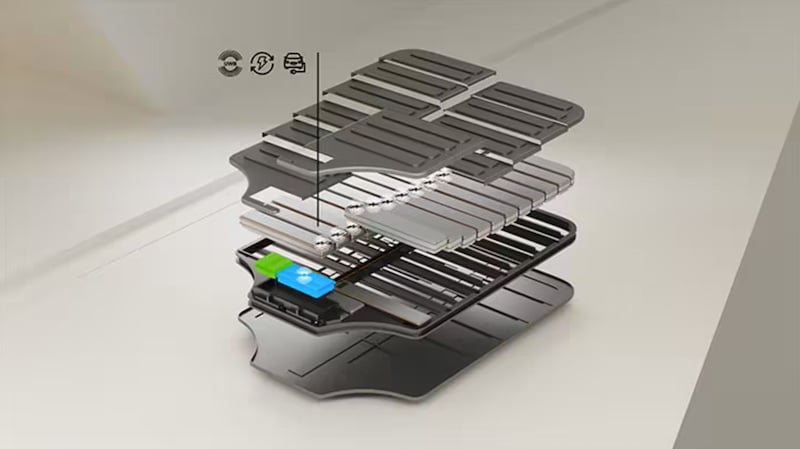
NXP’s UWB BMS system
NXP Optimizes BMS Power With UWB Solution
Integrated into a FlexCom chipset, NXP's UWB solution supports both wired and wireless configurations using a unified software architecture and safety libraries. This approach allows automotive manufacturers to reuse software across different platforms, accelerating development cycles and reducing engineering complexity.
The UWB solution operates over a broad spectrum between 6.0 GHz and 8.5 GHz to deliver data transmission that NXP claims surpasses the limitations of traditional narrow-band technologies. NXP says the UWB BMS provides reliable communication by addressing challenges like reflections and frequency-selective fading, both of which are common in metal-enclosed battery packs.
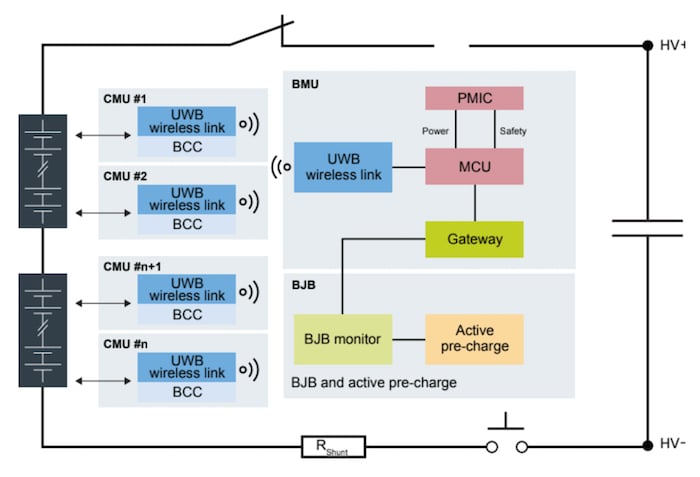
Block diagram of a battery pack with wireless inter-module communication
Thanks to these advances, NXP claims that the UWB BMS achieves performance benchmarks with a packet error rate below 10-6, a fourfold increase in bandwidth (7.8 Mbps), and 20 times faster synchronization than conventional systems. Additionally, the solutions reportedly feature a 5x faster packet rate and 40% power savings than conventional options. These capabilities help optimize the BMS' power consumption and enhance EV range and vehicle uptime.
Why Ultra-Wideband for Battery Management?
In BMS, UWB technology replaces traditional wired connections with high-bandwidth wireless communication.
UWB operates across a wide spectrum, typically between 6.0 GHz and 8.5 GHz, using short pulses for data transmission. This technique yields robust signal propagation within electrically noisy and reflective environments, such as metal-enclosed battery packs. Unlike narrow-band systems that are prone to fading and interference and rely on sinusoidal carrier frequencies, UWB leverages reflections to enhance signal strength and maintain reliable communication.
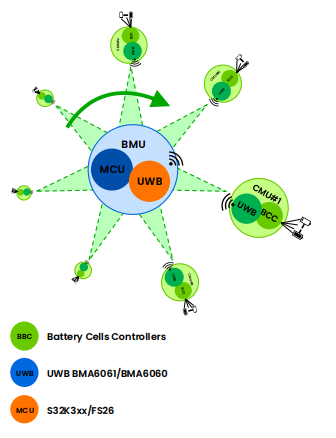
Application diagram of NXP’s UWB BMS
In a UWB-enabled BMS, data from individual battery cells—such as voltage, temperature, and state of charge—is transmitted wirelessly to the battery management unit. This eliminates the need for physical wiring harnesses, connectors, and intricate manual assembly processes. Removing these components increases energy density and enables more compact and efficient battery designs, extending EV ranges.
UWB offers other advantages over conventional BMS solutions, too. It simplifies mechanical and electrical integration, which accelerates design cycles and reduces engineering complexity. The wireless architecture decreases labor costs, enhances safety in high-voltage environments, and improves serviceability during maintenance. Additionally, the technology supports scalable and reusable designs, allowing manufacturers to adapt a single architecture across multiple platforms.
Back to EV Basics
NXP's UWB-enabled BMS reflects a growing emphasis on improving the technological foundation for electric vehicles. By addressing long-standing challenges associated with wired BMS, UWB may extend range and reduce the manufacturing constraints of EVs. NXP's UWB BMS solution is currently available to OEMs for evaluation, and development options will be ready in Q2 of 2025.