Facebook
 Google
 GitHub
 Linkedin
Next-Gen MOSFETs Target EV Speed and Durability
Navitas Semiconductor and Vishay are offering new MOSFETs for automotive and industrial use.
Navitas Semiconductor has released automotive-qualified variants of their third-generation 650 V and 1200 V GeneSiC silicon carbide (SiC) MOSFETs in D2PAK-7L (TO-263-7) and TOLL surface-mount packaging.
Navitas demonstrates its GeneSic technology. Video used courtesy of Navitas
The new auto-qualified power switches will target a wide range of power-dense electric vehicle applications, including cabin heaters, DC-DC converters, and onboard chargers (OBCs). According to Navitas, devices built on their GEN-3 Fast MOSFET technology operate with a significantly lower case temperature, resulting in an operating life three times longer than comparable SiC devices.
For the latest silicon MOSFET technology, Vishay Intertechnology’s 4th generation E Series Power MOSFETs are rated at 600 V and meet the needs of a broad range of industrial and lighting applications.
Also from Vishay, the VOMDA1271 automotive certified, optically-isolated MOSFET driver features an integrated fast turn-off and operates without needing an external supply voltage.
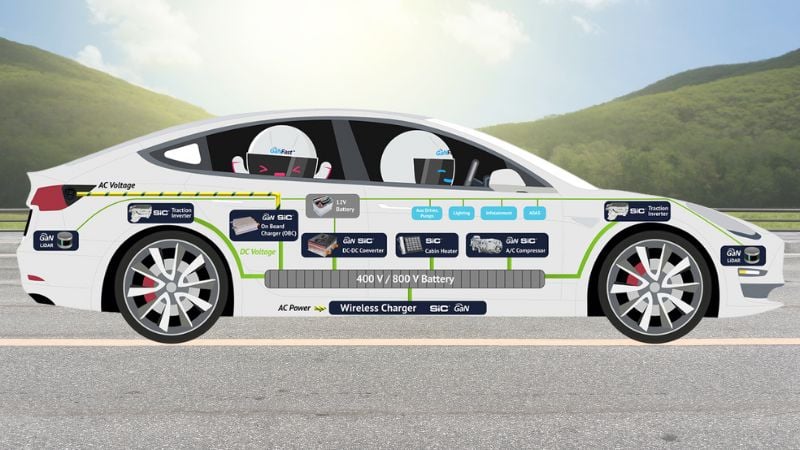
Wide bandgap tech powers modern EVs. Image used courtesy of Navitas Semiconductor
Silicon Carbide Power Switches for EVs
Navitas's newly automotive-qualified Gen-3 Fast MOSFETs offer high switching speeds and reduced power losses to accommodate the most power-dense EV applications like OBCs.
To achieve its power efficiency, the 650 V variant of the product series has a series resistance (RDS(ON)) as low as 20 mΩ. At the same time, its high-frequency operation supports power-dense designs that reduce weight and cost.
Using in-house technology, Navitas has developed an OBC demonstration platform rated to 22 kW with a power density of 3.5 kW/liter and more than 95.5% efficiency.
The surface-mount TOLL packaging, available for the 650 V SiC MOSFET, offers better thermal management properties, a 30% reduction in PCB footprint, and a height that’s one-half of D2PAK-7L packaged components.
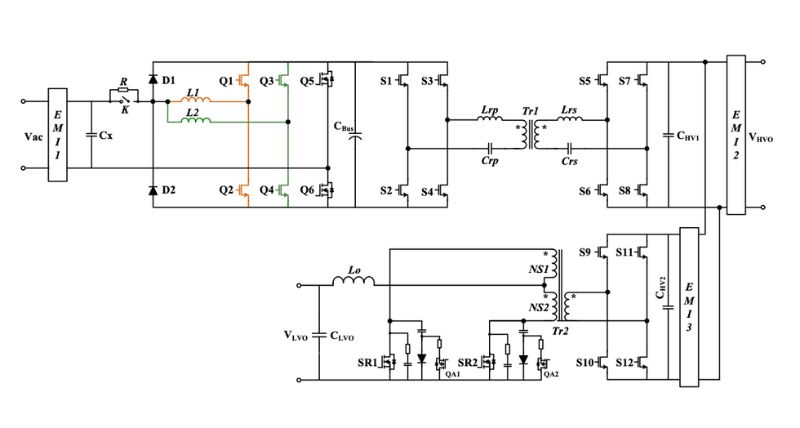
Bi-directional OBC reference schematic. Image used courtesy of Navitas Semiconductor
The 650 V-rated switches are targeted for 400 V EV battery bus architectures, while the 1200 V-rated devices serve the higher 800 V battery bus market.
High-Performance Silicon MOSFET
The 4th generation of Vishay's E Series Power MOSFETs offers a high figure of merit as defined by the product of channel on resistance and gate charge (RON x QG). The SiHD180N60E model from the series has an RON of 170 mΩ and QG of 21 nC typ.
The devices are rated to handle up to 20 A of continuous load current at a VGS threshold voltage of 10 V while operating at room temperature (25°C).
The package for the SiHD180N60E is a surface mountable DPAK (TO-252) with a height of 2.38 mm.
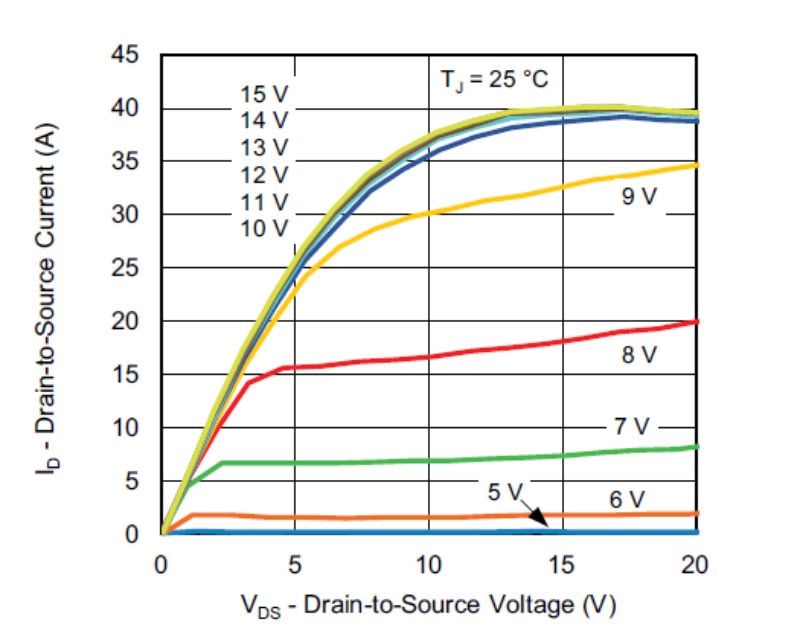
SiHD180N60E silicon power MOSFET channel characteristics, Image used courtesy of Vishay
Target applications for the silicon MOSFETs include switch mode power supplies, fluorescent ballast lighting, induction heating, motor drives, and battery chargers.
Optical FET Driver with Fast Turn-Off
Also from Vishay, the VOMDA1271 photovoltaic MOSFET driver derives all the necessary supply current to power internal circuits from its primary side infrared light emitting diode (LED). This eliminates the need for any external supply source.
With a forward current (IF) of 10 mA through the primary side LED, the output open circuit voltage for driving a FET gate or other load is about 8 V (6 V across a 500 kΩ load) with a short circuit drive current of about 15 µA.

VOMDA1271 MOSFET drive application with fast turn-off. Image used courtesy of Vishay
Fast turn-off allows energy from the MOSFET gate capacitance to be quickly discharged through the driver, supporting a turn-off time of just 80 µs.