Facebook
 Google
 GitHub
 Linkedin
Mean Well Unveils 500 / 750 W AC-DC Power Supply With PFC
The NSP-500 and NSP-750 enclosed power supplies offer 200% peak power capability.
Mean Well has released its NSP-500 and NSP-750 series, a new generation of 500 W and 750 W enclosed AC-DC power supplies with active power factor correction (PFC). The company stated the series is an upward expansion of its NSP family, following earlier lower-power models, and as a replacement for the long-running RSP-500/750 platform.
According to Mean Well, the NSP-500/750 devices are designed to deliver higher power density, broader operating conditions, and expanded safety compliance in a more compact enclosure than their predecessors.
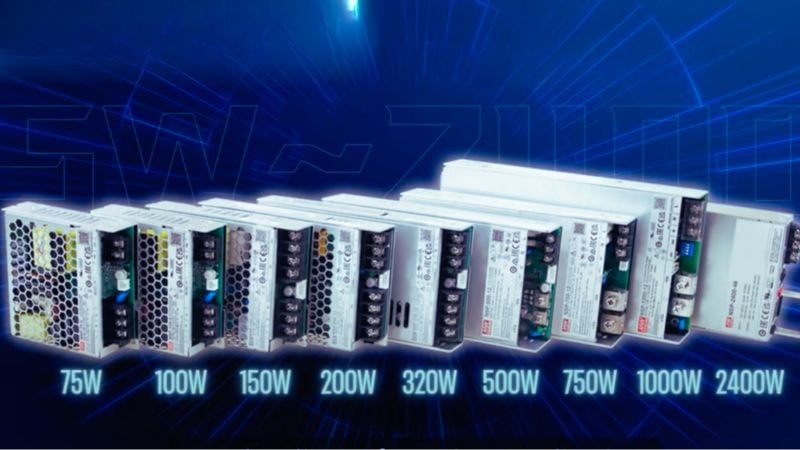
The complete NSP series. Image used courtesy of Mean Well
NSP-500 and NSP-750
The NSP-500 series delivers up to 500 W of rated output power, while the NSP-750 series supports up to 750 W. Depending on the output voltage configuration, both families offer a 200% peak power capability for up to five seconds. Available output voltage options include 5, 12, 15, 24, 27, 36, 48, and 60 V, enabling a single platform to cover a wide range of end-equipment requirements.
Both series operate from an ultra-wide 85 to 305 VAC input range, offer active PFC, support global mains operation, and are directly compatible with 277 VAC industrial power systems. At full load, the typical power factor exceeds 0.98 at 115 VAC and stays above 0.9 at 277 VAC. Peak efficiencies reach up to 95%, depending on the model and output voltage, and no-load power consumption stays between 0.75 W and 1 W.
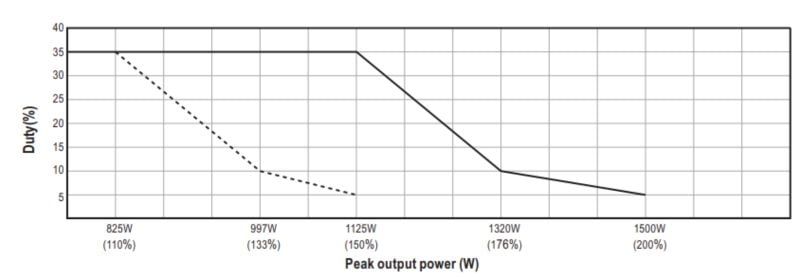
Peak power output versus duty cycle for the NSP750. Image used courtesy of Mean Well
Mechanically, the supplies are enclosed in metal cases with dimensions of 199 x 99 x 41 mm and 199 x 105 x 41 mm for the NSP500 and NSP750, respectively. Compared with the earlier RSP-500/750 generation, the units reduce overall volume by almost 33%, resulting in greater power density without trading off thermal margin. Both series support operation from -40°C to +85°C, with full-load capability maintained up to +60°C before derating.
Protection and control features include short-circuit, overload, overvoltage, and over-temperature protection. Mean Well also integrated an overload response that supports constant current limiting with defined behavior for output voltages above and below 30% of nominal. Remote on/off control, remote-sense compensation up to 0.3 V, and a DC OK signal are provided to support system-level monitoring and power sequencing.
From a safety perspective, the NSP-500 and NSP-750 meet Overvoltage Category III (OVC III) requirements and achieve 2 x MOPP isolation with ultra-low earth-leakage current below 350 µA at 277 Vac. Certifications include IEC/EN/UL 62368-1, IEC 60601-1 for medical electrical equipment, IEC 60335-1 for household appliances, IEC 61558-1/-2-16, IEC 62477-1, and SEMI F47 for semiconductor tools, depending on model and region.
PFC and Peak Power in AC-DC Supplies
Power factor correction is a baseline requirement for medium- to high-power AC-DC supplies used in industrial and commercial equipment. Active PFC circuits reshape the input current waveform to more closely follow the input voltage, reducing harmonic distortion and improving overall power factor. This reduces stress on upstream distribution infrastructure and helps equipment comply with harmonic-current standards, such as IEC 61000-3-2.
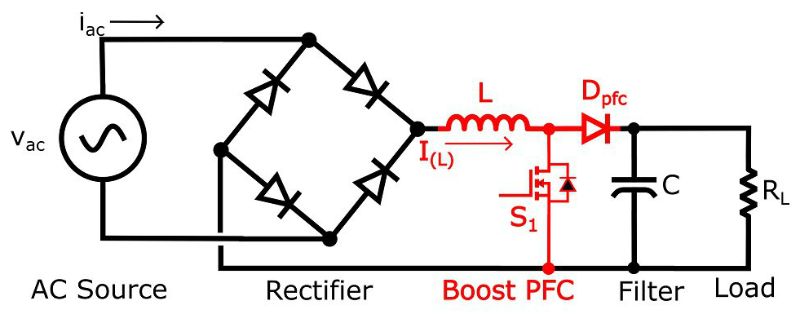
A boost PFC AC/DC converter circuit. Image used courtesy of All About Circuits
With wide input PFC stages, systems can operate across broad voltage ranges without manual selection, which benefits globally deployed systems or installations using 277 VAC feeds derived from three-phase power. This flexibility, however, places additional demands on the PFC design. To achieve high efficiency with a PFC front end, engineers should carefully select switching devices, magnetics, and control algorithms to manage losses at low and high line conditions.
Peak power capability is also an important characteristic in industrial power supplies. Many loads, such as actuators and capacitive systems, draw short bursts of current during startup or transient events that exceed their steady-state power rating. For that reason, system designers need to choose PSUs that can support peak power levels beyond typical operating ranges. To keep costs and size down, a supply must be able to accommodate these events without oversizing the nominal power rating.
Availability and Outlook
Mean Well states that the NSP-500 and NSP-750 series are entering production, with full certification markings to appear as mass production ramps.