 Facebook
 Google
 GitHub
 Linkedin
Infineon Reference Design Runs Models Directly on the BMS
The high-voltage platform pairs an AURIX TC4x MCU's parallel processing unit with pack- and cell-monitoring hardware.
Infineon Technologies introduced a high-voltage battery management system (BMS) reference design that runs computationally intensive battery models directly on the battery management unit (BMU), rather than offloading to the cloud. The platform combines an AURIX TC4x microcontroller, pack and cell monitoring hardware, and a software package.
Infineon claims that, depending on the application scenario, the onboard models can extend battery lifetime by up to 30% through optimized load profiles, enable pack designs with up to 20% fewer cells for the same range, and cut charging times by up to 20%.
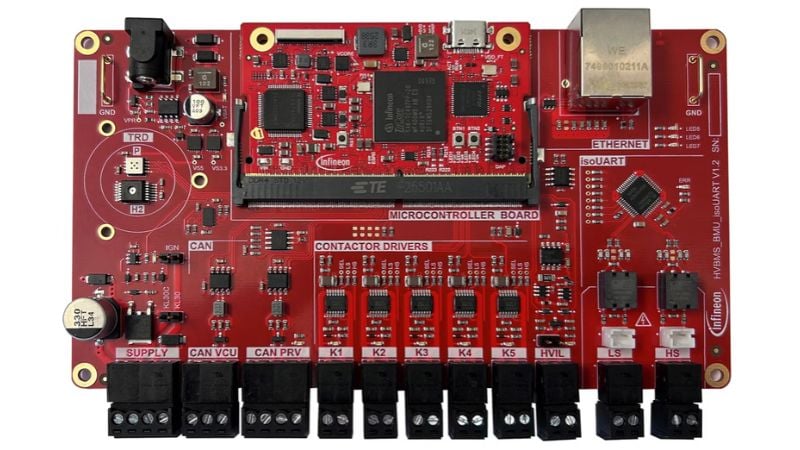
Infineon’s high-voltage BMS reference design. Image used courtesy of Infineon
Parallel Processing on the AURIX TC4x
The reference design ships with an AURIX TC497N module in SO-DIMM format, mounted on Infineon's Control Board V1.2. The TC4x family is built on a 28 nm process and offers up to six TriCore 1.8 cores running at 500 MHz, with ASIL D safety support.
The BMS workload runs on the TC4x's parallel processing unit. According to Infineon's TC4x overview, the PPU pairs a scalar core with a 256-bit SIMD vector unit rated at up to 48 GOPS. The PPU runs its own code based on Synopsys' ARC EV71 architecture and coordinates with the TriCore CPUs through shared memory.
Memory protection and quality-of-service controls keep its traffic from disrupting real-time tasks on the main cores. Infineon says the PPU delivers up to 30 times the processing performance of a standard CPU on suitable workloads.
That headroom supports machine learning, hybrid, electrochemical, and equivalent circuit models, as well as full digital twins. The BMU can combine these with conventional estimation methods, including electrochemical impedance spectroscopy, open-circuit voltage measurement, Coulomb counting, and Kalman filtering.
The outputs include internal cell temperature, state of charge, state of health, state of power, state of safety, and indicators of lithium plating, which the BMS can use during parking, driving, charging, fast charging, and cell balancing. Infineon's product page adds that the PPU-based models are aimed in part at next-gen semi- and full-solid-state cell chemistries.
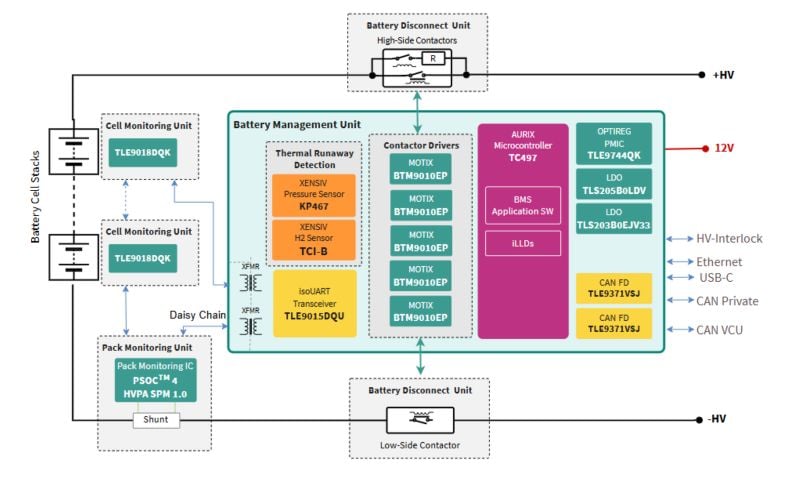
BMS block diagram. Image used courtesy of Infineon
Running models in the vehicle reduces the volume of data sent to the cloud, which Infineon says lowers both infrastructure requirements and latency. Keeping the same model architectures across laboratory, cloud, and edge deployments is also intended to simplify validation and software-over-the-air updates.
The approach differs from earlier industry demonstrations such as NXP's 2022 high-voltage BMS, which ran an AI battery digital twin in the cloud and left real-time control to an S32K3 MCU in the vehicle.
Infineon has pursued edge-based battery analytics on the TC4x since at least 2023, when it partnered with Eatron to run AI diagnostics such as lithium plating detection on the PPU.
A Three-Board BMS Stack
The BMU control board provides Ethernet, CAN, USB-C, and isolated UART (iso UART) connectivity, along with vehicle and laboratory power inputs, MOTIX contactor drivers, a high-voltage interlock loop, and EEPROM. XENSIV pressure and gas sensors detect early signs of thermal runaway, giving the BMS more time to take protective action.
The pack monitoring unit, meanwhile, is built on the PSOC 4 HVPA SPM 1.0, an ASIL D-compliant Arm Cortex-M0+ device with delta-sigma ADCs offering 16-bit resolution at 8 kSPS or 20-bit resolution at 1 kSPS. It handles current sensing, high-voltage monitoring up to 1,000 V, isolation-resistance measurement, and Coulomb counting. It also provides isolated UART links to Infineon's TLE9012 and TLE9018 cell monitors, an isolated CAN interface to the host MCU, SPI for pressure sensors, and a pyro-fuse interface.
The cell monitoring unit uses the TLE9018DQK, an 18-channel Li-ion monitoring and balancing IC that's compliant with ASIL D and ISO 26262. Each cell channel has a dedicated 16-bit delta-sigma ADC, and the device supports balancing currents up to 300 mA on all cells simultaneously. It draws power from three to 18 cells, and up to 62 boards can be cascaded in a daisy chain.
However, it's worth noting that the platform is intended for development and evaluation, not production vehicles. Infineon's 30-times figure applies to workloads suited to the PPU's vector unit, not to BMS processing as a whole, and the lifetime, cell count, and charging gains depend on the application scenario.