Facebook
 Google
 GitHub
 Linkedin
EPC Intros 5 kW 3-Phase GaN Inverters for Robotics and Light EVs
The EPC9186HC2 and EPC9186HC3 are three-phase GaN evaluation boards built around the 0.75 mΩ EPC2361 eGaN FET, delivering up to 150 A RMS and 5 kW for BLDC motor drive applications
Brushless DC motor drives in robotics and light electric vehicles demand high current without the penalty of bloated passives and rising switching losses. Efficient Power Conversion (EPC) is addressing that problem by introducing two evaluation boards (EPC9186HC2 and EPC9186HC3) that place multiple gallium nitride FETs in parallel to achieve 150 A RMS while keeping the power stage compact.
,_highlighting_two_EPC2361_FETs,_and_the_EPC9186HC3_board_(right),_showing_three_EPC2361_FETs.jpg)
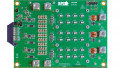
Top view of the EPC9186HC2 board (left), highlighting two EPC2361 FETs, and the EPC9186HC3 board (right), showing three EPC2361 FETs. Image used courtesy of EPC
Building on the EPC9186 Platform
The EPC9186HC2 and EPC9186HC3 extend EPC's existing EPC9186 inverter platform with a redesigned power stage built around the EPC2361 100 V eGaN FET. The original EPC9186 used four EPC2302 devices per switch position; the HC2 variant places two EPC2361s in parallel per position, and the HC3 uses three.
Adding devices in parallel reduces the equivalent on-resistance, thereby reducing conduction losses at the high phase currents these boards are designed to carry.
The EPC2361 offers lower gate charge and output capacitance compared to conventional silicon MOSFETs. In a motor drive context, that translates to faster switching transitions, smaller passive components, and tighter control bandwidth.
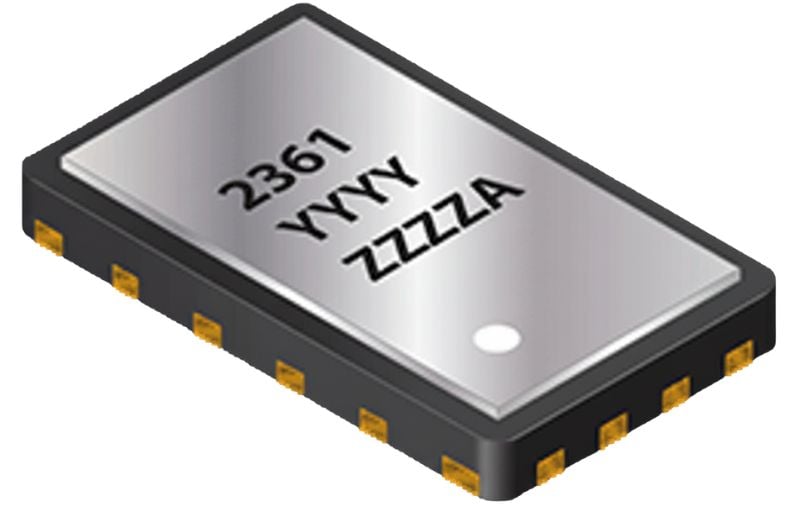
The EPC2361 features a 100 V, 133 A Enhancement-Mode GaN power transistor. Image used courtesy of EPC
Key Specifications
The boards operate from a DC input range of 14 V to 76 V. The HC2 is rated at 130 A RMS with a 180 A peak output; the HC3 raises that to 150 A RMS and 200 A peak. Both support PWM switching frequencies up to 120 kHz, well above the audible range, which directly reduces acoustic noise, a practical concern in warehouse robotics and agricultural machinery where operator exposure is prolonged.
The boards switch at a dv/dt of around 6 V/ns, fast enough to reduce torque ripple and acoustic noise, but also controlled enough to avoid the EMI issues that unconstrained GaN switching can cause. The boards operate up to 5 kW continuous, making them applicable to light electric scooters, forklifts, and high-power drones in addition to robotic actuators.
Integrated Control Infrastructure
Beyond the power stage, both boards integrate gate drivers, high-bandwidth phase-current sensing, voltage and temperature monitoring, and protection functions including over-current detection and input undervoltage lockout. That level of integration means engineers don't have to assemble protection circuits from scratch during the evaluation phase.
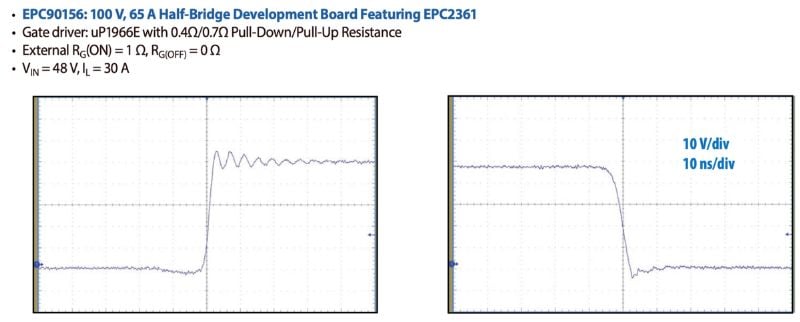
Typical half-bridge switching behavior. Image used courtesy of EPC
Phase-current sensing supports field-oriented control (FOC), enabling accurate torque control in closed-loop configurations. The boards are compatible with motor controller platforms from Microchip, Texas Instruments, and STMicroelectronics, and support both sensorless and encoder-based configurations, making them easy to drop into an existing motor control setup.
The product page includes schematics, BOM, a STEP file, and a quick-start guide for all three EPC9186 variants. Engineers who wish to go deeper into the power stage can also refer to the EPC2361 datasheet for the GaN FET's full electrical characteristics.
GaN's Expanding Role in Motion Control
For years, GaN's advantages in switching speed were offset by lower current ratings and higher cost per watt compared to mature silicon MOSFETs. Putting multiple GaN devices in parallel, as EPC does here, is a straightforward fix: more devices share the load, so current handling goes up without needing a single larger die.
As GaN costs keep falling and motor drive designs push toward higher switching frequencies for quieter, more efficient operation, boards like the EPC9186HC2/HC3 give engineers a low-risk way to test whether GaN fits their application before designing a custom board.