Facebook
 Google
 GitHub
 Linkedin
Emerson Software Adds BESS, Asset Management for Renewables
The Ovation Green platform includes specialized battery algorithms to expand battery control out of the box.
Emerson has launched a battery energy and asset management software integrated into its Ovation Green platform. According to Emerson, the tech seeks to enhance performance, reliability, and return on investment for battery energy storage system (BESS) operators by fusing power plant controllers with specialized supervisory control and data acquisition (SCADA) software. By providing a unified framework, Emerson's BESS software can help operators minimize maintenance overhead and optimize operational decisions.
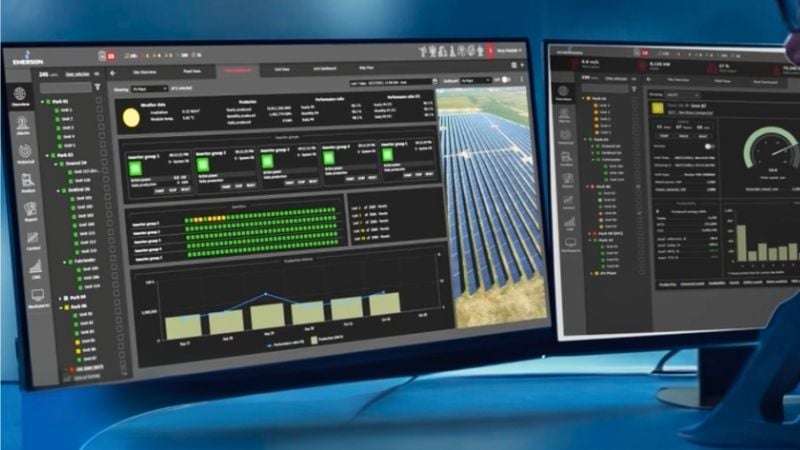
Emerson's Ovation Green for renewable energy systems. Image used courtesy of Emerson
Ovation Green Architecture and Capabilities
Emerson's Ovation Green battery software architecture integrates field-proven SCADA and power plant controllers with a comprehensive suite of energy management algorithms that distribute proportioned control setpoints across BESS components, such as inverters and battery management systems, to enable site-wide coordination. Designed for flexibility, the system supports standalone storage and complex hybrid applications.
According to Emerson, the energy management system offers functions such as energy arbitrage, load leveling, frequency response, voltage regulation, and reserves deployment. For instance, energy arbitrage capabilities use real-time pricing forecasts to schedule battery charge during off-peak hours and discharge during peak demand to maximize revenue. Load leveling reduces peak load strain by orchestrating battery discharge during high-demand periods and recharging during low-demand windows.
Grid service capabilities allow the system to respond rapidly to frequency and voltage variations, while the reserves functionality supports spinning and non-spinning reserve requirements. The EMS also enables black start capabilities, replacing traditional diesel generators with zero-emission stored energy during grid outages.

An Ovation power plant controller for solar farm management. Image used courtesy of Emerson
To enhance operational resilience, the platform features built-in redundancy, high-frequency data capture, and an open logic-based control framework. Its synchronized, centralized database offers instantaneous propagation of control strategy updates for improved change management. Operators can adjust parameters and control logic using common engineering tools and a graphic-based interface, which reduces training time and standardizes procedures across multiple sites.
Finally, Emerson has expanded the system by partnering with Zitara Technologies to leverage the company’s battery management software into the Ovation Automation platform. By incorporating advanced battery health analytics and state-of-charge visibility, the system improves predictive maintenance and operational planning for reduced downtime, extended battery life, and more reliable energy delivery.
Understanding Energy Arbitrage
Energy arbitrage in battery energy storage systems involves buying and storing electricity when prices are low and selling or discharging it when prices are high. A simple but powerful financial mechanism, it’s one of the ways that operators optimize revenue in energy markets with variable pricing structures.
The technical process begins with forecasting market conditions, including demand, supply, and pricing signals. The EMS uses these inputs to generate a charge/discharge schedule that aligns with economic optimization. During low-demand periods, when electricity prices drop, the system charges the batteries. Conversely, during peak demand or grid stress events, the EMS discharges stored energy to capitalize on elevated prices.
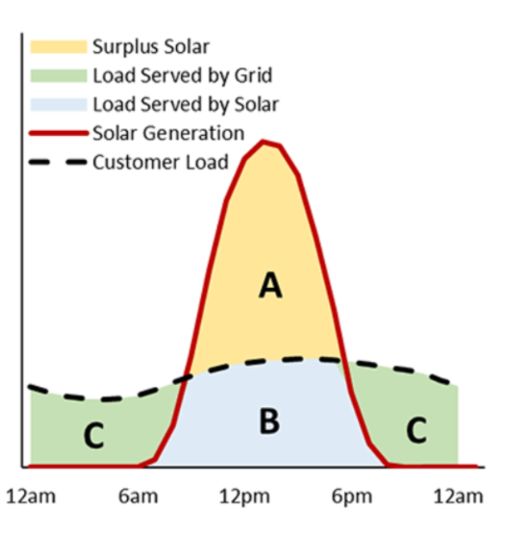
Discharging stored energy during peak demand periods. Image used courtesy of Berkeley Lab
This strategy requires coordinating battery charging cycles to avoid degradation while maintaining readiness for dispatch. Real-time data monitoring and predictive analytics allow the system to adjust to unforeseen shifts in market behavior or system constraints. Additionally, integration with external market platforms allows the EMS to automate bidding strategies and participate in ancillary service markets.
Ultimately, the value of energy arbitrage depends on battery efficiency, round-trip energy losses, and the cost spread between charge and discharge periods. As battery technologies improve and markets mature, arbitrage potential is expected to increase.
A Standardized Approach for Grids
By combining modular control logic with high-resolution data capabilities, Emerson’s platform provides a significant advantage to power producers with increasingly decentralized and renewable-heavy energy portfolios. Emerson will showcase the Ovation Green BESS platform at the Ovation Users’ Group conference, July 27-31, 2025, in Pittsburgh. The software is available as part of the broader Ovation Green renewable solutions suite.