Facebook
 Google
 GitHub
 Linkedin
Cool Chips: Coolant Distribution Unit Delivers Direct-to-Chip
LiquidStack’s coolant distribution unit is optimized for high-performance commercial direct-to-chip data center cooling systems.
LiquidStack, a Texas-based manufacturer of liquid cooling systems for data centers, has released the CDU-1MW, a high-performing coolant distribution unit (CDU) designed to move coolant through commercial direct-to-chip (DTC) data center cooling systems.
Constructed for power-intensive computing applications like artificial intelligence large language models, the CDU targets an underserved market for standardized solutions supporting data center DTC implementations.
The CDU-1MW offers 1,350 kW of cooling capacity through an efficient coolant flow distribution architecture to deliver flow rates up to 1,500 (liters per minute powered by dual, hot-swappable variable speed drive pumps.
According to LiquidStack, compared with comparable solutions, the new CDU reduces energy used for cooling by 36% and reduces the total cost of ownership of cooling systems by 25% over a nominal 20-year period.
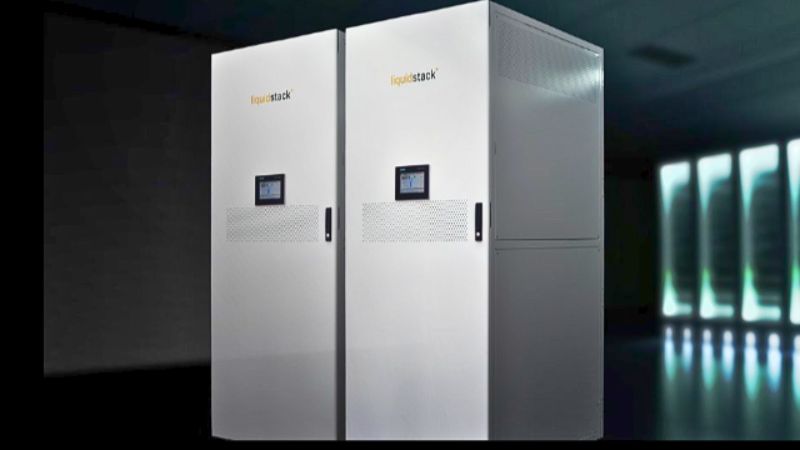
CDU-1MW coolant distribution unit. Image used courtesy of LiquidStack
Growing Demand for Data Center Power and Cooling
According to Goldman Sachs, data center workloads nearly tripled between 2015 and 2019, yet global power consumption for data centers remained flat at about 200 TWh per year. This was primarily due to efficiency improvements in data center power management and delivery.
However, with the rise in AI workloads, efficiency gains are no longer keeping pace with rising power demands. As a result, Goldman Sachs is predicting data center power consumption to increase by 200 terawatt-hours per year through 2030, with AI representing roughly 19% of total data power center demand by 2028.
With rising power demand comes the need for more and better heat removal capabilities.
Direct-to-Chip Cooling Solutions
Data center operators wrestle with two main challenges: managing rising power requirements for graphics processing units (GPU) from increasing AI workloads and managing the environmental impact of increased power usage.
Large data centers can generate enormous amounts of heat from their operations. To remove this heat more efficiently, data center operators use liquid and hybrid cooling (liquid and air) systems with better energy efficiency and cooling performance.
Some options for liquid cooling in data center applications include single-phase immersion, two-phase immersion, and direct-to-chip (DTC) cooling.
In DTC implementations, liquid coolant is delivered directly to the hottest part of the data center, typically the GPU processors, through a cold plate placed directly on the chip. Liquid coolant circulates through channels in the cold plate, absorbing heat from the chip to the cold plate.
In DTC systems, the coolant distribution unit pumps coolant through the cold plates and to heat exchangers, where heat is removed.
CDU-1MW Coolant Distribution Unit
The CDU-1MW coolant distribution unit uses internal pumps to push coolant through its technology cooling system. It delivers coolant to the DTC cooling plates, absorbing heat from the data center processors. The heat exchange system (316SS plate heat exchanger) then transfers the thermal energy to the facility water system for removal from the system.
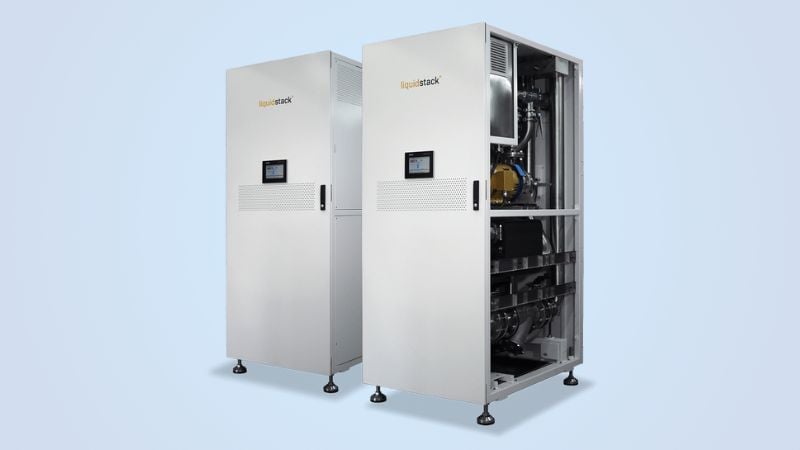
CDU-1MW. Image used courtesy of LiquidStack
With its two variable speed drive pumps, the CDU-1MW can push up to 1,500 lpm of coolant through a DTC system with a cooling capacity of 1350 kW or heat dissipation ratio of 1.15 lpm/kW.
Each unit weighs about 2,000 pounds, with a height of a little over 7 feet. The CDU-1MW consumes 23 kW of power (11 kW per pump) and runs on standard 50/60Hz AC line power.
The TCS loop coolant volume is about 21 gallons, while the FWS loop that removes heat from the CDU holds about 31 gallons of coolant.