Facebook
 Google
 GitHub
 Linkedin
Allegro Claims ‘First’ Safety PMIC to Integrate a Wheel-Speed Sensor Link
Allegro’s A81415 safety PMIC integrates wheel speed sensing, power management, and ASIL-D safety features into a single chip for electromechanical brake by wire systems.
Allegro Microsystems has released the A81415, an ASIL-D capable safety PMIC designed for electromechanical braking architectures.
Brake by wire systems are changing what has to happen at each wheel. The vehicle may be getting more centralized from a software and compute perspective, but braking still happens right around the corner. That can put a lot of pressure on the electronics sitting near the caliper. Those systems need safe power delivery, reliable wheel speed information, and fast fault response. They also have to survive heat, vibration, and harsh electrical conditions while fitting into a tight physical space.
Allegro is targeting that problem with the A81415. The big difference is that it does more than manage power. It also integrates a multi-protocol wheel speed sensor interface directly into the same device.
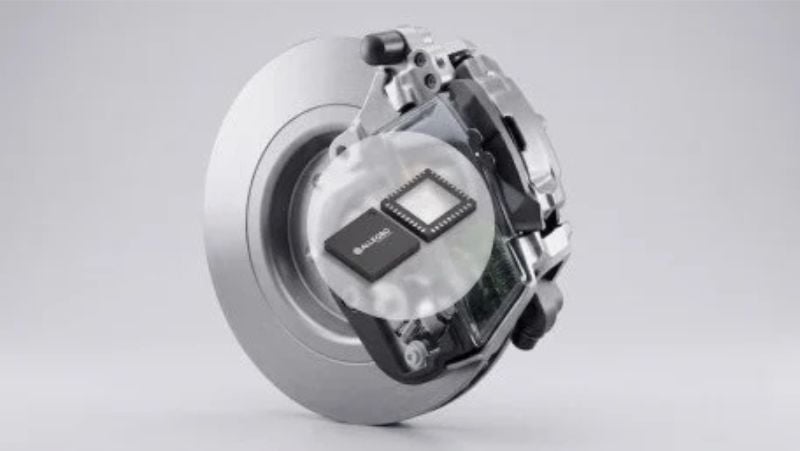
Allegro’s A81415 safety PMIC integrates power management and wheel speed sensor decoding for next-generation electromechanical braking systems.
Why the Wheel Speed Interface Matters
In many brake by wire designs, wheel-speed sensing is handled separately from the PMIC. Designers may use a safety PMIC, a separate wheel speed decoder, and additional analog circuitry to bring the signal into the braking controller. That adds cost and board area. It also creates more points of failure in one of the most safety-critical parts of the vehicle.
The A81415 changes that by bringing the wheel speed sensor interface on chip. It can decode 2-level, PWM, and AK wheel speed protocols, including high-resolution AK formats, making the PMIC part of the sensing chain rather than just the power management layer. That integration is significant because wheel speed information feeds directly into braking behavior. By handling the physical layer inside the PMIC and sending decoded data over SPI, the device can reduce latency in the braking loop and free MCU bandwidth for other control tasks. More information is available in the A81415 data sheet.
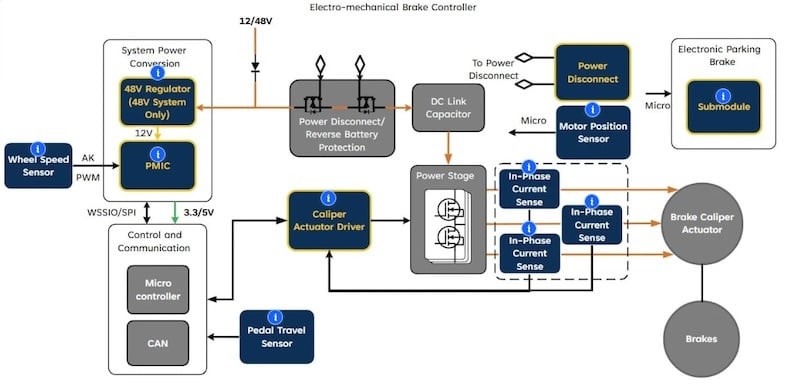
Electromechanical braking systems require power, sensing, communication, and actuator control to work together inside the wheel corner module.
In short, the PMIC is no longer just powering the corner module. It is helping manage one of the signals the braking system depends on.
Cutting Down External Components
The other major story is integration. Allegro says the A81415 can eliminate up to nine external components by combining the wheel speed decoder, power management functions, and protection features into one device. The PMIC includes five internal low dropout regulators with short-circuit protection, a single inductor architecture, and a power design that does not require external switches or diodes. It also includes built-in fault handling, dual watchdogs, and safety features intended for ASIL-D systems.
That reduces the amount of support circuitry around the device. Board space is limited, and the environment isn’t exactly friendly. Fewer components can mean a simpler layout, fewer interconnects, and fewer potential failure points. Allegro says the integration can open more than 50% of usable PCB area and save up to $4 in semiconductor bill of material cost per vehicle. That may sound small at the component level, but it matters at automotive production scale.
Built for Functional Safety
The A81415 is developed as a hardware safety element out of context with ASIL-D capability. It is also AEC-Q100 Grade 0 qualified, which points to the use in high-temperature automotive environments. The device supports an input operating range from 3.2 V to 36 V, with a 40 V maximum. That fits the electrical reality of vehicle systems, where supply rails can see transients and variation.
The PMIC also supports Allegro’s broader sensing ecosystem. Its low noise power rails are tuned for Allegro XtremeSense TMR angle sensors, which can be used in the commutation and clamping force signal chain.
Why 12V-to-48V Scalability Matters
The A81415 is also designed around the automotive shift from traditional 12 V systems toward new 48V corner modules. A 48 V architecture has the benefit of being able to support higher power actuators and faster response while reducing current levels compared with 12 V designs. Allegro positions the A81415 as a path between those two worlds. It can operate natively in 12 V systems, but it can also be paired with the APM81815 pre-regulator and 48 V gate drivers to support next generation 48 V corner modules.
That scalability is practical for Tier 1 suppliers. It means a braking architecture can start in a 12 V design and migrate toward 48 V without a full redesign of the power and sensing foundation.
A More Integrated Corner Module
The larger point is that brake by wire systems are pushing more responsibility into the corner module. Power, sensing, diagnostics, and safety response all have to be handled close to the wheel. The A81415 is designed for that shift. By integrating a wheel speed sensor interface into an ASIL-D safety PMIC, Allegro reduces the number of devices needed while tightening the connection between sensing and power management.
That combination is the point for electromechanical braking. The wheel corner needs to be smaller, safer, faster, and easier to scale. The A81415 tries to pull more of that into a single chip.
All images used courtesy of Allegro.