Facebook
 Google
 GitHub
 Linkedin
Wind, Solar, Storage Heat Up in 2025
This year, massive solar farms, offshore wind turbines, and grid-scale energy storage systems will join the power grid.
Dozens of large-scale solar, wind, and storage projects will come online worldwide in 2025, representing several gigawatts of new capacity.
The Oasis de Atacama in Chile will be the world’s largest storage-plus-solar project. Video used courtesy of Grenergy
Key solar players like China and the U.S. are seeing significant growth in solar photovoltaic (PV) capacity and technology development. Grid-scale storage systems address the technical challenges of integrating renewables into existing grids. Land-based wind projects are in demand in the U.S., while offshore wind is gaining traction in the U.K. and Europe. The latest projects incorporate next-generation solar and wind components as manufacturers expand their performance and efficiency to meet market demand.
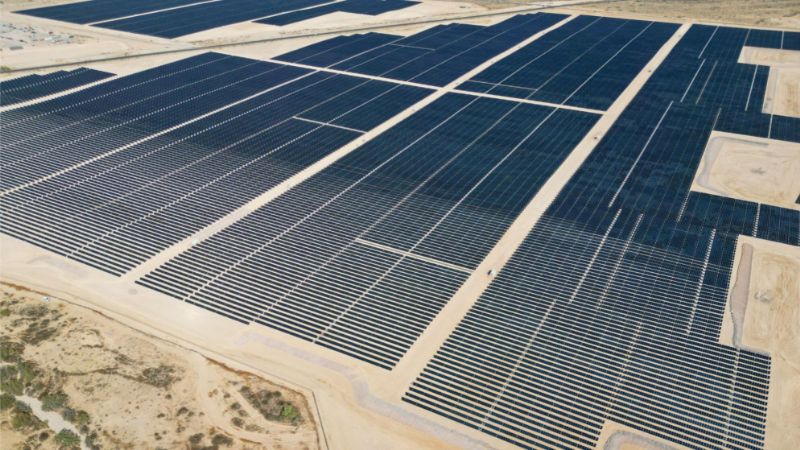
Sun Streams 4, one of the largest solar projects in the U.S., will connect 377 MW of PV and 300 MW/1.2 GWh of storage to Arizona’s power grid in 2025. Image used courtesy of Longroad Energy
2025 PV Projects
Annual global PV installations are projected to rise 9% in 2025 to 610 GW. China leads with a 47% share, followed by Europe (11%) and the U.S. (7%). With low module prices pushing demand high in the second half of 2024, solar module manufacturers are gearing up for a busy year. Bernreuter Research recently reported that the top-six module suppliers—including leading Chinese players like Jinko, Longi, and Trina—eyed a 40% growth rate last year, translating to around 622 GW of capacity based on their shipment targets.
In the U.S., more than 112 GW of large-scale solar projects are under construction or development, according to a database from the Solar Energy Industries Association. Most utility-scale and commercial solar projects slated to come online in the next few years have already secured an interconnection agreement or started construction. The Energy Information Administration (EIA) projects that 25 GW of solar capacity will come online in 2025, displacing about 11 GW of coal generation capacity set to retire in the same period.
One of the biggest solar and storage projects underway in the U.S. is Longroad Energy’s Sun Streams Complex in Arizona, totaling 973 MW of solar and 600 MW/2.4 GWh of battery storage capacity. After the first two phases began operations in 2021 and 2024, the fourth and largest project is underway with 377 MW of solar and 300 MW/1.2 GWh of storage. Commercial operations are slated for mid-2025.
One of the largest PV projects in South America is continuing construction in Brazil this year. The 902 MW Altas Vista Alegre Solar Park is expected to connect to the grid in 2025, generating 2 TWh annually for about 1 million households. Sungrow is supplying its line of modular inverters that can be combined in blocks for site flexibility.
China leads the world in solar deployment and is an early adopter of new solar innovations. Chinese developers recently unveiled a unique offshore solar concept with a 1-GW open-sea PV plant about 4.9 miles off the coast of Dongying, Shandong. By 2025, the Shandong province plans to deploy more than 11 GW of this technology.
China recently commissioned its first wave-resistant floating PV platform in the Yellow Sea. The Yellow Sea No. 1 unit will undergo final equipment commissioning before a one-year trial period.
Grid-Scale Energy Storage
Voltage instability and decreasing grid inertia have emerged as significant side effects of growing wind and solar integration, shifting the market towards grid-scale storage solutions to balance supply and demand.
Last year, the EIA estimated that developers would bring more than 300 utility-scale battery projects online by 2025 (9 GW). Among the biggest developments is Arizona’s Papago Storage, the state’s largest standalone storage project with 1.2 GWh of capacity. The site will come online in 2025, featuring e-Storage’s SolBank battery storage system.
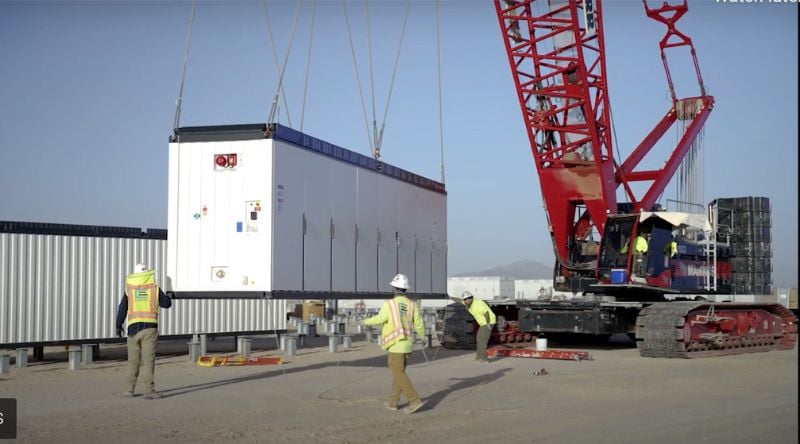
SolBank battery. Image used courtesy of e-Storage
Outside the U.S., Chinese PV manufacturer Sungrow will debut one of the world’s largest energy storage plants this year, with 7.8 GWh of capacity across three sites in Saudi Arabia. The project will install over 7 million battery cells and 1,500 sets of PowerTitan liquid-cooled systems featuring an AC storage integrated design with high energy density. The developers expect to secure a grid connection later this year.
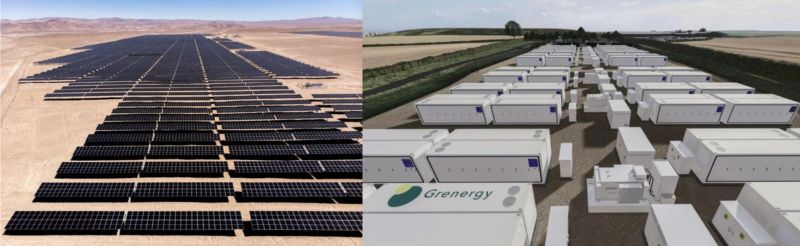
Grenergy will pair a 10.9 GWh battery storage system with a 2 GW solar farm in Chile’s Atacama desert. Image used courtesy of Grenergy
An even larger mega-project is underway in Chile. Grenergy will install a 10.9 GWh battery storage system co-located with a 2-GW solar farm as part of the Oasis de Atacama project. The first phase was scheduled to be connected by late 2024, with the remaining phases slated for 2025 and 2026.
Last October, Grenergy signed a supply deal with CATL for 1.25 GWh of EnerX battery containers and over 7,100 modules. The partners tout the product’s high energy storage density, capturing more energy in less space.
Onshore and Offshore Wind
Last year was eventful for offshore wind in the U.S., with the first two projects delivering their first megawatts of capacity along the East Coast. Two others are scheduled to begin construction in 2025, including the multi-state 1.2-GW SouthCoast Wind project and Avangrid’s 791-MW New England 1.
Meanwhile, the U.K. continues building its 3.6-GW Dogger Bank Wind Farm, about 80-118 miles off England’s North Sea coast. The project comprises three phases, each adding 1.2 GW of capacity. Turbine installation and commissioning in the first phase is expected to finish in the second half of 2025. The first GE Haliade-X turbines and the onshore converter station have already been installed, and the second converter will begin operating later this year. When completed in 2027, Dogger Bank will be the world’s largest offshore wind farm, powering 6 million homes.
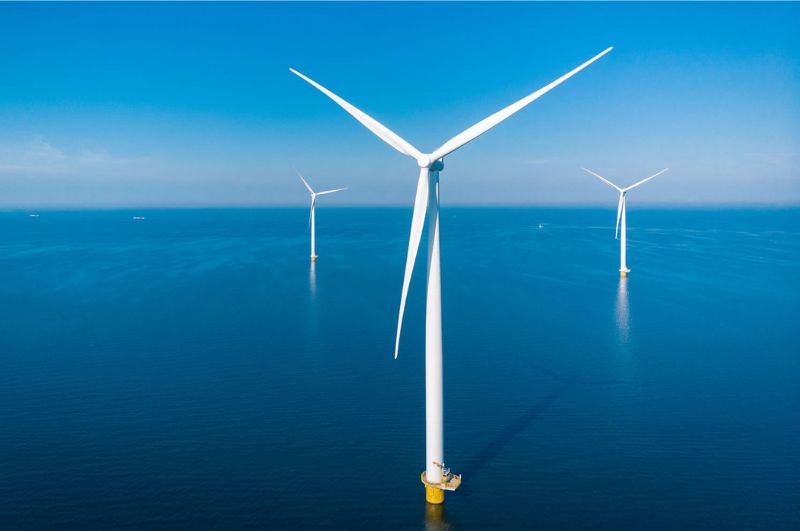
Construction continues on the 3.5-GW Dogger Bank Wind Farm off the coast of England. Image used courtesy of Dogger Bank Wind Farm
Despite offshore wind’s recent traction, conventional land-based turbines continue to expand worldwide. Pattern Energy will continue building its multi-state SunZia wind farm and transmission project this year, bringing power to 3 million Americans in New Mexico and Arizona. Among the largest renewable projects in the U.S., SunZia will install 3.5 GW of wind generation and a 550-mile-long high-voltage direct current transmission line to export energy from east-central New Mexico through Arizona, linking with the Western Interconnection grid near Phoenix. The transmission project started construction in 2023 and is expected to be completed this year, while the wind farm will come online in 2026.
Meanwhile, in Montana, Puget Sound Energy will soon commission its 248-MW Beaver Creek Wind project. When it becomes operational in August 2025, it will deliver enough power for 83,000 homes. The company has assembled all 88 turbines, and operations are expected to begin in August 2025. A future phase could add more wind units and a lithium-ion battery storage installation.