Facebook
 Google
 GitHub
 Linkedin
South Korean Researchers Create Technique to Estimate Daily Heating, Cooling in Buildings
Researchers from the Korea Institute of Civil Engineering and Building Technology introduced a new technique for measuring heating and cooling based on seasonal weather and advanced metering data across 12 commercial buildings in Seoul.
Researchers from the Korea Institute of Civil Engineering and Building Technology (KICT) in South Korea have developed a technique that provides real-time power usage data to help buildings reduce energy consumption.
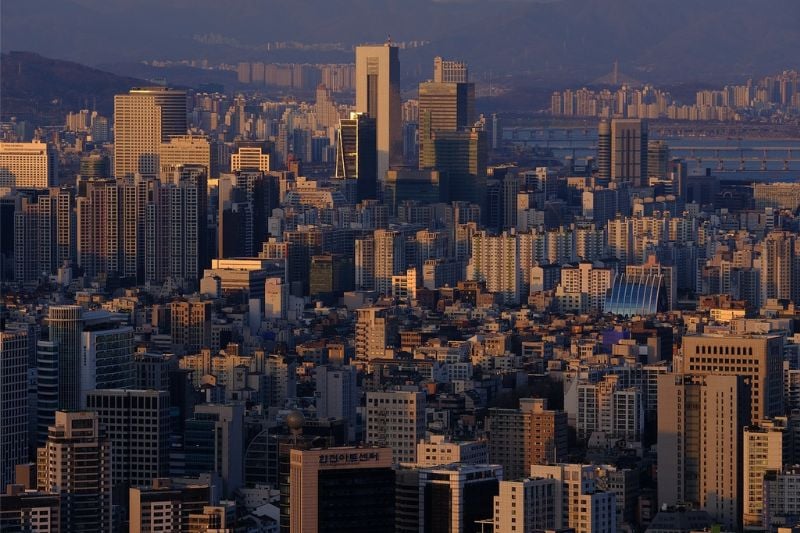
Seoul, South Korea. Image used courtesy of Pixabay
The method estimated the daily average of heating and cooling by energy use intensity across a dozen commercial buildings in Seoul, combined with real-time outdoor temperature and solar irradiance information from the Korea Meteorological Administration. They gathered the power consumption data from advanced metering infrastructure (AMI), a two-way communications system that uses smart meters to measure customers’ energy consumption.
Utilities are increasingly installing AMI systems worldwide, including South Korea’s largest electricity provider, the Korea Electric Power Corporation (KEPCO). The company previously planned to install 22.5 million smart meters nationwide. According to KICT, it completed around 48% of its AMI penetration target as of August 2022. It intends to reach the full target in 2024.
The South Korean government mandates public buildings to have AMI installed as part of its 2030 target to reduce national carbon emissions by 40% from 2018 levels. The country’s Green New Deal, introduced in 2020, calls for sustainability-focused renovations and remodeling on more than 227,000 public buildings, ensuring their transition into zero-carbon facilities. For scale, consider this: According to government statistics, South Korea had 7.3 million buildings in use in 2022, with residential (4.5 million) and commercial facilities (1.3 million) topping all categories, followed by industrial with 340,706 sites.
As part of its Zero-Energy Buildings plan, South Korea required all new public buildings with a gross floor area of at least 10,763 square feet to be designed with zero-energy requirements starting in 2020, using renewable energy for heating and power and optimized insulation performance. New public and private buildings with at least 5,381 square feet of floor area will be required to do the same by 2030.
Estimating & Benchmarking Heating/Cooling in Buildings
The study, published in Sustainability, mentions that most existing building energy benchmarking methods are based on total energy use intensity, which fluctuates seasonally. The KICT researchers wanted to develop a more reliable data pathway by employing an information gain-based temporal segmentation (IGTS) method to measure seasonal transition times based on hourly weather patterns and the matching building energy levels.
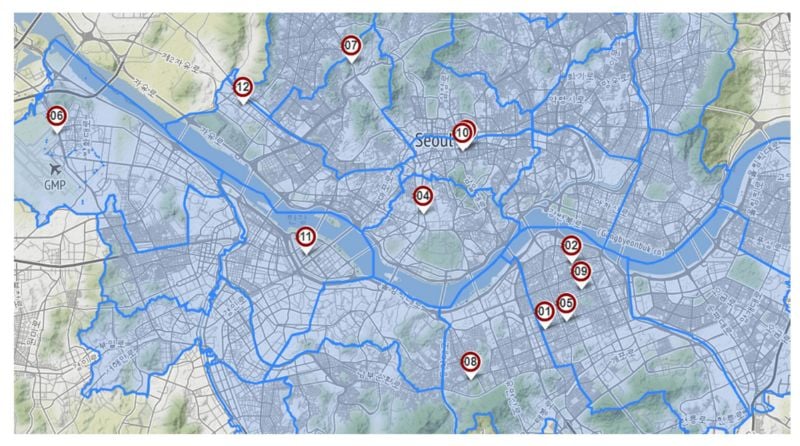
A map of the 12 commercial buildings analyzed in the study, all scattered across Seoul. Image used courtesy of the study’s authors (Figure 2) – Creative Commons
They used IGTS to analyze data from four seasons and gathered base-load and cooling/heating energy data covering 12 commercial buildings in Seoul. They measured eight end-uses of electricity across each building hourly for over a year: cooling and heating, hot water supply, air movement from fans, lighting, appliances, indoor transportation, and auxiliary devices. They also used data on gas end-uses, including cooling, heating, and hot water supply.
The researchers found the summer and winter periods revealed a linear relationship with an average difference of 9.07 kilowatt-hours per square meter. Differences in the benchmarking results from estimated to measured heating/cooling energy data were marginal, meaning the approach can effectively determine actual heating/cooling energy consumption in buildings.

Carpet plots with temporal segmentation results measure the total energy for two of the 12 buildings. Image used courtesy of the study’s authors (Figure 5) – Creative Commons
The authors also noted the South Korean government’s 2030 goal to cut carbon emissions in the building sector by 32.8% through energy-efficient technologies and energy-saving equipment.
The researchers said they plan to discuss expanding the technique’s application to the Public Buildings Energy Information System, run by the Korea Authority of Land and Infrastructure Safety. In future work, they aim to completely automate the system from data collection to storing, analyzing, and evaluating the information via logical algorithms.