Facebook
 Google
 GitHub
 Linkedin
Solar Energy Is Dropping in Price for Surprising Reasons
An MIT-led study revealed the hidden contributors to plummeting solar costs, and many had nothing to do with solar at all.
The drop in solar energy costs over the past five decades has been dramatic, from over $100 per watt in the 1970s to under $0.25 per watt today. However, while headlines have often pointed to improvements in panel efficiency or manufacturing scale, an MIT study shows that the real story is much more complex.
The study in PLOS One revealed that many innovations from outside the energy sector have been critical in reducing costs, from semiconductor manufacturing techniques to software automation and even oil and gas infrastructure practices.
The research combines quantitative modeling with qualitative mapping to identify more than 80 innovations that have significantly impacted the cost structure of photovoltaic (PV) systems. Importantly, it distinguishes between cost reductions in PV modules and the often overlooked balance-of-system components like racking, inverters, site planning, and labor. Each has had a different innovation trajectory, and many of the biggest cost-cutting breakthroughs had surprisingly little to do with solar R&D.

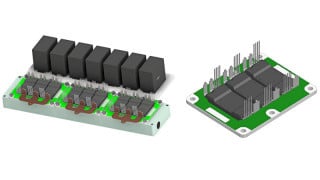
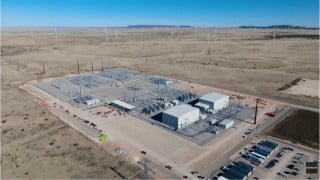
Multiple factors have led to decreasing prices in solar energy. Adapted from images used courtesy of Canva
From Semiconductor Labs to Rooftop Arrays
The study found a striking link in prices to the semiconductor industry, providing foundational technologies to scale solar manufacturing. This includes everything from silicon wafer production and wire sawing techniques to anti-reflective coatings and plasma-enhanced chemical vapor deposition.
For instance, the transition from slurry-based wafer slicing to diamond wire sawing—a process originally honed in chip fabs—dramatically cut material waste and kerf loss, increasing throughput. The MIT team estimates this alone reduced system-level PV costs by more than $5 per watt across decades.
Other technical contributions came from industrial glass manufacturing, which provided cost-effective cover glass and coatings with optical properties tailored to solar wavelengths. Manufacturing automation, borrowed from flat-panel display assembly lines and LED packaging, further streamlined module production. These developments didn’t just lower per-watt costs but also enabled the consistency and reliability needed for mainstream adoption.

Solar panel interlayer sheets at First Solar plant in Ohio. Image used courtesy of National Renewable Energy Laboratory/Dennis Schroeder
The timeline of these innovations also shows a lag between invention and solar deployment. Many enabling technologies existed for years before they were integrated into PV. In the case of PECVD, used to passivate surfaces in solar cells, it took more than a decade for the method to transition from semiconductor fabs to solar lines.
The Silent Power of Soft Innovations
While module costs get most attention, the MIT authors emphasize that BOS innovations were just as critical and often more diverse in origin. For example, innovations in permitting software and inspection protocols, particularly in markets like Germany and California, helped streamline deployment. Automated site assessment tools borrowed from civil engineering workflows reduced installation time and labor costs. Tools like inverter string sizing software, once a manual engineering task, became increasingly algorithmic, allowing non-specialists to design compliant systems at scale.
One standout example is the development of pre-assembled racking systems. While mechanically simple, they removed a major installation bottleneck and reduced crew training requirements. The result was faster installations and fewer errors in the field, with corresponding reductions in soft costs. Innovations like these highlight how some of the most influential advances were not necessarily high-tech, but rather logistical or organizational.
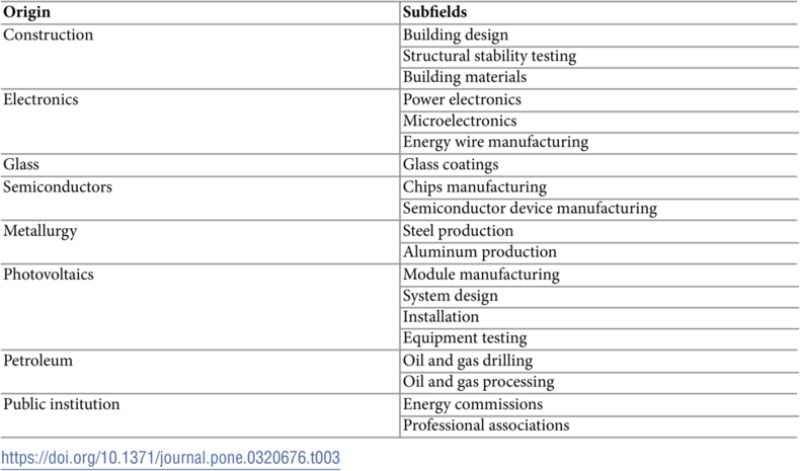
Industries and institutions involved with PV innovations. Image used courtesy of Kavlak et al.
Interestingly, several impactful BOS techniques came from non-solar infrastructure sectors. The study notes that directional drilling and trenchless cabling, refined for oil and gas, were later repurposed to lay underground power lines for solar farms, especially in constrained or urban environments. These technology transfers often happened quietly outside formal solar R&D funding channels.
Building a Blueprint for Cross-Sector Innovation
Rather than tracing cost changes only, the MIT team built a framework to categorize cost reduction mechanisms (such as material efficiency, process yield, or labor automation) and the source industries behind them. This dual-layered approach makes it possible to identify which innovations are likely to generalize across other fields, and which might be domain-specific dead ends.
This framework could prove valuable for analyzing past success and anticipating where future gains might come from. For example, the authors suggest that AI-based forecasting tools, modular robotic construction, and adaptive power electronics will likely play a significant role in solar’s next cost curve. Likewise, the growing overlap between electric vehicle battery systems and PV inverters points to convergence in materials sourcing, power management ICs, and thermal design.
The study also raises questions about funding models. If many of solar’s key innovations came from outside the solar industry, narrowly targeted energy R&D funding may miss important upstream enablers. Instead, fostering cross-pollination may offer a better return on investment. For engineers, the essential takeaway is that innovation doesn’t need to happen within your industry to change it.