Facebook
 Google
 GitHub
 Linkedin
Salt and ‘Fizzy Water’ Offer Alternatives to Lithium Recovery
Two research teams have developed sustainable, efficient options for recovering key metals from spent lithium-ion batteries.
The need for advanced battery technologies is growing as the world seeks sustainable, zero-emission energy sources. This demand is evident in applications ranging from supplemental energy storage for solar panels to the power systems of electric vehicles.
However, the rapid growth of lithium-ion batteries brings its own sustainability challenges. Manufacturing these batteries requires substantial quantities of raw materials that, like all finite resources, are limited in supply, and if disposed of improperly, pose an environmental risk of soil and groundwater contamination. Recycling spent batteries is critical for resource conservation and environmental protection, but it faces significant challenges, including limited recycling channels, high costs, and technical barriers.
Two developments in lithium-ion recycling technology come from Argonne National Laboratory (ANL) and a joint team from the Chinese Academy of Sciences and the Beijing Institute of Technology.
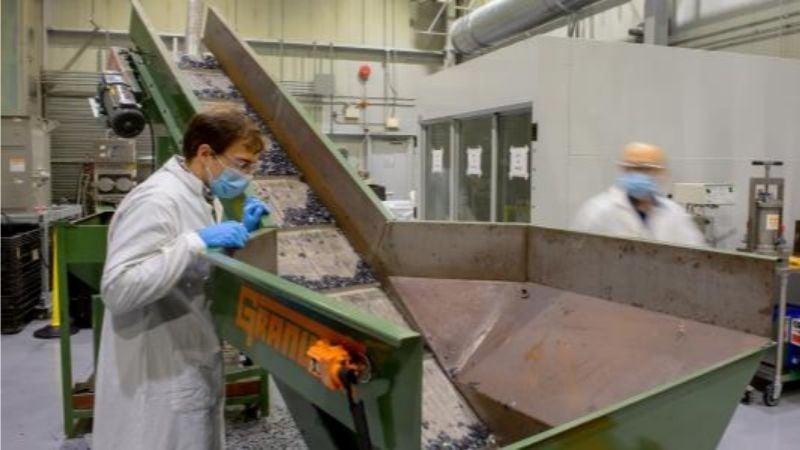
Battery recycling. Image used courtesy of Argonne National Laboratory
Molten Salt Baths
ANL researchers are developing a molten-salt process to extract valuable metals from used lithium-ion battery cathodes. The method is a form of pyroprocessing, a recycling technique already used to close the loop in the nuclear fuel cycle. It relies on two lithium-hydroxide-based salt mixtures that melt at relatively low temperatures and can tolerate moisture contamination—an important advantage since real-world recycled materials often contain water.
The first approach uses a lithium hydroxide-potassium hydroxide mixture at 280°C. Electricity dissolves the cathode metals into the salt solution, and the metals are then recovered by electrolysis, even in the presence of moisture.
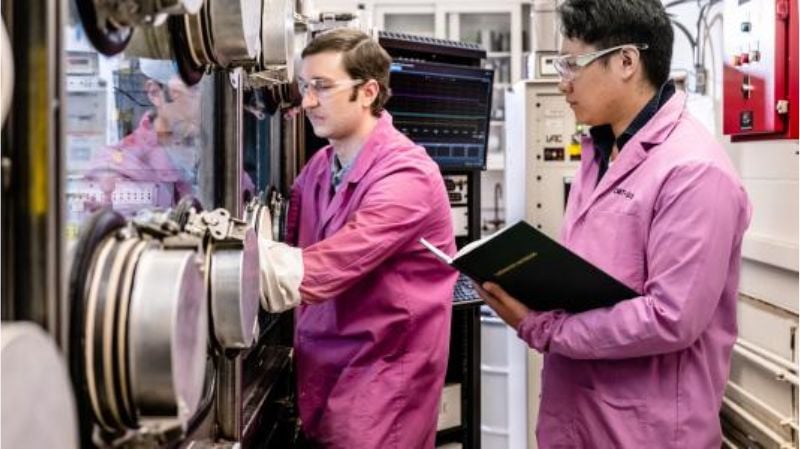
ANL battery recycling research. Image used courtesy of ANL
The second approach uses a lithium hydroxide-lithium chloride mixture. This process removes lithium and oxygen from the cathode, converting the internal compounds into metal-like forms that cluster together. Electrolysis subsequently recovers the lithium.
Because these salts melt at lower temperatures and tolerate water, the process could simplify battery recycling and reduce energy and pretreatment costs. The research team plans to scale the technology to 100-gram cathode batches to better understand operational requirements for larger facilities. If successful, the method could significantly lower the cost of lithium-ion battery recycling.
The Fizzy Water Fix
A joint team from the Chinese Academy of Sciences and the Beijing Institute of Technology has developed a “three-in-one” process for recovering metals from spent batteries. The method combines lithium extraction, recovery of cobalt, nickel, and manganese, and a unique form of carbon dioxide (CO₂) sequestration.
A CO₂-water mixture extracts lithium from the cathode. The reaction forms carbonic acid, essentially “fizzy water,” which is strong enough to gently dissolve lithium without harsh chemicals. The researchers report a lithium recovery rate of about 95%, comparable to conventional chemical recycling methods.
In cathodes containing cobalt, nickel, and manganese, the carbonic acid solution works the same to extract the metals. The recovered materials can then be reused as catalysts in energy and chemical processes.
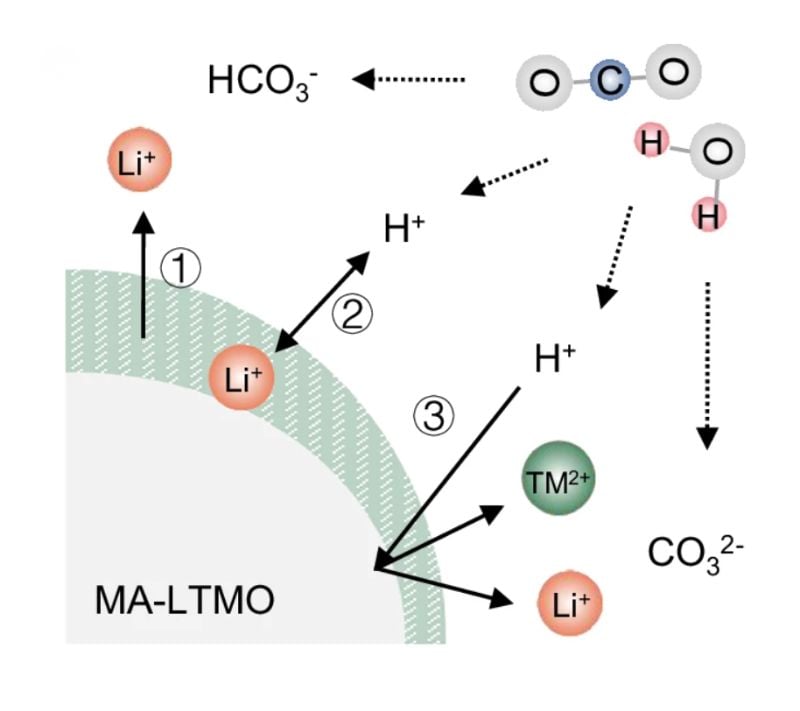
The lithium leaching pathway in a CO2 “fizzy water” solution. Image used courtesy of Wang et al.
A key advantage of the system is that CO₂ becomes chemically bound in the solid by-products, permanently locking it away instead of releasing it as emissions. The process operates at room temperature and normal pressure, improving safety while lowering energy and equipment costs. Although large-scale performance remains unproven, the approach offers a promising pathway to efficient lithium recovery and broader heavy-metal recycling from spent batteries.