Facebook
 Google
 GitHub
 Linkedin
Rethinking Physics in Wind Farm Design
MIT’s physics-based mathematical model for wind rotor aerodynamics gives wind farm designers a blueprint for energy efficiency.
Wind power is crucial in the renewable energy transition, and engineers have been developing new ways to capture this natural resource. Offshore wind farms capitalize on the high wind speeds far out to sea, and ultra-high-altitude wind farms can provide significant power because of the strength of air currents in mountainous regions.
Wind turbine wake simulation. Video used courtesy of American Physical Society
Until now, wind farm design has relied on inefficient testing and targeted adjustments to improve wind farm performance. However, understanding wind behavior may lead to better-designed wind farms.
MIT engineers are developing a theory of aerodynamics that updates momentum theory and reimagines rotor design, wind farm layout, and dynamic farm operations management as wind speed and direction change. This unified momentum model for rotor aerodynamics can help provide a theoretical blueprint for managing blade angles and wind turbine tower formation to minimize wake effects.
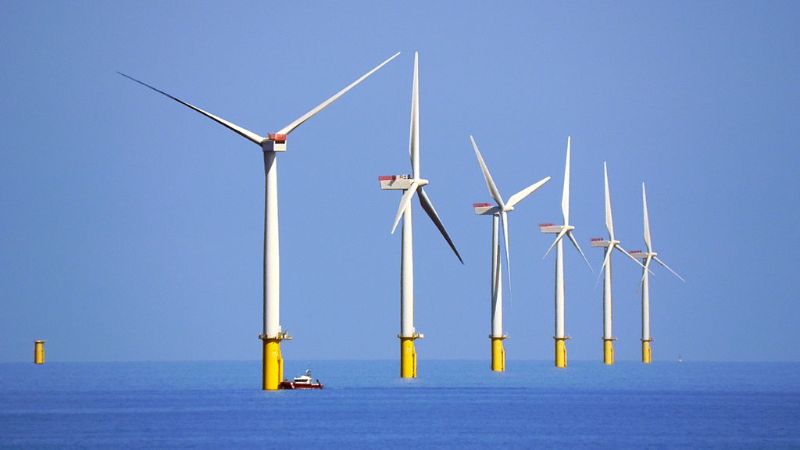
Walney offshore wind farm near England. Image used courtesy of Wikimedia Commons/David Dixon
Wind Wake Effects and Momentum Theory Limits
Wind farm management is a complex process. Winds change speed and direction constantly, and the turbine positioning and blade angles present challenges in optimizing energy efficiency. Local teams have handled the optimization because gaps exist between existing momentum theory and practical applications.
One primary practical problem for wind farm operators includes wake effects, which significantly impact overall energy production. Wake effects occur when the airflow behind a wind turbine is disrupted, reducing the wind speed and increasing turbulence for downstream turbines. This interaction can lead to an energy output drop for affected turbines and, according to researchers at the University of Colorado, can ultimately reduce power generation by 34%-38%.
The optimal layout of turbines is crucial for minimizing these wake losses. However, determining the best configuration involves balancing multiple factors, including turbine spacing, alignment with prevailing wind directions, and terrain features. For instance, studies have shown that spacing turbines at least seven rotor diameters apart can reduce wake losses, but this requires more land, which might not always be available.
Further complicating the issue is that wind conditions are not static. They change over time, requiring dynamic adjustments in turbine operation. Advanced computational models and real-time data are increasingly used to predict and mitigate wake effects. Still, because the calculations are always localized and never universalized, the industry is hampered by a constant need to rework solutions for particular wind farm configurations and conditions. As wind farms increase in size and number, effectively managing wake interactions and finding a fundamental approach to wind farm operation is a key challenge for maximizing their efficiency and economic viability.
The Unified Momentum Model and its Predictive Power
The MIT team might have found the fundamental mathematical model needed to help significantly improve wind farm design and operation. Momentum theory, established for over 100 years, presumes one-dimensional air flow and cannot account for the various flow patterns that impact wind farms daily. This false assumption has forced constant corrections, but a new Unified Momentum Model can account for more complex flow regimes and establish a stronger starting point for operational design.
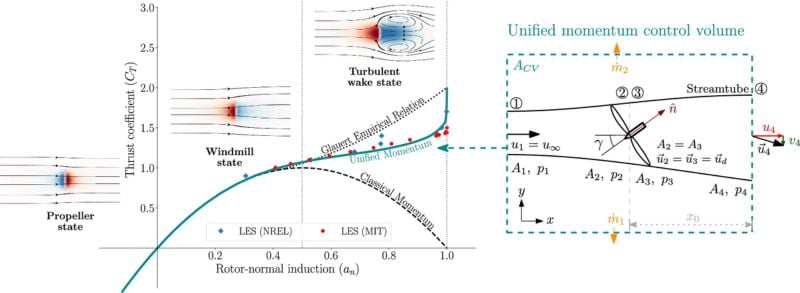
MIT researchers considered turbulent wake effects on turbines. Image used courtesy of Liew et al.
The model analytically relates induction, streamwise and lateral wake velocities, and wake pressure by applying control volume analysis around an actuator disk. Unlike previous theory, it accounts for pressure deficits persisting beyond the rotor, leading to more accurate predictions of thrust and power, especially under high thrust and yaw misalignments. The model integrates Bernoulli's equation and momentum conservation but excludes turbulence effects, focusing on near-wake dynamics.
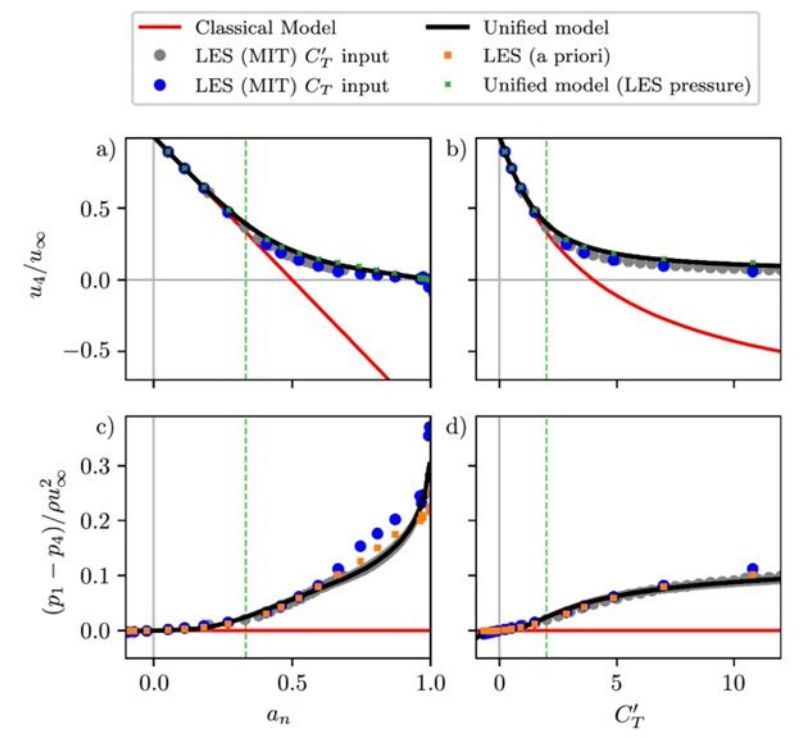
A contrast between the Unified Model and a previously used model. Image used courtesy of Liew et al.
Validation against large eddy simulations shows the model's superior accuracy over classical approaches, especially for higher induction factors. The model also predicts a marginal increase in power coefficient above the classical Betz limit due to the wake pressure deficit considerations. This model is extended into a blade element Momentum model, eliminating the need for empirical corrections in high-thrust and yaw scenarios and providing a more accurate and consistent prediction of turbine performance across different operating conditions.
This model's robustness and its potential to improve the predictive accuracy of turbine aerodynamic models is an exciting step forward for the wind power industry. Instead of constant re-testing and making ad hoc design adjustments, this theoretical leap in the aerodynamic modeling of wind turbines might be able to transform the practical processes and calculations associated with wind farm operation.