Facebook
 Google
 GitHub
 Linkedin
Researchers Explore Soapstone, Granite as Solar Storage Materials
A research team in Tanzania found that soapstone and granite show promise in storing thermal energy for concentrated solar power generation and food-drying applications.
Researchers from the Nelson Mandela African Institution of Science and Technology in northern Tanzania recently explored the potential viability of using soapstone and granite as thermal energy storage materials to address the intermittency of solar energy in concentrated solar power generation (CSP) and solar drying applications.

Researchers in Tanzania collected granite and soapstone samples from two geo-tectonic regions (Usagara and Craton) and tested their thermo-physical, thermo-chemical, and thermo-mechanical properties at different temperatures. Image used courtesy of the American Chemical Society (Creative Commons)
In CSP systems, heat from the sun can be stored to generate electricity or dry foods. Typically, this function is handled by large batteries, but high production costs are a significant drawback limiting the market. Granite and soapstone, created under high heat and abundant worldwide, present compelling battery alternatives. Location matters, though, as the researchers found that samples from two geo-tectonic belts in Tanzania contained very different properties.
Ultimately, soapstone from Tanzania’s Craton region performed best as a thermal energy storage material, staying stable at high temperatures and transferring, storing, and absorbing heat effectively.
Rocks as Thermal Storage
The researchers wrote in the abstract that granite—the continental crust’s most abundant rock—has already been established to exhibit a high energy storage potential. Soapstone/steatite rocks, meanwhile, offer a higher thermal shock resistance than most natural rocks but primarily haven’t been studied for thermal storage.
Natural rocks are efficient for concentrated solar power generation, making them well-suited for storing thermal energy. Storage with air-rock beds also has low investment costs, high reliability, and efficiency and doesn’t require heat exchangers. They work by storing solar thermal energy captured by concentrating collectors to temperatures reaching 932 to 1,112 degrees Fahrenheit (°F), serving as the heat transfer fluid warming the air to higher temperatures, which then boils into steam to churn the generator turbines to produce electricity.
Beyond power generation, when thermal energy is used to dry agricultural food products, it’s stored at a much lower temperature, around 104 to 167 °F.
Granite and soapstone bring promising opportunities for both applications. However, since their properties vary widely by location, a rock from one site may significantly outperform a similar alternative many miles away. For example, the rock samples collected in the study came from regions 162 miles apart by driving distance.
Comparing Soapstone and Granite Performance
The researchers started the project by obtaining rock samples from two geo-tectonic settings: Craton (in the Dodoma region) and Usagara (Iringa region).

Section “a” of the map shows the sample locations and geotectonic settings of the Dodoma and Iringa regions; “b” and “c” zoom out to reveal the site locations in maps of Tanzania and Africa. Image used courtesy of the American Chemical Society (Creative Commons)
The researchers detailed their experimental investigation in a recent paper published in the American Chemical Society’s Omega journal. They sought to explore soapstone and granite rocks as potential thermal energy storage materials and the influence of the sample sites’ geo-tectonic settings.
The research team investigated the rocks’ thermo-chemical, thermo-physical, and thermo-mechanical properties, finding that soapstone from Craton presented the best candidate for thermal energy storage at solar drying and CSP temperatures. It outperformed the other rock candidates in thermal capacity and conductivities, yielding suitable storage and transmission of heat per degree change. It also stays stable at higher temperatures.
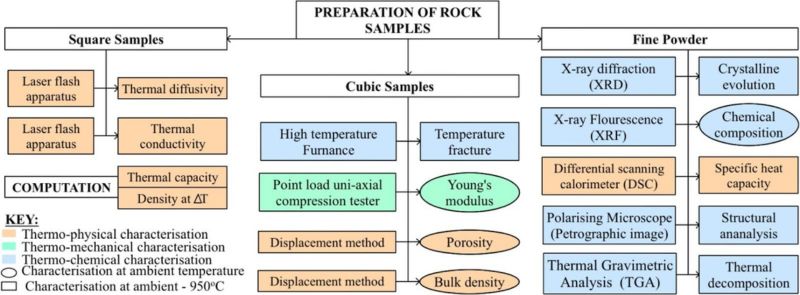
An overview of the characterization experiments used to study thermal energy storage in rocks. Image used courtesy of the American Chemical Society (Creative Commons)
However, granite from Craton exhibited visible fractures under high temperatures, while the three other rocks didn’t show signs of cracking.
Soapstone from Usagara was a close second regarding thermal capacity and thermal conductivities. Still, the rocks were vulnerable to deterioration at high temperatures and showed the lowest mechanical strength, making them easy to disintegrate due to rock-bed loading.
Meanwhile, the Usagaran granite exhibited low thermal capacity and conductivity, requiring a high temperature change to meet the same energy storage levels of soapstone—meaning it’s insufficient for solar drying, as temperatures exceeding 167 °F can affect the nutritional content of dried foods. Craton granite rock also disintegrates at solar drying temperatures.
In the paper’s conclusion, the researchers noted that more experimentation is needed to determine the rocks’ real-world performance capacity in thermal energy storage applications.