Facebook
 Google
 GitHub
 Linkedin
NREL Rolls Out Python-Enhanced Ocean Energy Models
The upgraded Marine and Hydrokinetic Toolkit helps developers assess and improve marine renewable energy technologies.
Renewable energy has transformed the wind, the sun, and battery chemistries into the engines of the future. However, marine renewable energy (MRE) remains an untapped sector with potential.
Learn about the National Renewable Laboratory’s MRE research. Video used courtesy of NREL
MRE can meet the entire world’s annual electricity needs, according to the World Economic Forum, if the projects used to capture it are executed, scaled, and optimized to their fullest potential. Then what’s the holdup? MRE modeling techniques, data simulations, and analytical tools are all still in the development phase, and many teams have had to work in isolation to build models and prototypes to test the waters with their ideas. Additionally, the harsh marine environment is hostile to small-scale innovations, and many companies cannot afford to build the necessary support to move ideas into production.
The National Renewable Energy Laboratory (NREL), Sandia National Laboratories, Pacific Northwest National Laboratory, and others collaborated to release the Marine and Hydrokinetic Toolkit (MHKiT). The project has updated the toolkit with MATLAB, Python modules, and data enhancements to help researchers bring their MRE projects to life.
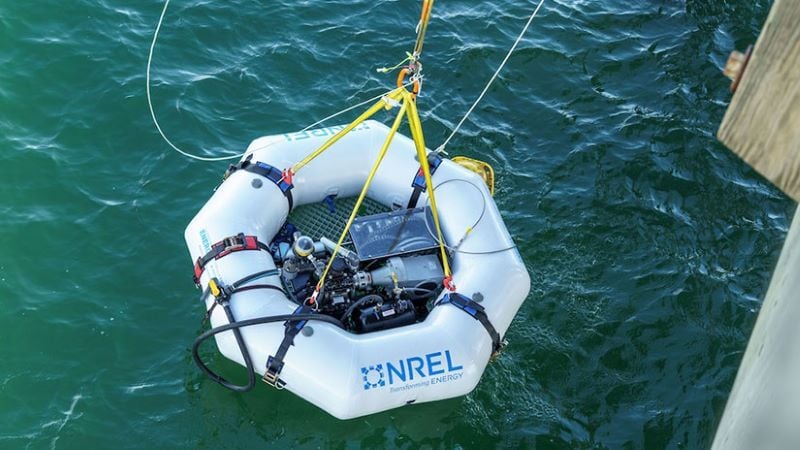
Researchers are working on a wave converter using the MHKiT. Image used courtesy of NREL/Andrew Simms
Why It’s So Difficult to Scale Wave Energy Converters
MRE projects try to capture the energy of waves, tides, and ocean thermal energy conversion (OTEC), which capitalizes on temperature differences in the water. However, the most common MRE project involves offshore wind farms. Classifying offshore wind farms as MRE projects almost seems inappropriate since wind is the main resource creating power. MRE projects that use the ocean’s energy, like wave energy converters, too often remain dead in the water due to expensive scaling costs and difficulties faced in the research and development phase.
Building wave energy converters (WECs) presents numerous technical challenges, particularly due to the harsh and unpredictable marine environment. A primary issue is survivability: WECs must endure extreme weather conditions, such as high waves and powerful storms, without sustaining damage. Mechanical components like turbines, hinges, and generators are susceptible to corrosion from saltwater and require advanced materials and coatings to prevent deterioration.
Because survivability is low, it is difficult to secure significant infrastructure investment. One notorious WEC failure was when Pelamis Wave Power, an early pioneer in wave energy, gave up in 2014 after spending years attempting to develop WECs.
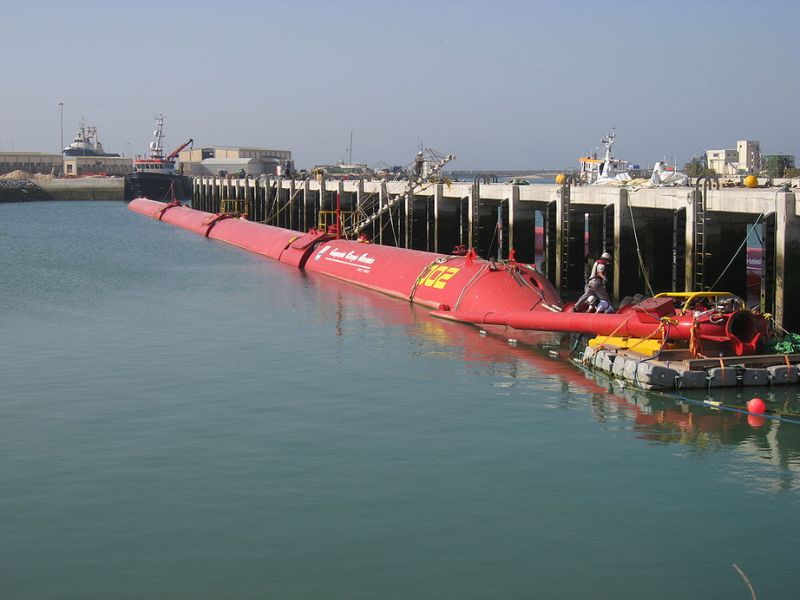
Pelamis WEC. Image used courtesy of Wikimedia Commons
Despite their innovative approach, the company’s technology faced significant difficulties in scaling up to a commercially viable model due to high costs, survival challenges during rough sea conditions, and a lack of robust performance data.
Early-stage MRE developers often struggle to validate and improve their technologies without tools like MHKiT, which offers standardized data analysis and performance modeling. These hurdles make it difficult to attract investment or achieve the operational scale necessary for success, leading to abandoned or delayed projects.
Another significant challenge is the variability in wave energy. Wave patterns are irregular and differ based on location and season. This makes it difficult to design WECs that can consistently harness energy across wave heights and frequencies. Additionally, the high deployment and maintenance costs, given the remoteness of most WEC sites, further complicate scaling up these technologies.
MHKiT’s MATLAB and Python Versions
The MHKiT’s advantages will make research, development, and scalability more feasible for WECs and other marine projects yet to be commercialized.
Since it first became available in 2020, MHKiT has been downloaded 29,000 times, showing the need and demand for the tools it already offers. Experts continue performing unit testing and code reviews to ensure these tools are maintained and developed as software development processes evolve.
The updated version of MHKiT has been built for the MATLAB programming platform (MHKiT-MATLAB). This version can assist researchers with modeling sea conditions accurately. Another version has also been developed for Python, allowing easy access and use of multidimensional data typically furnished by research institutions such as the Coastal Data Information Program and the National Oceanic and Atmospheric Administration. These software versions, combined with access to authoritative data, can help developers standardize their data and produce models to facilitate development rooted in dependable, accurate information without hazarding the high seas.
Importantly, MHKiT can now help with the site selection process, which is difficult, given the wide variety of weather factors and other variables. Researchers can confidently vet sites for WECs or OTEC projects with specific geographic parameters for operation.
Accurately modeling tidal flows, ocean turbulence, and wave swells with MHKiT will allow researchers to predict how their equipment will perform, bringing us one step closer to building and testing that equipment.