Facebook
 Google
 GitHub
 Linkedin
Machine Learning Delivers Faster, More Reliable Power Flow
MIT researchers created a problem-solving framework that outperforms other methods in identifying grid constraints.
In power grid operations, solving the AC Optimal Power Flow (AC-OPF) problem is fundamental, and grid operators must determine the most cost-effective way to dispatch power while never violating system constraints. Grid operators must run the optimization continually, in response to fluctuating demand, dynamic grid topologies, and generation variability, especially from renewable sources.
Conventional optimization methods, such as interior-point or sequential quadratic programming algorithms, can solve the AC-OPF problem to global or near-global optimality. However, as power grids scale in size and complexity, these solvers face performance bottlenecks. They can require extensive computation time to solve large nonconvex OPF instances, which impedes real-time decision-making.
To address these limitations, MIT researchers developed FSNet, a two-stage optimization framework that merges machine learning and mathematical programming to deliver fast, feasible, and high-quality solutions to constrained optimization problems. FSNet is specifically designed to ensure feasibility across both equality and inequality constraints, a crucial requirement for safety and reliability in grid operations.

Machine learning can optimize power grid operations. Adapted from images used courtesy of Canva
Neural Predictions Plus Feasibility Refinement
FSNet separates the solution process into two complementary phases. The first phase uses a deep neural network to generate an initial guess for the solution. The network trains on historical or simulated OPF instances and their corresponding optimal or near-optimal solutions. After learning complex mappings between problem instances and feasible solutions, the network can rapidly produce a near-feasible prediction.
The second phase involves a feasibility-seeking optimization algorithm that refines the neural network’s output. This stage uses the prediction as a warm start and iteratively reduces constraint violations through a constrained optimization process. The goal is not to recompute the solution from scratch, but to correct the neural guess just enough to satisfy the full set of AC-OPF constraints.
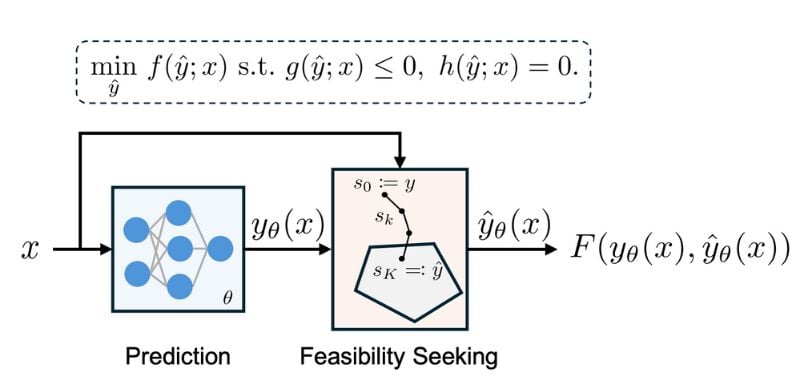
The FSNet framework for solving constrained optimization problems. Image used courtesy of Nyugen and Donti
In the feasibility step, a constrained minimization problem incorporates both equality constraints, such as Kirchhoff’s laws and power balance equations, and inequality constraints, like line limits and generator bounds. This refinement uses no custom neural architecture for constraint handling; rather, it relies on classical constraint enforcement mechanisms applied post-prediction. This architecture allows the FSNet to be used in a wide variety of optimization domains beyond power systems.
Benchmarking Against Traditional Solvers and Pure ML Models
The researchers tested FSNet on standard OPF cases ranging from small IEEE 14-bus systems to larger, more realistic grid configurations with hundreds of buses and dozens of generators. Each benchmark compared FSNet against three baselines:
- conventional optimization solvers
- pure deep learning predictors without feasibility correction
- other hybrid models that attempt constraint handling during or after training
The results demonstrated that FSNet achieved orders-of-magnitude faster computation times compared to traditional solvers while maintaining constraint satisfaction. Where conventional solvers might take tens of minutes to hours for large test cases, FSNet reduced this to minutes or even seconds, depending on the system size.
Pure neural networks, although fast, frequently produced infeasible solutions, violating critical grid constraints such as bus voltage limits or generator capacities. These violations render such predictions unusable in real-time dispatch environments. FSNet, by contrast, consistently delivered feasible solutions due to its second-stage optimization process.
_showed_near-zero_constraint_violations_compared_to_other_solving_methods.jpg)
FSNet (blue) showed near-zero constraint violations compared to other solving methods. Image used courtesy of Nyugen and Donti
In addition, FSNet offered better quality solutions than traditional solvers in some complex cases. This outcome stems from the neural network's ability to identify latent structure in the training data that solvers cannot exploit directly. When initialized from this data-informed position, the feasibility refinement step avoids local minima that often trap deterministic solvers.
From a numerical analysis perspective, FSNet also demonstrated robustness to initialization and parameter settings. The feasibility stage’s convergence behavior was largely insensitive to the quality of the neural prediction, thanks to the convexification strategies used in the refinement subroutine. This decoupling between prediction and correction adds to FSNet’s practicality in operational deployments.
Implications for Grid Operations and Constrained Optimization
FSNet presents a meaningful step forward for real-time optimization in energy systems. By reducing solve times from hours to minutes without compromising constraint satisfaction, it enables faster re-dispatch cycles, more responsive contingency analysis, and enhanced integration of variable resources like wind and solar.
In high-penetration renewable scenarios, grid conditions fluctuate too rapidly for traditional OPF solvers to keep up. FSNet’s architecture supports a predictive-operational loop, where the network continually learns from solved instances and adapts to new topologies or demand patterns. The feasibility step guarantees safe execution, making the system resilient to forecasting errors or unmodeled dynamics.
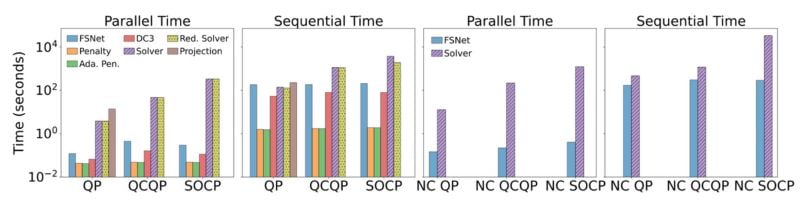
The FSNet used less computational time. Image used courtesy of Nyugen and Donti
Beyond power systems, the FSNet framework generalizes to any domain requiring constrained optimization with strict feasibility. Examples include supply chain scheduling, financial portfolio design, autonomous systems control, and robotics. The core principle of using ML to generate a warm start followed by constraint-aware refinement ultimately applies wherever feasibility is a hard requirement.
Limitations still exist. FSNet’s memory footprint can be significant, especially for large-scale neural networks trained on high-dimensional data. The researchers acknowledge the need for more efficient model architectures and faster refinement solvers. Additionally, while FSNet ensures constraint satisfaction, it does not guarantee global optimality. However, in many practical applications, a fast, feasible solution is preferable to a slower theoretically optimal one.