Facebook
 Google
 GitHub
 Linkedin
Ice-Fire Flash Annealing Could Create More Powerful Capacitors
Researchers have developed a one-second method for producing high-performance capacitors that endure extreme temperatures while preserving wafer-scale compatibility.
A team of materials scientists at the Chinese Academy of Sciences has unveiled a flash annealing technique that crystallizes energy storage capacitors in just one second, a process they liken to forging “with ice and fire.” Using simultaneous heating and cooling at an astonishing 1,000°C per second, the team successfully locked in the high-temperature nanostructure of a relaxor antiferroelectric (RAFE) film, resulting in record-setting performance in both energy density and thermal stability.
The process targets a perennial bottleneck in electronics: how to build capacitors that are compact, powerful, and reliable in extreme environments. The researchers’ flash heating and cooling (FHC) method enables the rapid fabrication of lead zirconate films with finely tuned nanodomains and defect-resistant grain boundaries. These films boast a breakdown field of nearly 5 MV/cm and an energy density of 63.5 J/cm3, while maintaining stable performance up to 250°C, a thermal envelope wide enough for automotive and aerospace deployments.
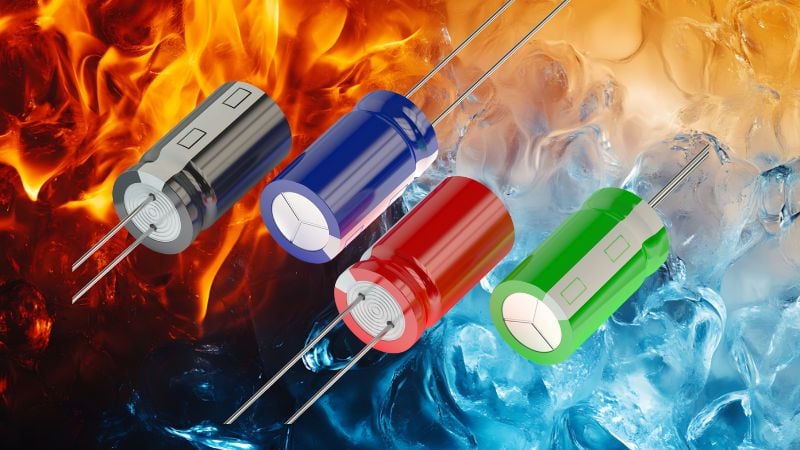
Scientists say an "ice and fire” forging process could produce capacitors with higher energy density. Adapted from images used courtesy of Canva
One Second To Lock in Order
The core idea behind the team’s breakthrough is deceptively simple. You capture the optimal high-temperature domain structure and freeze it in place before it can relax into a lower-performance state. In practice, this means pushing amorphous PZO films through a phase transformation in less than a second. Electromagnetic induction and thermal conduction heat the films on a graphite stage to above 600°C almost instantaneously, which then plunge into liquid nitrogen to quench the structure.
The result is a wafer-scale film comprising densely packed nanodomains and an unusually high fraction of low-angle subgrain boundaries, both keys to performance. The nanodomains allow the film to exhibit slim, low-loss polarization-electric field (P-E) loops, which means more energy can be recovered during discharge. The subgrain boundaries, meanwhile, disrupt the long-range domain ordering that typically causes energy loss and instability under thermal cycling.
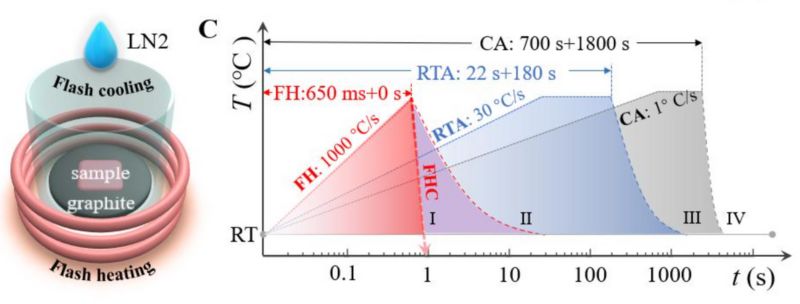
Flash heating and cooling, leading to relaxor AFE film synthesis in about one second. Image used courtesy of Chinese Academy of Sciences
Where conventional processing methods, such as rapid thermal annealing or standard furnace treatment, rely on slower temperature ramps and cooling times measured in minutes, FHC completes the cycle in under a second. This suppresses lead volatilization, which is a common defect source in PZO films, and ensures a more chemically balanced final product. That, in turn, reduces leakage current and improves the material’s dielectric strength.
Grain Structure and Performance in Sync
Crucially, the researchers found the unique structural features of FHC-treated films arise from the interplay of thermal gradients, lattice stress, and defect formation during the quench. Atomic-resolution microscopy revealed that FHC produces smoother surfaces, narrower grain boundaries, and a much higher density of dislocation-induced subgrains compared to films treated by slower methods.
This fine-grained structure correlates directly with improved performance. PZO films treated with FHC can withstand electric fields up to 4.8 MV/cm, which is nearly four times higher than those processed in a conventional furnace. Thanks to their slim P-E loops and minimized hysteresis, they can store and recover significantly more energy per cycle. Leakage current, a typical limiting factor in dense capacitors, drops by up to five orders of magnitude.
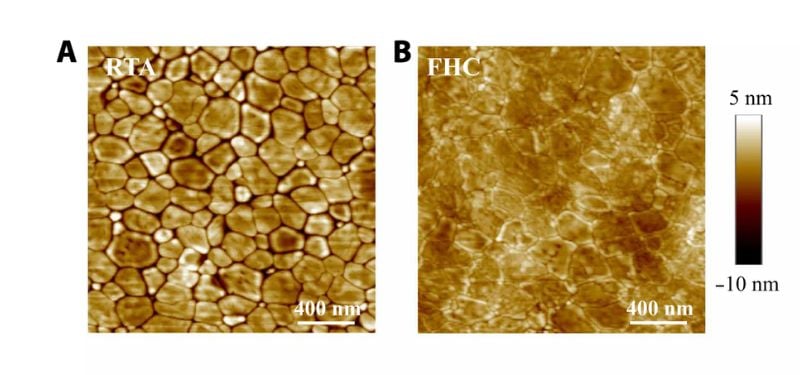
Grain distributions of RTA vs. FHC. Image used courtesy of Li et al.
Even after 100 rounds of exposure to temperatures ranging from –196°C (liquid nitrogen) to 400°C, the FHC films retained more than 99% of their initial energy density. By comparison, films annealed by slower methods degraded noticeably, both in structure and electrical performance.
Ready for Scaling
Beyond raw performance, the FHC process is noteworthy for its compatibility with industrial manufacturing. The team demonstrated their technique on a full 2-inch wafer, achieving tight uniformity in both crystal structure and energy storage characteristics across multiple sites. This opens the door to on-chip capacitors that combine high power density with extreme resilience.
Because the technique is also compatible with other ferroelectric materials, its potential reach goes beyond PZO-based systems. The researchers showed that FHC treatment can transform conventional ferroelectrics into high-performance relaxor states, boosting their energy density by a factor of five in some cases.
For now, the team’s focus remains on refining the process and exploring new materials. However, there are broad implications for forging high-performance energy films uniformly, at wafer scale, in just one second.