Facebook
 Google
 GitHub
 Linkedin
Could an Underwater Power Grid Help Offshore Wind?
An offshore power grid could make offshore wind farm expansion easier and less expensive.
The U.S. East Coast offers vast offshore wind power potential, but transmitting electricity from offshore wind farms to onshore communities has presented a significant challenge. Traditional transmission methods have proven costly and disruptive, while efforts to build new onshore transmission lines often face public opposition.
How is offshore wind power connected to users on land? Video used courtesy of DTU Wind and Energy Systems
The U.S. Department of Energy and several Northeast states have developed plans for an offshore electric power grid. The project addresses obstacles to the widespread adoption of offshore wind power.
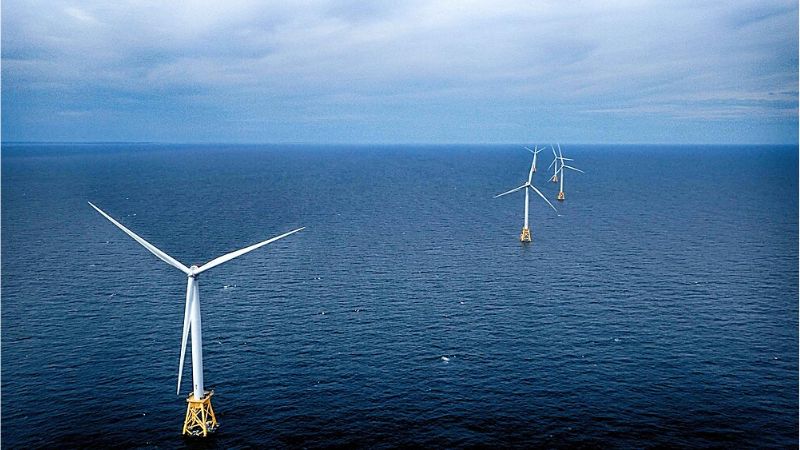
Block Island wind farm near Rhode Island. Image used courtesy of Wikimedia Commons
Offshore Wind Challenges
Wind is a carbon-free, renewable energy source that produces electricity without fuel combustion or air pollution. In the U.S. alone, wind energy helps prevent 336 M metric tons of carbon emissions each year, equivalent to the emissions from 73 million cars. According to one study, offshore wind farms could generate up to 11 times the anticipated global electricity demand for 2040.
Yet, despite wind power’s promise, transmitting power from offshore wind farms to onshore communities poses significant challenges.
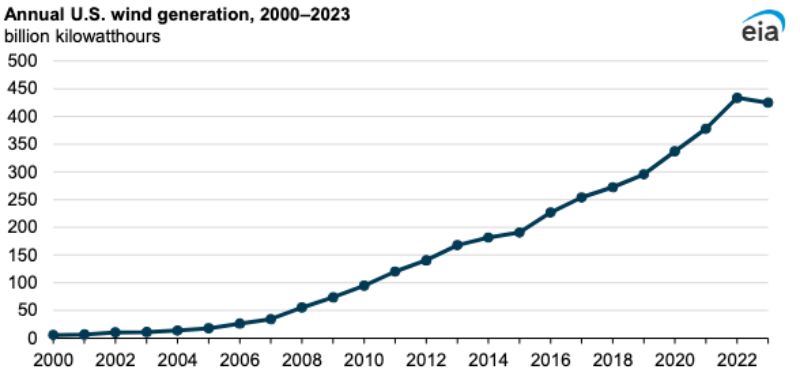
U.S. wind production has grown steadily until last year. Image used courtesy of Energy Information Administration
The distance between these farms and population centers necessitates extensive transmission infrastructure. Traditional point-to-point methods are becoming increasingly inefficient and costly as projects increase. Meanwhile, installing onshore power grids to support wind energy is a complex and expensive process ranging from $1 million to $3 million per mile for high-voltage transmission lines. From 2021 to 2023, costs for offshore wind projects increased by up to 50%.
Finally, constructing new onshore transmission lines frequently encounters public resistance due to concerns about visual impact and property values. The result is prolonged approval processes and potential delays in infrastructure build-out.
Winds of Change
The U.S. Department of Energy and 10 Northeast states planned a new approach to the offshore electric power grid, which they hope can reimagine electricity transmission from East Coast wind farms.
This grid will feature backbone transmission lines stretching from North Carolina to Maine, connecting multiple offshore wind projects through a "meshed" or "backbone" design. Unlike the current point-to-point system, this coordinated approach allows numerous wind farms to share transmission lines, ultimately reducing infrastructure needs and costs. Using subsea cables, electricity produced offshore can connect to the onshore grid, effectively reducing the need for new land-based transmission lines.
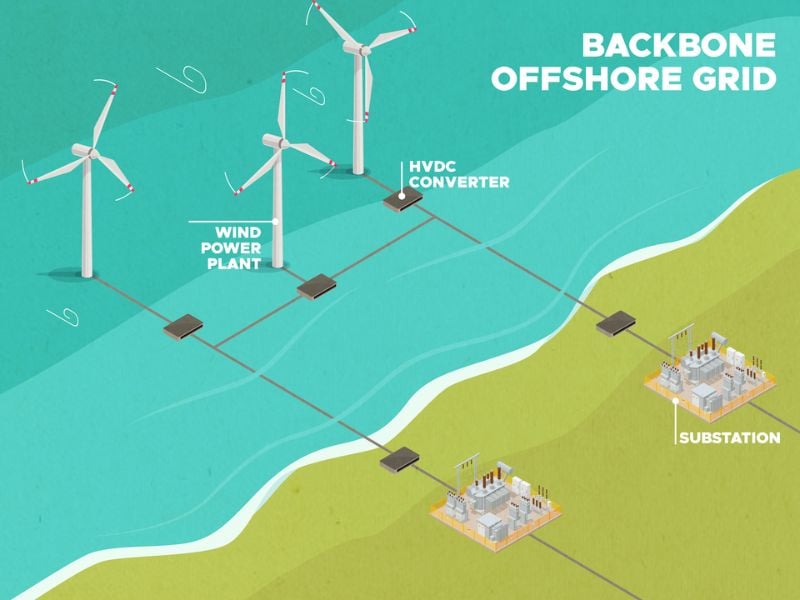
Backbone design for wind power transmission. Image used courtesy of Pacific Northwest National Laboratory/Stephanie King
The design can reduce beach crossings by a third and transmission cable miles by 35-60% compared to point-to-point systems. Additionally, its positioning in federal waters may help reduce conflicts associated with public approvals.
The grid aims to support 85 gigawatts of offshore wind power by 2050, which alone nearly reaches the U.S. goal of 110 GW.
Powering Tomorrow
By addressing notable challenges in transmission and cost-effectiveness, the DOE hopes the transmission infrastructure will accelerate the adoption of offshore wind power along the U.S. East Coast. As South Fork, the first utility-scale wind farm in the U.S., was completed in March 2024, the timeline for implementing this grid system seems feasible within the next few decades.