Facebook
 Google
 GitHub
 Linkedin
Hot Wire: 5 Breakthroughs in Renewable Energy Tech
Researchers worldwide innovate solutions for grid-edge management, carbon capture tech, nuclear batteries, dry-coated electrodes, and more.
As the industry aims for greater sustainability through increased renewable use and decreased waste, academic research has led to many practical developments. The most recent research seeks to enhance grid resilience, reduce material waste, and improve battery technology.

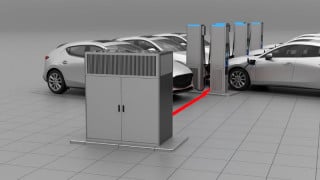
Steam production from the chemical-looping combustion plant. Image uaed courtesy of KIER
1. MIT’s EUREICA Framework
Considering the power grid vulnerabilities caused by cyber-attacks and natural disasters, MIT engineers have developed the EUREICA framework. This decentralized grid-edge system combines rooftop solar panels, electric vehicle chargers, smart thermostats, batteries, and other IoT devices. EURERICA aims to improve grid resilience.
The system uses an advanced algorithm to dynamically coordinate distributed resources and mitigate power deficits ranging from 5% to 40%, while field tests have validated its effectiveness under simulated attacks. The architectural design focuses on real-time data exchange, secure device authentication, and rapid shutdown capabilities.
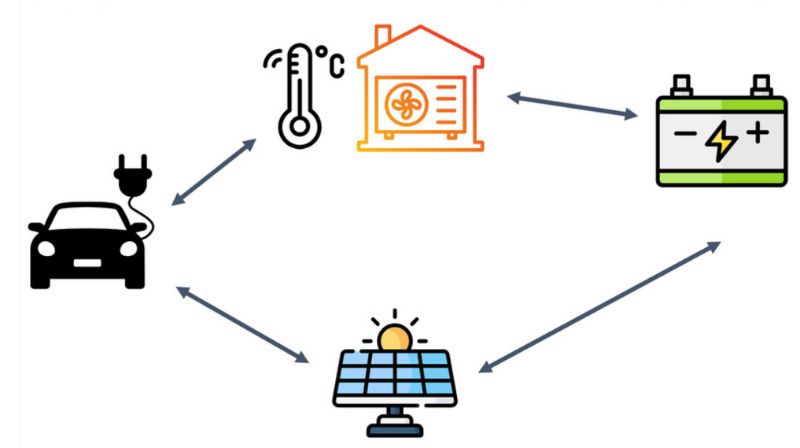
IoT integrating decentralized devices. Image used courtesy of MIT News
2. Korea’s Chemical Looping Combustion Technology
Addressing the challenge of efficiently separating carbon dioxide from conventional gas combustion emissions, the Korea Institute of Energy Research, in collaboration with the Korea Electric Power Corporation, has developed a chemical looping combustion (CLC) system that isolates CO₂ during power generation. The system uses oxygen-carrying particles to deliver pure oxygen to fuel and enable flameless combustion that produces only CO₂ and water vapor. The result is the elimination of post-combustion separation and a significant reduction of NOₓ emissions.
According to the team, this method lowers CO₂ capture costs by 30%, supports steam production for electricity, captures over 150,000 tons of CO₂ annually, and can help companies boost profits by 4% annually. The team demonstrated that a 3 MW pilot plant with over 300 hours of continuous operation had an impressive CO₂ separation efficiency exceeding 96%.
3. The Gamma-Powered Battery
Safely managing radioactive waste from nuclear power plants is a big challenge. Recently, researchers at Ohio State University have developed a novel battery that converts ambient gamma radiation from nuclear waste into electricity using scintillator crystals and solar cells.
The compact 4-cm³ prototype extracts energy from isotopes like cesium-137 and cobalt-60 to generate 288 nanowatts and 1.5 microwatts, respectively. Some structural optimizations in crystal volume and surface area enhance light emission and power output, while the design ensures the battery remains safe to touch despite its radiation-harvesting functionality. The battery is designed for deployment near nuclear waste storage or extreme environments.
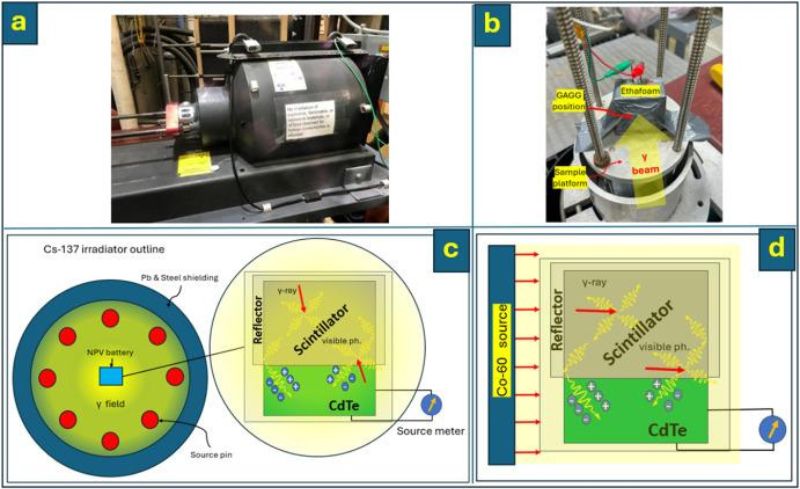
Experimental arrangements of the atomic battery. Image used courtesy of Oksuz et al.
4. The Dry Process Electrode Battery
A research team at UNIST has developed a dry process electrode that addresses the challenge of manufacturing thicker battery electrodes without clumping during solvent evaporation. The electrode from this dry process is five times thicker than conventional models. It exhibits a mixture layer density of 3.65 g/cm³ and an areal capacity of 20 mAh/cm², equivalent to a 14% increase in EV range.
A porous spherical conductive material incorporated in the design significantly enhances conductivity despite increased thickness and facilitates the large-scale production of high-capacity 1 Ah-class pouch cells.
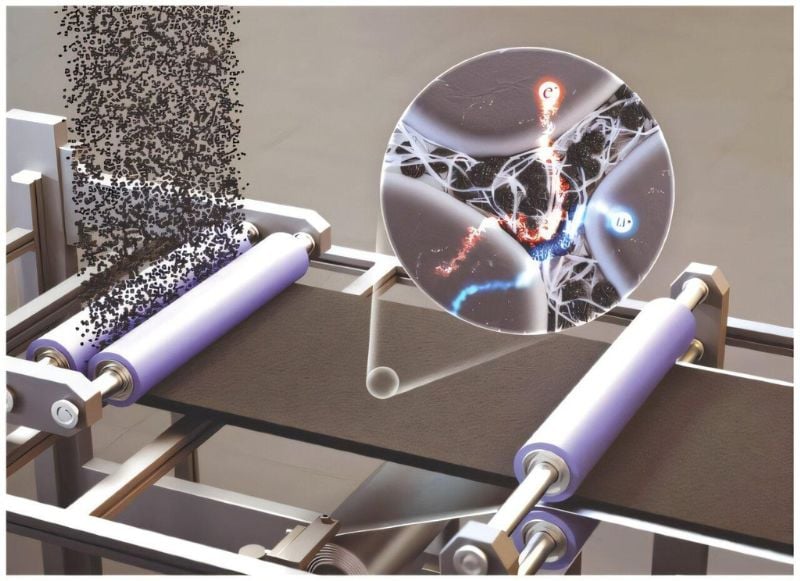
Dry-processed thick electrode design. Image used courtesy of UNIST
5. Preventing Blackouts in Rural Areas
Regions such as Texas, Michigan, California, North Carolina, and Ohio have experienced an increasing frequency of weather-related power outages over the past 20 years. Researchers at Incheon National University in South Korea have developed an optimization model to enhance microgrid stability. This method streamlines historically complex models by reducing computational overhead and improving adaptability to fluctuating energy supply and demand. The model has demonstrated enhanced microgrid reliability during intermittent renewable energy output to support the integration of wind, solar, and hydropower. Notably, California achieved 100% renewable electricity supply for a record 98 days in 2024.