Facebook
 Google
 GitHub
 Linkedin
Could Diamonds Be an EV Battery’s Best Friend?
Researchers have devised an easier way to create diamond quantum sensors, which could improve EV battery management.
Electric vehicle battery management systems have become more effective in maximizing the life and performance of an EV battery pack. Yet, battery monitoring still needs more refinement to deliver the accuracy required to ensure that all battery cells run safely and efficiently.
How do diamond quantum sensors work? Video used courtesy of Nature
Diamond quantum sensors could significantly increase precision in battery monitoring. They are hard and durable, ideal for the sensors needed in battery monitors for EVs, which often operate in extreme temperatures or rough environments. However, their complexity makes them difficult to manufacture at a large scale.
Japanese researchers discovered an easier and cheaper way to create diamonds that could streamline their use in EV battery management systems. These diamond sensors were noise-resistant and delivered precise current measurements.

How can diamonds help an EV? Adapted from images used courtesy of Canva
The Pros and Cons of Diamond Sensors
Diamond quantum sensors use nitrogen-vacancy (NV) centers to detect tiny changes in magnetic fields that reveal defects in materials or activity. In battery monitoring systems, the highly sensitive diamond quantum sensors can provide precise measurements for temperature, pressure, current, and magnetic and electric fields.
Quantum diamonds are lab-grown using either a high-pressure, high-temperature process (HPHT) or a homoepitaxial chemical vapor deposition (CVD) method. Both techniques use either natural or synthetic diamond seeds as a substrate for growing the new diamonds. The HPHT seed crystals must be high-quality, making the method expensive and difficult to scale up.
Previous studies have used heterogeneous (or non-diamond) substrates in their CVD process, but the resulting substrates were only a few millimeters thick. To address this problem, scientists from the Institute of Science Toyko opted for a new growth technique.
Heteroepitaxial (111) Diamond Quantum Sensors
Using a heteroepitaxial CVD method, the Japanese team created a 150 µm thick diamond film on a non-diamond substrate. The (111)-oriented surface area was larger than was previously achieved, and the NV-diamond layer achieved a spin coherence time of 20µs. The researchers also added a tilt correction mechanism to improve sensor performance.
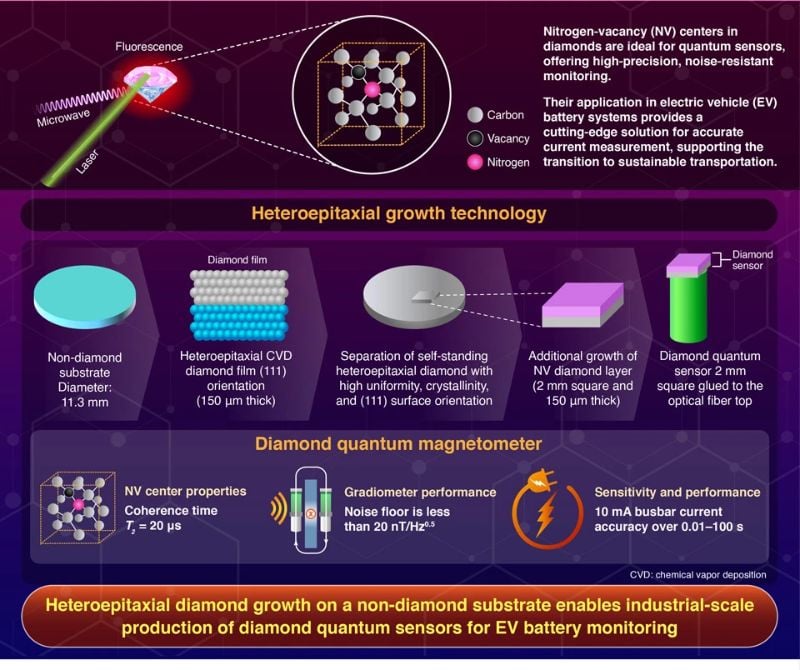
Heteroepitaxial diamond growth process. Image used courtesy of Institute of Science Tokyo
They used a continuous-wave optically detected magnetic spectroscopy to estimate the NV concentration and the sensor’s decoherence time. The sensor demonstrated a low noise floor without needing magnetic shielding. The low magnetic field noise enabled the sensor to detect busbar currents as small as 10 mA over a time from 10 ms to 100 s.
The Shin-Etsu Chemical Co. and the National Institute of Advanced Industrial Science also contributed to the research. Study results were published in Advanced Quantum Technologies.
Future Diamond Quantum Studies
For their next study, researchers want to improve the diamond quantum sensors’ sensitivity by using electron beam irradiation to increase the NV center density. They also want to extend coherence time and increase fluorescence collection efficiency.
The ability to grow heteroepitaxial CVD diamonds on large substrates can make large-scale diamond productivity possible. Mass production of diamond quantum sensors could be the key to building more effective EV battery management systems.
In a press release, Musuko Hatano, the team leader, emphasized the potential of the sensor research to improve electric vehicle performance.
“The ability to measure currents accurately while minimizing interference makes this sensor a promising candidate for monitoring battery systems in electric vehicles, where precision and reliability are paramount,” he said.